
Liquid Floor Scrubber Formula
USD $60
PDF manual · Instant downloadLiquid Floor Scrubber Formula: a PDF guide to low-foam cleaners for floor scrubber machines, with neutral, alkaline and acid grades, ingredients, dilution, testing and safety.
Payment Methods
Refund Policy
Custom Formulation Services
Formulation Consultation
Contact Us
Choosing a liquid formula for a floor scrubber depends on the type of floor and the desired cleaning result. Floor scrubbers, also called autoscrubbers, dispense cleaning solution, scrub with rotating brushes or pads and recover the dirty water with a vacuum squeegee, so the solution must clean well but produce very little foam. This practical PDF guide, Liquid Floor Scrubber Formula, is for cleaning chemical manufacturers, janitorial suppliers, startups and entrepreneurs. This page explains how a liquid floor scrubber formulation works, the main grades for different floors, how to make, test and pack it, and how to sell it to facility managers and contract cleaners.
This guide is published by Chemical Formulation Services, the formulation publishing and consultancy business of CFS Formulation Services Ltd in Sheffield, United Kingdom. It is written for people who want to understand the product from the raw material to the finished pack, and it keeps its claims practical rather than promotional.
At a glance
- Product: Liquid Floor Scrubber Formula, a digital PDF Product Making Guide.
- Also searched as: liquid floor scrubber formulation, autoscrubber detergent, scrubber machine cleaner, low-foam floor cleaner, neutral floor cleaner.
- Grades: neutral daily cleaner, alkaline degreaser and acidic descaler.
- Key goals: low foam, soil removal, safety on floor finishes, rinsability and slip safety.
- Who it is for: cleaning chemical makers, janitorial distributors, facility managers, contract cleaners and entrepreneurs.
- Delivery: instant PDF download after payment is confirmed.
- Publisher: CFS Formulation Services Ltd, England and Wales company number 16678503.
How scrubber machines use cleaning liquid
A ride-on or walk-behind floor scrubber carries a solution tank and a recovery tank. The solution flows to the brush or pad, which agitates and loosens soil. A squeegee behind the machine gathers the dirty liquid, which a vacuum sucks into the recovery tank. Because the recovery system relies on airflow, foam is a serious problem: foam enters the vacuum motor, reduces suction, overflows the tank and damages equipment. Scrubber liquids are therefore formulated for low foam or controlled foam, and are used at low dilution, often 1:100 or even 1:200 in the machine tank. Strong cleaning from low use rates and no residue are the targets.
Main grades
Neutral floor cleaner
A neutral pH cleaner, around pH 6.5 to 8, suitable for most floors including vinyl, tile, laminate, sealed hardwood, linoleum and finished floors. It uses non-ionic and low-foam surfactants, chelating agents and light solvents to remove everyday dirt, grime and spills without dulling finishes or attacking sealers. This is the daily-use workhorse.
Alkaline degreaser
For kitchens, workshops, warehouses, car parks and industrial areas with oils and heavy soil. The pH is typically 10 to 12, from alkalis such as sodium hydroxide, potassium hydroxide, silicate, carbonate and amines, plus strong surfactants, chelants and solvents such as glycol ethers. It cuts grease but can strip floor polish and harm aluminium or sensitive floors, so test and dilute correctly.
Acidic descaler
For removing hard-water scale, mineral deposits, grout haze, soap scum and rust stains on tiles and quarry floors. It uses acids such as citric, sulfamic or phosphoric, with surfactants and corrosion inhibitors. Acids damage cement-based grout, natural stone and marble, so use only on suitable surfaces and rinse thoroughly.
Specialty grades
Disinfectant-cleaners for hospitals and food areas, which require regulatory registration; enzyme or microbial cleaners for odour control in washrooms; and polish-restoring cleaners that deposit a thin polymer layer for gloss.
Key ingredients
- Low-foam non-ionic surfactants: alcohol ethoxylates, propoxylated types and alkyl polyglucosides.
- Anionic surfactants (small amounts): to boost cleaning when foam is controlled.
- Builders and chelants: sodium gluconate, GLDA, MGDA, phosphonates, citrate and carbonate.
- Solvents and couplers: glycol ethers, hydrotropes, isopropanol.
- Defoamers: silicone-free or low-silicone types, if needed.
- Corrosion inhibitors: for metals in scrubbers and floors.
- Fragrance, dye and preservative.
Cost per square metre and machine productivity
Facility managers rarely buy the cheapest litre; they buy the lowest cost per cleaned area while keeping floors safe and attractive. Calculate cost per square metre by dividing the cost of diluted solution per litre by the coverage the scrubber achieves, typically 300 to 1000 square metres per tank depending on machine size and soil. A concentrated product used at 1:200 can cost less per square metre than a cheaper product used at 1:30. Show this in a simple table for each grade, and add savings from lower labour time, reduced rinsing and fewer re-cleans. Data-based sales conversations differentiate professional suppliers from generic distributors.
Training, dosing equipment and consistency
Many scrubber problems come from human factors: over-dosing by eye, mixing different chemicals in the tank, leaving dirty solution in tanks for days, or using worn squeegees and pads. Support customers with wall-mounted dosing units that give a precise dilution, colour-coded containers and charts for each grade, short staff training sessions and laminated quick-reference cards for machine operators. Include a reminder to empty and rinse tanks after each shift. Better habits improve results more than any change in formula.
Environmental and green-cleaning options
More buyers ask for biodegradable, low-VOC, fragrance-light and eco-labelled floor cleaners. Formulations based on alkyl polyglucosides, citrate and gluconate builders, plant-derived solvents and readily biodegradable chelants can meet many eco-label criteria. Keep documentation ready for each ingredient, since third-party labels require evidence. Offer concentrated products to reduce packaging and transport, and refillable containers. Green positioning must not compromise performance: test against standard cleaners and show customers the results in real use.
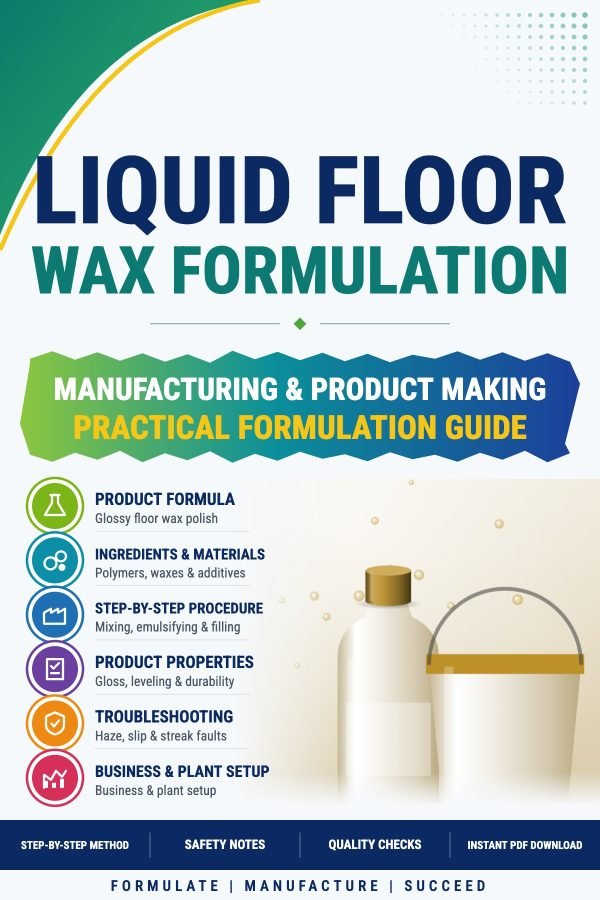
What is inside the Liquid Floor Scrubber Formula guide
The guide discusses the selection of a liquid formula for a floor scrubber, depending on the type of floor and the desired cleaning outcome, beginning with neutral floor cleaner as suitable for most floor types including vinyl, tile, laminate and sealed hardwood, which cleans dirt, grime and spills. It supplies detailed formulas, process steps, dilution tables and troubleshooting.
Blending process
Step 1: Water and chelants
Charge soft water to a clean stainless steel or plastic tank. Dissolve chelating agents and builders.
Step 2: Surfactants and solvents
Add low-foam surfactants slowly with gentle agitation to avoid foam. Add hydrotrope and solvent until clear.
Step 3: Alkali or acid (if required)
For alkaline grades, add alkali slowly while cooling, since dilution is exothermic. For acidic grades, add acids carefully with inhibitors in acid-resistant equipment.
Step 4: Final adjustments
Add inhibitors, fragrance, dye and preservative. Adjust pH and viscosity, and check clarity.
Step 5: Filter and fill
Filter and fill into pails, drums or IBCs with appropriate closures and labels.
Dilution and use
Scrubber cleaners are used at low concentrations. A neutral cleaner may be used at 1:100, an alkaline degreaser at 1:50 to 1:20, and an acid descaler at 1:20 to 1:10, depending on soil. Dosing systems on machines or in cleaning stores deliver accurate dilutions and reduce waste. Pre-sweeping removes grit that would scratch floors, and an initial pre-spray of degreaser on heavy soil improves results. After scrubbing acids or alkalis, rinse with clean water and neutralise. Tell staff to follow dilution guidance, because over-dosing wastes chemical, causes residue and slippery floors.
Floor compatibility
Match chemistry to floor type. Vinyl and linoleum like neutral cleaners; sealed concrete tolerates moderate alkalinity; unsealed stone and terrazzo need neutral products; marble must not meet acid; quarry tiles can handle alkali and, with care, acids; polished floors with acrylic finish need neutral or specially buffered cleaners to protect the finish; wood floors need minimal water and neutral pH. Include a compatibility chart on labels and technical sheets.
Testing and quality control
- pH, density and clarity.
- Foam height in use dilution, with and without soil.
- Cleaning performance on standard soiled tiles.
- Residue and streaking.
- Effect on floor finish after repeated scrubbing.
- Metal and seal compatibility with the machine.
- Slip resistance after cleaning.
- Storage stability.
Troubleshooting
Foam in recovery tank
Wrong surfactant or high dosage. Use low-foam products, reduce dose and add defoamer.
Streaks or cloudy floor
Residue from too strong dilution or hard water. Reduce dose and use chelants.
Dull floor finish
Alkalinity too high for the polish. Use a neutral cleaner.
Slippery floors
Over-dosing or insufficient recovery. Check dilution, squeegee condition and dryness.
Corrosion on machine parts
Aggressive acid or lack of inhibitors. Rinse the machine and select a milder product.
Odour in recovery tank
Bacterial growth in dirty water. Empty and rinse tanks daily and use odour-control cleaners.
Safety and regulation
Concentrated alkalis and acids are corrosive. Provide gloves, eye protection and safe dispensing equipment, and clear labels with hazard pictograms. Never mix acid and alkaline products or chlorine bleach. Train cleaning staff in chemical safety and wet-floor hazards. Meet local rules on disinfectant claims, biodegradability and discharge of cleaning water. Provide safety data sheets and instructions for spill response.
Packaging and business opportunity
Supply 5, 10 and 20 litre containers, 200 litre drums and 1000 litre IBCs, plus wall-mounted dispensers. Customers include supermarkets, shopping centres, warehouses, airports, hospitals, schools, factories and contract cleaners. Offer packages combining neutral cleaner, degreaser, descaler, floor polish and maintenance products, with training on dilution and safe use. Cost-in-use calculations that show savings per square metre cleaned are powerful sales tools. Private-label supply for janitorial distributors can build volume quickly.
Extend your floor care range with the Floor Products, Cleaning Products, Detergent Formulations and Construction Chemicals categories, and see High Shine Floor Polish Formula, , Heavy Duty Truck Wash Detergent, , and Seamless Epoxy Flooring Systems.
Getting started
Create a neutral low-foam cleaner with non-ionic surfactant, chelant and hydrotrope. Test foam and cleaning in a borrowed scrubber on a mixed floor, adjust, and add alkaline and acid grades. Prepare labels, dilution charts and safety data, and trial with a local facility manager.
How to get the best results from this guide
Treat the guide as a tested starting point rather than a finished factory. Begin with a small trial batch in the laboratory or on a bench, using the exact raw materials you plan to buy, and record every weight, temperature, mixing time and observation. Compare the result with the quality checks in the guide, change only one thing at a time, and keep a note of what each change did. Once a small batch is consistently good, repeat it several times, then scale up in stages, because mixing, heating and cooling behave differently in larger vessels. Keep retained samples of every batch, write simple standard operating procedures for your team, and build relationships with two suppliers for each key raw material. Finally, check the labelling, safety and product rules in the country where you will sell, and ask a qualified person to review your process. This careful, documented approach is what turns a good formulation into a reliable product and a trusted brand.
Who should buy this guide?
The guide is written for practical readers. It suits manufacturers who want to add a new product to an existing plant, startups choosing their first product, private-label brands that need to understand what they are buying, technical staff who must set specifications and train operators, and consultants and students who want a structured, plain-language reference. It is less suitable for anyone looking for a quick shortcut or a guarantee, because every formulation still needs testing with your own materials, equipment and local rules. If you are unsure whether it matches your project, send a short question through the contact page before you order, and we will tell you honestly whether it fits.
What is inside the Liquid Floor Scrubber Formula guide
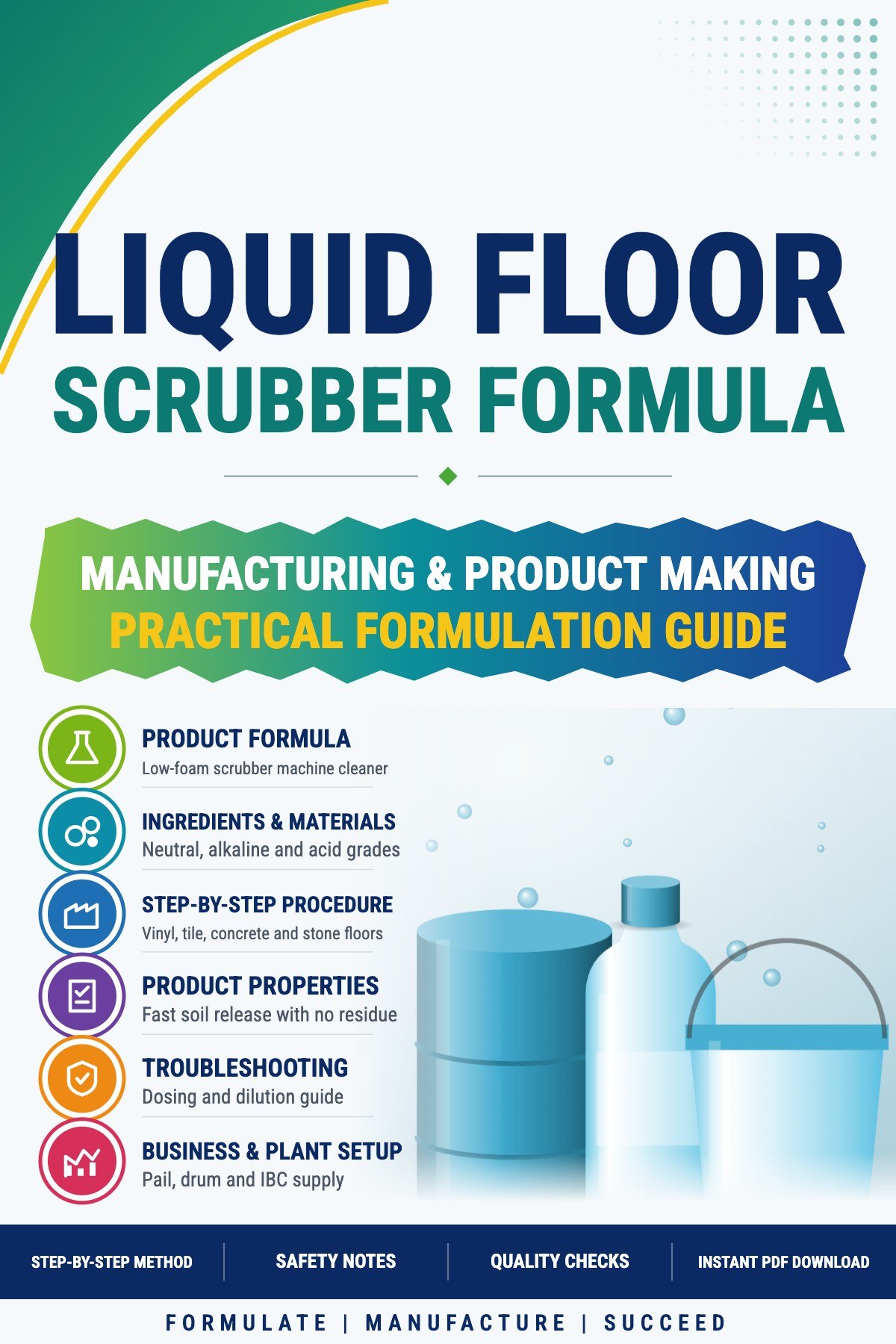
Every Product Making Guide in our shop follows the same structure so you know where to look. This guide includes the product formula, the ingredients and materials, the procedure and preparations, the industrial requirements and the technical specifications. In practice you receive:
- The formulation, written so you can follow it at the bench and scale it up.
- Ingredients and materials, with the job of each material and advice on grades and suppliers.
- The manufacturing procedure, including order of addition, mixing and preparations.
- Industrial requirements, covering equipment, space and packaging.
- Technical specifications, describing what a good finished product should look like and how it should behave.
- Troubleshooting for the faults that makers meet most often.
- Business guidance, to help you take the product from the bench to the market.
These Product Making Guides of chemical formulations and formulas are for manufacturers, startups and entrepreneurs. Every guide contains industrially tested, practical formulations. Anyone who buys a guide can make the product by following its step-by-step instructions. Raw materials vary between suppliers, so always confirm your results with a small trial batch before scaling up.
Who stands behind this guide?
Chemical Formulation Services is the trading name of CFS Formulation Services Ltd, registered in England and Wales under company number 16678503, with its office at Unit F, Winston Business Park, Churchill Way, Sheffield S35 2PS. The business was founded by George Enrick and publishes formulation manuals, technical guides and industry reports. You can check our details on the Companies House register, read about us, or contact us with any question before you order.
A written formulation cannot replace testing with your own raw materials, equipment and climate, and we say so plainly. What the guide does give you is a tested, structured starting point that can save you months of trial and error. Our terms and conditions explain what a purchase from us covers.
How to order
- Select Add to cart to keep browsing, or Buy Now to go straight to checkout.
- Pay with PayPal, Stripe, Xoom by PayPal, Payoneer, payment links for debit and credit cards, or Western Union, Ria and all money exchanges.
- If you pay through a money exchange, email your payment slip to Info@chemicalformulationservices.com. After confirmation, your instant download link is emailed to you.
- For online payments, the PDF is available as soon as the payment is confirmed.
All products are digital downloads and all payments are nonrefundable once the file is delivered, so please read the refund policy and the FAQs before you order. You can compare this guide with others in the formula shop or browse our industrial project reports.
Frequently asked questions about liquid floor scrubber formula
What is the Liquid Floor Scrubber Formula guide?
It is a digital PDF Product Making Guide to low-foam liquid cleaners for floor scrubber machines, covering grades, ingredients, making, dilution, testing and troubleshooting.
Why must scrubber cleaners be low foam?
Foam enters the vacuum recovery system, reduces suction and can damage the machine.
Which grade suits most floors?
A neutral pH cleaner suits most vinyl, tile, laminate and sealed floors.
Can acid cleaners be used on marble?
No. Acids damage marble and other calcium-based stone.
What dilution is typical?
Neutral cleaners about 1:100, degreasers 1:50 to 1:20, and acids 1:20 to 1:10, depending on soil and product.
How do I receive the guide?
You receive an instant PDF download after payment is confirmed. For money exchanges, email your payment slip to Info@chemicalformulationservices.com and the link is emailed after we confirm it.
Is the payment refundable?
All payments are nonrefundable because the product is an instant digital download. See the refund policy for details.
Can you help with a custom formulation?
CFS Formulation Services Ltd offers formulation and product development consultancy. Send a short brief through the Contact page.
Last reviewed: November 2026. This page is general information about a digital product. It is not a safety data sheet or professional advice, and any formulation should be tested and reviewed by a qualified person before commercial use.