
Mosquito Repellent Cream Formulation
USD $60
PDF manual · Instant downloadMosquito Repellent Cream Formulation: a PDF guide to repellent creams and lotions, with active ingredients, base formulas, manufacturing, testing and regulatory notes.
Payment Methods
Refund Policy
Custom Formulation Services
Formulation Consultation
Contact Us
Mosquito Repellent Cream Formulation is a practical PDF guide for personal-care manufacturers, pharmaceutical and public-health suppliers, startups and entrepreneurs who want to make mosquito repellent creams and lotions. These are topical products designed to prevent mosquitoes from biting and potentially transmitting diseases such as malaria, dengue fever, Zika virus or West Nile virus. A repellent cream works by leaving a layer on the skin that mosquitoes find unattractive, discouraging them from landing and biting. This page explains how a mosquito repellent cream and lotion formulation works, what goes into a mosquito repellent cream formula, how it is made and tested, and the registration and safety rules every manufacturer must follow.
This guide is published by Chemical Formulation Services, the formulation publishing and consultancy business of CFS Formulation Services Ltd in Sheffield, United Kingdom. It is written for people who want to understand the product from the raw material to the finished pack, and it keeps its claims practical rather than promotional.
At a glance
- Product: Mosquito Repellent Cream Formulation, a digital PDF Product Making Guide.
- Also searched as: mosquito repellent cream formula, mosquito repellent lotion formulation, insect repellent cream, DEET cream, picaridin lotion.
- Types: oil-in-water creams and lotions, gels and sprays.
- Active options: DEET, picaridin (icaridin), IR3535, oil of lemon eucalyptus (PMD) and others.
- Who it is for: personal-care makers, public-health suppliers, pharmacies and entrepreneurs, subject to local registration.
- Delivery: instant PDF download after payment is confirmed.
- Publisher: CFS Formulation Services Ltd, England and Wales company number 16678503.
Why mosquito repellents matter
Mosquitoes are among the deadliest animals on Earth because they carry parasites and viruses. In warm and tropical regions, malaria, dengue, chikungunya, Zika, yellow fever, filariasis and West Nile virus are real threats, and even where disease risk is low, bites are a daily nuisance. Bed nets, window screens, coils and sprays reduce exposure, but a skin-applied repellent gives personal protection when outdoors, at dawn and dusk, while travelling or working in the field. Cream and lotion formats are popular because they spread evenly, can be dosed with the fingers, are easy to apply on children’s limbs and face (avoiding eyes and mouth) and last longer on the skin than a spray evaporating in the air.
Repellent actives and how they work
Repellents do not kill mosquitoes. They interfere with the insects’ ability to detect human skin odours such as carbon dioxide and lactic acid, or they are simply unpleasant on contact. The main actives are well studied, and public-health bodies publish guidance on their use.
DEET (N,N-diethyl-meta-toluamide)
The longest-used and most extensively tested repellent. Higher concentrations give longer protection, but beyond a certain level there is little added benefit. It is effective against many mosquitoes, ticks and flies. It can damage some plastics, synthetic fabrics and finishes, and has a distinct feel.
Picaridin (icaridin)
A modern synthetic repellent with effectiveness comparable to DEET at similar concentrations, a lighter feel, little odour and less damage to plastics and fabrics. It is widely recommended by health agencies.
IR3535
An amino-acid-derived repellent with a good safety record, widely used in Europe and for children’s products, with somewhat shorter protection at low concentrations.
Oil of lemon eucalyptus and PMD
A plant-derived repellent whose active, para-menthane-3,8-diol (PMD), gives protection comparable to low-concentration DEET. It is not recommended for very young children in some guidelines.
Citronella and other essential oils
Natural oils such as citronella, lemongrass, geranium and neem are popular, but they evaporate quickly and generally give short protection. They can be used as supporting ingredients, but should not be marketed as equal to registered actives without evidence.
The cream base
A repellent cream is usually an oil-in-water emulsion that also protects the skin. A good base spreads easily, absorbs moderately, does not feel greasy, holds the active on the skin without rapid loss to sweat and suits tropical conditions. It must be stable with the chosen active and must not irritate the skin.
- Repellent active: at a registered or recommended concentration.
- Emulsifier system: such as cetearyl alcohol with a non-ionic emulsifier, forming a stable cream.
- Oil phase: light emollients that help dissolve the active and give skin feel.
- Humectants: glycerin or propylene glycol to soften skin.
- Film formers and polymers: to help the active remain on the skin and slow evaporation.
- Preservative system: to protect the water phase.
- Fragrance: kept mild, since insects may be attracted by some floral scents.
- Antioxidants and chelants: improve stability.
Concentration, duration and what customers should expect
Customers often assume that a higher percentage always means better protection, but health agencies note that increasing the concentration of an active mainly lengthens protection time up to a plateau, and that very high concentrations add skin exposure without much benefit. Explain on the label how long protection is expected under typical conditions and when to reapply, for example after swimming, heavy sweating or several hours. Make clear that no repellent gives absolute protection, and that people in disease areas should combine it with bed nets, long clothing, treated clothing and screened rooms. Honest expectations lower complaints and strengthen trust in your brand.
Using repellent with sunscreen and other products
People often wear sunscreen and repellent together. Guidance usually recommends applying sunscreen first, then repellent over it, and warns that some repellents reduce the sun protection factor of sunscreen. Combined products raise additional questions because sunscreen needs frequent reapplication while repellent should be used sparingly. For this reason many regulators discourage or tightly control combined products. If you plan one, take specialist advice on testing, labelling and registration before development.
Formats beyond cream and lotion
Customers buy repellent in many forms: pump sprays and aerosols that cover large areas quickly, roll-on bottles with controlled application, wipes for travel, gels with a clear look, sticks for the face and patches or bands that release active slowly. Each format has different formulation and regulatory demands. Aerosols involve propellants and flammability, sprays risk inhalation if misused and wipes need non-woven materials compatible with the active. A cream or lotion has the advantage of easy application on the face and body without inhaling droplets, and it suits families. Starting with a cream and adding other forms later is a sensible plan.
Packaging and labelling in detail
Use tubes, flip-top bottles or pump bottles made of materials tested with the active. Include child-resistant features where required. The label should list the active ingredient and its percentage, all other ingredients, net content, batch number, expiry date, manufacturer and registration number, directions for use, age restrictions, precautions and first aid. Use clear pictograms for avoiding eyes and mouth. Place instructions in the language of the market. Multilingual packaging is useful for travel retail.
Supply chain and production hygiene
Because the product is applied to skin, it must be produced under hygienic conditions. Use clean-in-place procedures, sanitised vessels and a controlled environment. Keep raw materials in sealed containers, test incoming actives for identity and purity, and quarantine suspect lots. Avoid cross-contamination with other products, particularly those containing allergens. Maintain batch records, sample retention and a complaint-handling system so any adverse reaction can be investigated and reported to authorities as required.
What is inside the Mosquito Repellent Cream Formulation guide
The guide explains that mosquito repellent creams and lotions are topical products designed to prevent mosquito bites and the diseases mosquitoes may transmit, such as malaria, dengue, Zika and West Nile virus, and that they create a barrier on the skin that repels mosquitoes. It then covers common active ingredients, cream and lotion bases, manufacturing steps, quality checks, packaging and troubleshooting, with a clear emphasis on registration and safe use.
How the cream is made
The process follows normal cosmetic emulsion making, with attention to the volatile or irritating nature of repellent actives.
Preparing the water and oil phases
Heat the water phase, with glycerin, to about 70 to 75 degrees Celsius. Heat the oil phase, with emulsifier and fatty alcohol, to the same temperature.
Emulsifying
Add the oil phase to the water phase under high shear, then keep stirring to form a smooth emulsion.
Cooling and adding the active
Cool the emulsion under gentle mixing. Add the repellent active, preservative, fragrance and any heat-sensitive materials below about 40 degrees Celsius to limit evaporation of volatile ingredients. Mix until fully dispersed.
Adjusting and filling
Check pH, viscosity and appearance. Fill into tubes, squeeze bottles or jars that resist the active. Test compatibility: DEET can soften certain plastics.
Efficacy and quality testing
- Content of active ingredient: verified by chromatography or other approved analytical methods.
- Repellency testing: arm-in-cage or field studies following recognised protocols, with trained volunteers and ethics approval, to measure complete protection time.
- Stability: hot and cold storage, freeze-thaw, with checks for separation, colour and odour.
- Skin compatibility: patch testing, irritation assessment and dermatological review.
- pH and viscosity: within specification.
- Microbiological testing: total counts and challenge test.
- Packaging compatibility: no leaching or softening of containers.
Troubleshooting
Cream separates
Active is acting as a solvent for the emulsifier system. Adjust emulsifiers and mixing and check the compatibility of the active.
Sticky or greasy feel
Too much oil or film former. Reduce oils and use lighter emollients.
Short protection time
Low active level, fast evaporation or heavy sweating. Use a registered concentration, add film formers and advise reapplication.
Skin irritation
Active level, fragrance or alcohol. Review the formulation with a safety assessor and reduce irritants.
Container damage
Active attacks plastic. Use compatible materials such as HDPE or lined tubes.
Strong odour
Active or essential oil dominance. Use refined actives and rebalance fragrance.
Registration, safety and responsible claims
This is the most important section. In most countries mosquito repellents applied to skin are regulated as biocidal products, pesticides, drugs or cosmetics-with-claims, and must be registered or approved before sale. Regulators require evidence of the active ingredient’s identity and purity, product safety, efficacy data and approved labelling. Only approved actives at approved concentrations may be used. You cannot simply sell a homemade repellent. Labels must state the active, its percentage, directions for use, age limits, warnings (avoid eyes, mouth and broken skin, do not use under clothing, wash off when no longer needed) and first-aid advice. Do not claim protection against specific diseases unless the product’s registration permits it. Do not market products as repellents on the strength of essential oils alone if your regulator requires registration. Seek legal and regulatory advice early, and follow good manufacturing practice, keeping complete batch records.
Business opportunity
Demand for repellents is strong in tropical countries, travel retail and outdoor markets. Pharmacies, supermarkets, camping shops, public-health programmes, schools and workplace programmes buy creams and lotions. Product lines can include adult and children’s versions, long-lasting formulas, plant-based registered actives and combined repellent-sunscreen products (checked carefully for compatibility and regulation). Branding that emphasises trusted active ingredients, clear instructions and transparent testing earns trust. Partnership with public-health agencies or NGOs can open bulk supply channels, if you meet their quality standards.
Related CFS guides help you build a personal-care range. Browse the Personal Care Products, Cosmetics Industry and Cleaning Products categories, and see , , , , Liquid Hand Soap Formula and .
Getting started
First, find out your regulator’s rules and which actives are approved. Choose a registered active, work with a laboratory or contract manufacturer that holds the right licences if needed and make small trial batches of base cream. Arrange stability and efficacy testing, prepare compliant labels, and apply for registration. Only after approval should you begin to sell, starting with pharmacies and travel shops, and gathering feedback on feel and effectiveness.
How to get the best results from this guide
Treat the guide as a tested starting point rather than a finished factory. Begin with a small trial batch in the laboratory or on a bench, using the exact raw materials you plan to buy, and record every weight, temperature, mixing time and observation. Compare the result with the quality checks in the guide, change only one thing at a time, and keep a note of what each change did. Once a small batch is consistently good, repeat it several times, then scale up in stages, because mixing, heating and cooling behave differently in larger vessels. Keep retained samples of every batch, write simple standard operating procedures for your team, and build relationships with two suppliers for each key raw material. Finally, check the labelling, safety and product rules in the country where you will sell, and ask a qualified person to review your process. This careful, documented approach is what turns a good formulation into a reliable product and a trusted brand.
Who should buy this guide?
The guide is written for practical readers. It suits manufacturers who want to add a new product to an existing plant, startups choosing their first product, private-label brands that need to understand what they are buying, technical staff who must set specifications and train operators, and consultants and students who want a structured, plain-language reference. It is less suitable for anyone looking for a quick shortcut or a guarantee, because every formulation still needs testing with your own materials, equipment and local rules. If you are unsure whether it matches your project, send a short question through the contact page before you order, and we will tell you honestly whether it fits.
What is inside the Mosquito Repellent Cream Formulation guide
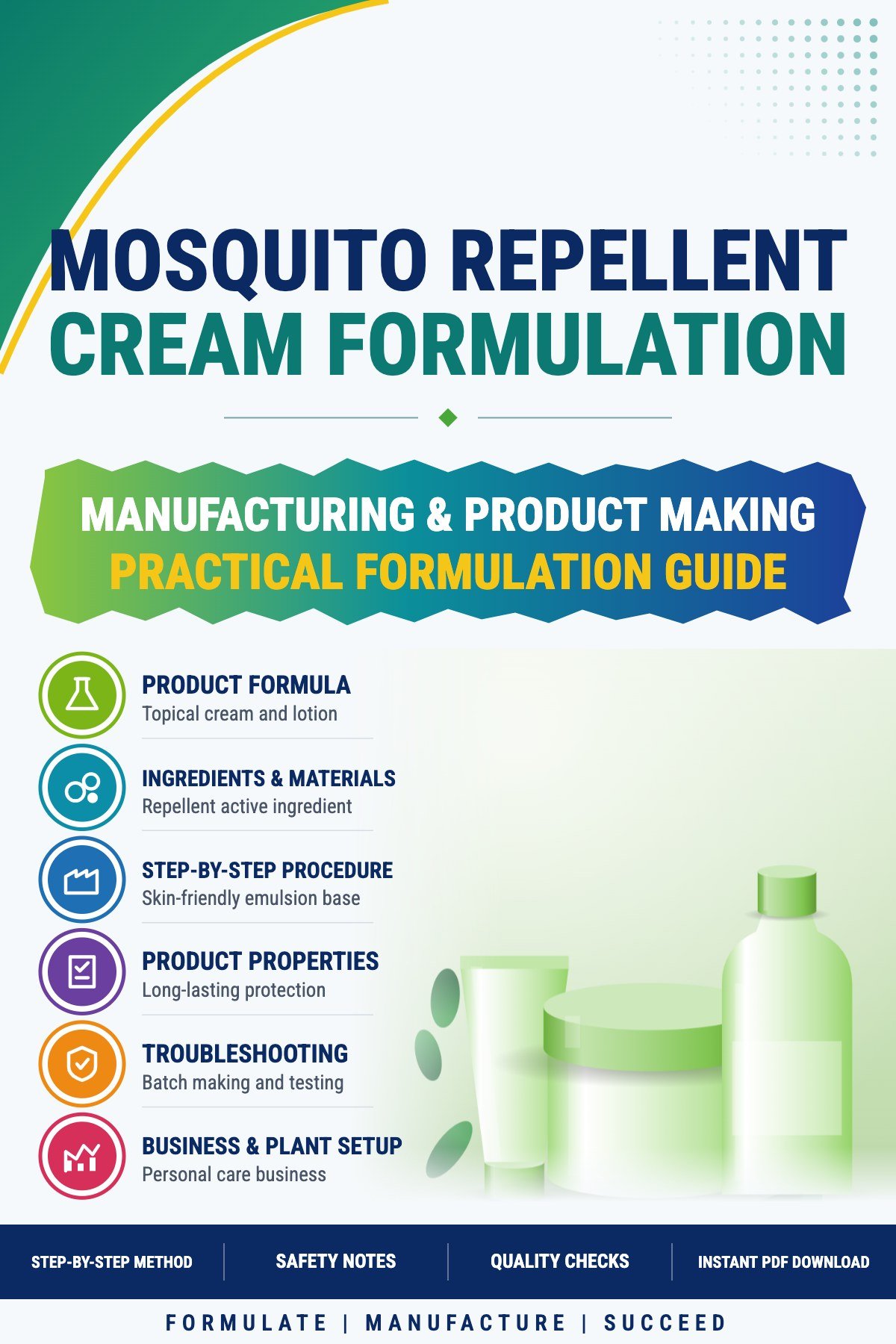
Every Product Making Guide in our shop follows the same structure so you know where to look. This guide includes the product formula, the ingredients and materials, the procedure and preparations, the industrial requirements and the technical specifications. In practice you receive:
- The formulation, written so you can follow it at the bench and scale it up.
- Ingredients and materials, with the job of each material and advice on grades and suppliers.
- The manufacturing procedure, including order of addition, mixing and preparations.
- Industrial requirements, covering equipment, space and packaging.
- Technical specifications, describing what a good finished product should look like and how it should behave.
- Troubleshooting for the faults that makers meet most often.
- Business guidance, to help you take the product from the bench to the market.
These Product Making Guides of chemical formulations and formulas are for manufacturers, startups and entrepreneurs. Every guide contains industrially tested, practical formulations. Anyone who buys a guide can make the product by following its step-by-step instructions. Raw materials vary between suppliers, so always confirm your results with a small trial batch before scaling up.
Who stands behind this guide?
Chemical Formulation Services is the trading name of CFS Formulation Services Ltd, registered in England and Wales under company number 16678503, with its office at Unit F, Winston Business Park, Churchill Way, Sheffield S35 2PS. The business was founded by George Enrick and publishes formulation manuals, technical guides and industry reports. You can check our details on the Companies House register, read about us, or contact us with any question before you order.
A written formulation cannot replace testing with your own raw materials, equipment and climate, and we say so plainly. What the guide does give you is a tested, structured starting point that can save you months of trial and error. Our terms and conditions explain what a purchase from us covers.
How to order
- Select Add to cart to keep browsing, or Buy Now to go straight to checkout.
- Pay with PayPal, Stripe, Xoom by PayPal, Payoneer, payment links for debit and credit cards, or Western Union, Ria and all money exchanges.
- If you pay through a money exchange, email your payment slip to Info@chemicalformulationservices.com. After confirmation, your instant download link is emailed to you.
- For online payments, the PDF is available as soon as the payment is confirmed.
All products are digital downloads and all payments are nonrefundable once the file is delivered, so please read the refund policy and the FAQs before you order. You can compare this guide with others in the formula shop or browse our industrial project reports.
Frequently asked questions about mosquito repellent cream formulation
What is the Mosquito Repellent Cream Formulation guide?
It is a digital PDF Product Making Guide to repellent creams and lotions, covering active ingredients, bases, manufacturing, testing and regulatory points.
Which actives are commonly used?
DEET, picaridin, IR3535 and oil of lemon eucalyptus (PMD) are widely recommended by health agencies.
Do I need registration to sell it?
In most countries, yes. Repellents are regulated, so check your regulator before manufacturing for sale.
Are essential-oil repellents as good?
Most give shorter protection than registered actives, so avoid exaggerated claims.
Can I use it on children?
Follow the product label and local guidance, since age limits and concentrations differ by active.
How do I receive the guide?
You receive an instant PDF download after payment is confirmed. For money exchanges, email your payment slip to Info@chemicalformulationservices.com and the link is emailed after we confirm it.
Is the payment refundable?
All payments are nonrefundable because the product is an instant digital download. See the refund policy for details.
Can you help with a custom formulation?
CFS Formulation Services Ltd offers formulation and product development consultancy. Send a short brief through the Contact page.
Last reviewed: November 2026. This page is general information about a digital product. It is not a safety data sheet or professional advice, and any formulation should be tested and reviewed by a qualified person before commercial use.