
Acid Resistance Epoxy Adhesive Formula
USD $75
PDF manual · Instant downloadAcid Resistance Epoxy Adhesive Formula: a PDF guide to a two-component epoxy adhesive that keeps its bond in acidic environments, with ingredients, mixing and testing.
Payment Methods
Refund Policy
Custom Formulation Services
Formulation Consultation
Contact Us
Acid Resistance Epoxy Adhesive Formula is a practical PDF guide for adhesive makers, chemical-plant maintenance suppliers, startups and entrepreneurs who want to produce a two-component epoxy adhesive that keeps bonding strength when exposed to acids. Ordinary adhesives soften, swell or let go when they meet acid splashes, fumes or immersion, which creates leaks, failed linings and costly shutdowns. This page explains how an acid resistance epoxy adhesive formula is built, which resins, hardeners and fillers give resistance, how the adhesive is mixed and tested, and how to turn it into a product line. It also uses the phrase acid resistance epoxy adhesive formulation for the full development process.
This guide is published by Chemical Formulation Services, the formulation publishing and consultancy business of CFS Formulation Services Ltd in Sheffield, United Kingdom. It is written for people who want to understand the product from the raw material to the finished pack, and it keeps its claims practical rather than promotional.
At a glance
- Product: Acid Resistance Epoxy Adhesive Formula, a digital PDF Product Making Guide.
- Also searched as: acid resistance epoxy adhesive formulation, acid-proof epoxy glue, chemical resistant epoxy adhesive, novolac epoxy adhesive.
- System: two-component epoxy resin and hardener with acid-resistant fillers.
- Key goals: bond strength in acidic environments, chemical resistance, durability and easy application.
- Who it is for: adhesive makers, plant maintenance suppliers, tank-lining contractors and entrepreneurs.
- Delivery: instant PDF download after payment is confirmed.
- Publisher: CFS Formulation Services Ltd, England and Wales company number 16678503.
Where acid-resistant adhesives are needed
Acid is common in industry. Battery rooms, plating shops, pickling lines, chemical plants, fertiliser units, food-processing sites, laboratories, wastewater treatment works and water tanks all contain surfaces that meet acid in some form. Acid-proof tiles and bricks are bedded and jointed with chemical-resistant mortars, stainless steel and plastic components are bonded into acid lines, and linings are repaired with adhesives that must not fail. A standard epoxy adhesive will often survive mild acids but weaken under strong, concentrated or hot acid. An acid-resistant epoxy is designed to keep a tight, chemically stable crosslinked network and to avoid weak points that acid can attack.
What gives an epoxy resistance to acids
Resistance comes from four things working together: the resin, the hardener, the fillers and the cure.
The resin
Standard bisphenol A epoxy resin has good general chemical resistance. Epoxy novolac resins have more reactive epoxy groups on each molecule, which produces a denser crosslink and better resistance to strong acids, solvents and heat. Bisphenol F resins offer lower viscosity and good chemical resistance. Many acid-resistant formulations use a blend of these resins to balance performance, handling and cost.
The hardener
Hardener type strongly affects acid resistance. Aliphatic polyamines cure at room temperature, but the cured film can be less resistant to acids. Cycloaliphatic amines, aromatic amines and modified polyamine adducts give tighter networks and better chemical resistance, although some need heat to reach full cure. Polyamide hardeners give flexibility and moisture tolerance but lower acid resistance, so they are less common in this application. The choice depends on cure conditions, working time and the acid exposure the product must meet.
The fillers
Fillers reduce shrinkage and cost, add compressive strength and, if chosen correctly, strengthen resistance by lowering the amount of resin exposed. They must themselves resist acid. Quartz and silica flour, barytes, graphite, carbon and certain acid-proof clays are widely used. Carbonate fillers such as calcium carbonate or limestone must be avoided, since acid dissolves them and creates voids. Particle size distribution matters for packing and viscosity.
The cure
Complete cure is essential. An undercured adhesive has unreacted groups and extractable components that acid can attack. Correct mix ratio, thorough mixing, suitable temperature and sufficient time, sometimes with post-cure heating, produce the full property set.
Selecting the right grade for the acid exposure
Acid exposure differs widely, and one adhesive does not cover every case. Occasional splash contact with dilute acid in a battery room is a much milder duty than continuous immersion in hot sulphuric or hydrochloric acid in a pickling tank. Hydrofluoric acid attacks silica fillers and glass, so it needs a specialist system with carbon or graphite fillers. Oxidising acids such as nitric acid attack many amine-cured epoxies. Ask each customer for the acid type, concentration, temperature, contact time and whether the exposure is splash, spill, fume or immersion. Offer two or three grades: a general-purpose acid-resistant adhesive for splash and fume areas, a novolac-based grade for stronger acids and higher temperatures and a graphite-filled grade for demanding duties. A short chemical resistance chart, based on your own immersion tests, becomes your most useful sales tool.
Joint design and application tips
Even a perfect adhesive fails if the joint is poorly designed. Keep bond lines thin and uniform, usually a fraction of a millimetre for metal bonding and a few millimetres for tile bedding and jointing. Avoid sharp peel loading, spread load over a wide overlap and seal exposed edges so acid cannot creep into the bond line. For tile and brick linings, apply a continuous bed with no voids, then finish the joints with a matching acid-resistant grout. Allow the full cure time before the first acid contact, and warm cold surfaces so the adhesive can cure. Cover and protect fresh joints from rain and condensation during cure.
Records, shelf life and storage
Date every batch, record the resin, hardener and filler lots and keep retained samples. Epoxy resins and hardeners usually keep well for a year or more when sealed and stored cool and dry, but fillers can absorb moisture and amine hardeners can pick up carbon dioxide, so reseal containers promptly. Check old stock for crystallisation of the resin in cold weather, which can be reversed by gentle warming, and for thickening or discolouration in the hardener, which signals ageing.
What is inside the Acid Resistance Epoxy Adhesive Formula guide
The guide describes an adhesive specifically designed to withstand exposure to acids, providing strong bonding and durability in acidic environments where standard adhesives fail. It lists features such as chemical resistance, strong adhesion and durability, and then gives the formulation, mixing ratio, filler choices, curing schedule, tests and troubleshooting.
Manufacturing the two components
The adhesive is supplied as two parts. Part A is the resin side and part B is the hardener side. Each is made separately and packed in a pair of containers sized to the mix ratio.
Making Part A, the resin component
Charge the epoxy resin, or resin blend, to a mixer with a dispersing blade. Add reactive diluent if the viscosity needs lowering, then rheology additives and wetting agents. Add the dry acid-resistant fillers gradually under dispersion, scraping the walls, until the mix is smooth and uniform. Degas under vacuum if the product is to be cast or used in thin films, to remove air voids that become weak points.
Making Part B, the hardener component
Charge the amine hardener or adduct to a clean, dry vessel. Add fillers and additives compatible with amines, mix to uniformity and protect from moisture and carbon dioxide, which can form carbamate surface films.
Packaging
Fill in pre-weighed kits that match the ratio, such as 2:1 or 4:1 by weight or volume. Label clearly. For field use, use twin-cartridge or large kit packaging with mixing instructions.
How to use the adhesive
Surface preparation decides success. The surface should be clean, dry, free of oil, rust, old coatings and loose material. Abrasive blasting or grinding is typical for steel, while concrete must be sound, dry and roughened. Plastics are lightly abraded and solvent wiped. Mix the two parts in the stated ratio until the colour is uniform, apply in a thin, even layer, assemble the parts, apply light pressure and allow the specified cure time before putting the joint in service. Full chemical resistance generally develops only after full cure, which may take several days at room temperature.
Testing the adhesive
- Mix viscosity and pot life: working time at the application temperature.
- Cure time: tack-free and handling strength.
- Lap shear strength: bond strength on steel, concrete, tile or plastic.
- Acid immersion test: cured specimens soaked in acid at defined concentration and temperature, then checked for weight change, hardness, swelling, discolouration and retained strength.
- Thermal resistance: behaviour at elevated service temperatures.
- Filler compatibility: verify fillers are acid inert.
- Batch consistency: density, colour and viscosity.
Troubleshooting
Adhesive stays soft or tacky
Wrong mix ratio, poor mixing, cold temperature or moisture contamination. Weigh accurately, mix thoroughly and warm the materials if necessary.
Bond fails after acid exposure
Wrong hardener, undercure or acid-soluble filler. Use novolac resin, a more resistant hardener and acid-proof fillers, and allow full cure.
Blistering or bubbles in the bond line
Air trapped in mixing or moisture on the surface. Mix slowly, degas and dry the surface.
Poor adhesion to the surface
Contamination or smooth surface. Clean and roughen the surface before application.
Amine blush on the surface
Reaction with moisture and carbon dioxide in cool, humid air. Control humidity, use a blush-resistant hardener and wash the surface before overcoating.
Cracking of the bond line
Brittle system or high shrinkage under thermal movement. Add a flexibilising resin or adjust the filler loading.
Safety and handling
Uncured epoxy resins and amine hardeners can cause skin irritation and sensitisation, and amines are corrosive and can burn skin and eyes. Wear chemical-resistant gloves, safety glasses and protective clothing, work in ventilated areas and avoid skin contact, since repeated exposure can lead to allergic dermatitis. Keep mixing waste small, allow it to cure before disposal and follow local waste rules. Concentrated acids that the product will face are dangerous in their own right, so give clear guidance on the limits of use. Provide safety data sheets and hazard labels in line with local regulation.
Business opportunity
Maintenance departments in chemical, fertiliser, battery, mining, metal-finishing and water-treatment plants buy acid-resistant repair materials regularly. Contractors who install acid-proof tile and tank linings need compatible adhesives and mortars. A producer can sell small kits for maintenance crews, bulk packs for contractors and custom grades for equipment manufacturers. Technical support and independent test data on resistance to the acids the customer uses are the most persuasive selling tools. Complementary products such as acid-resistant putty, primer and coatings make a complete repair system and raise the value of each sale.
Related CFS guides help you expand into adhesives and protective materials. Browse the Industrial Adhesive Formulations, Construction Chemicals and Coating Formulations categories, and see Typical Epoxy Adhesive Formulation, Epoxy Marine Coating Formula, Metal Bond Adhesive Formula, Construction Water Proofing Chemicals Formulation, Contact Adhesive Formulations and Metal Pickling Paste Formulation.
Getting started
Pick one target use, such as bonding acid-proof tile or repairing a stainless fitting, and choose a resin-hardener-filler set accordingly. Make small trial kits, cure test pieces and immerse them in the actual acids. Compare against commercial products, record retained strength and note any swelling or discolouration. Improve the formulation, then set up packaging, labels and safety data sheets. Approach local plants and contractors with samples and use their feedback to refine your range.
How to get the best results from this guide
Treat the guide as a tested starting point rather than a finished factory. Begin with a small trial batch in the laboratory or on a bench, using the exact raw materials you plan to buy, and record every weight, temperature, mixing time and observation. Compare the result with the quality checks in the guide, change only one thing at a time, and keep a note of what each change did. Once a small batch is consistently good, repeat it several times, then scale up in stages, because mixing, heating and cooling behave differently in larger vessels. Keep retained samples of every batch, write simple standard operating procedures for your team, and build relationships with two suppliers for each key raw material. Finally, check the labelling, safety and product rules in the country where you will sell, and ask a qualified person to review your process. This careful, documented approach is what turns a good formulation into a reliable product and a trusted brand.
Who should buy this guide?
The guide is written for practical readers. It suits manufacturers who want to add a new product to an existing plant, startups choosing their first product, private-label brands that need to understand what they are buying, technical staff who must set specifications and train operators, and consultants and students who want a structured, plain-language reference. It is less suitable for anyone looking for a quick shortcut or a guarantee, because every formulation still needs testing with your own materials, equipment and local rules. If you are unsure whether it matches your project, send a short question through the contact page before you order, and we will tell you honestly whether it fits.
What is inside the Acid Resistance Epoxy Adhesive Formula guide
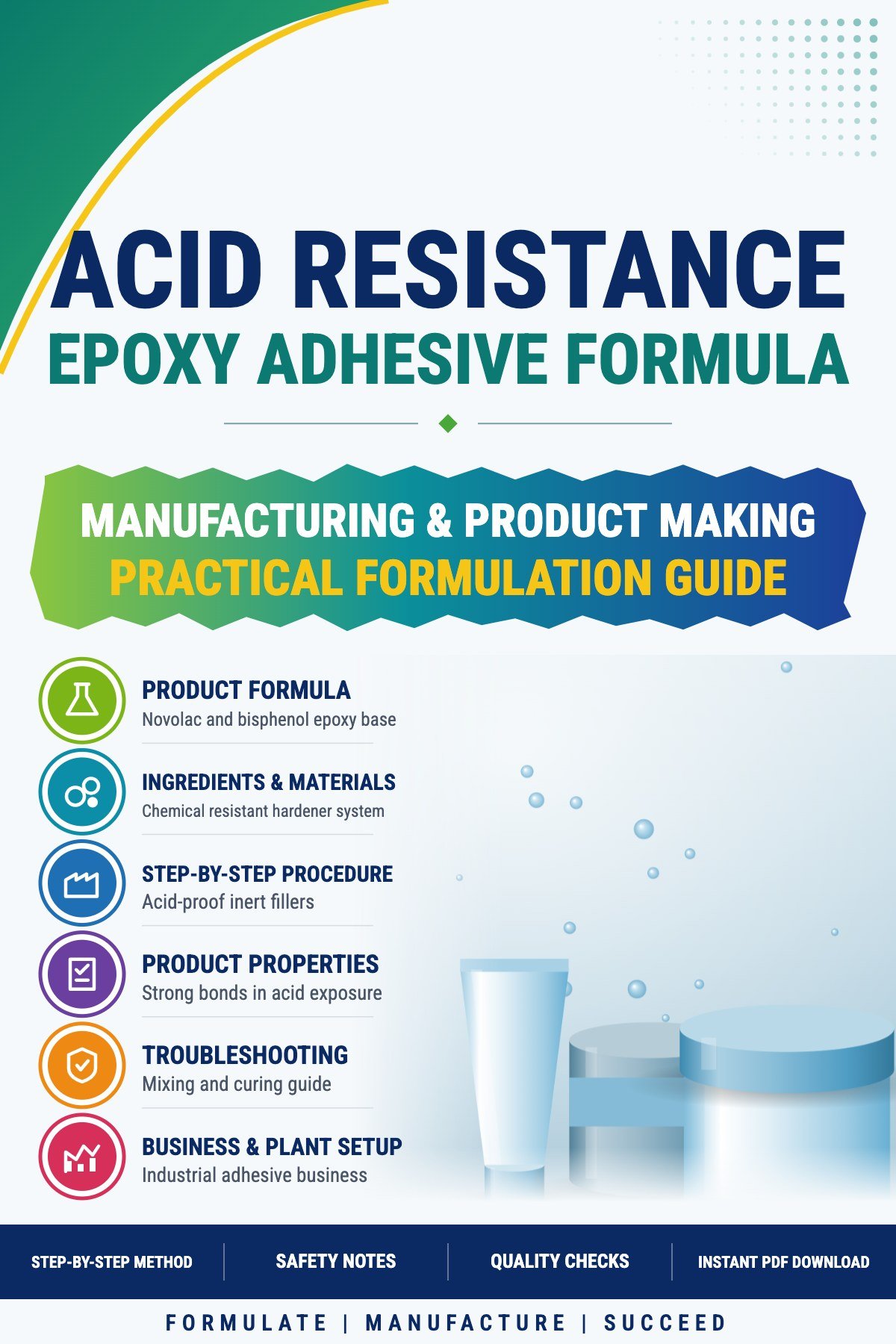
Every Product Making Guide in our shop follows the same structure so you know where to look. This guide includes the product formula, the ingredients and materials, the procedure and preparations, the industrial requirements and the technical specifications. In practice you receive:
- The formulation, written so you can follow it at the bench and scale it up.
- Ingredients and materials, with the job of each material and advice on grades and suppliers.
- The manufacturing procedure, including order of addition, mixing and preparations.
- Industrial requirements, covering equipment, space and packaging.
- Technical specifications, describing what a good finished product should look like and how it should behave.
- Troubleshooting for the faults that makers meet most often.
- Business guidance, to help you take the product from the bench to the market.
These Product Making Guides of chemical formulations and formulas are for manufacturers, startups and entrepreneurs. Every guide contains industrially tested, practical formulations. Anyone who buys a guide can make the product by following its step-by-step instructions. Raw materials vary between suppliers, so always confirm your results with a small trial batch before scaling up.
Who stands behind this guide?
Chemical Formulation Services is the trading name of CFS Formulation Services Ltd, registered in England and Wales under company number 16678503, with its office at Unit F, Winston Business Park, Churchill Way, Sheffield S35 2PS. The business was founded by George Enrick and publishes formulation manuals, technical guides and industry reports. You can check our details on the Companies House register, read about us, or contact us with any question before you order.
A written formulation cannot replace testing with your own raw materials, equipment and climate, and we say so plainly. What the guide does give you is a tested, structured starting point that can save you months of trial and error. Our terms and conditions explain what a purchase from us covers.
How to order
- Select Add to cart to keep browsing, or Buy Now to go straight to checkout.
- Pay with PayPal, Stripe, Xoom by PayPal, Payoneer, payment links for debit and credit cards, or Western Union, Ria and all money exchanges.
- If you pay through a money exchange, email your payment slip to Info@chemicalformulationservices.com. After confirmation, your instant download link is emailed to you.
- For online payments, the PDF is available as soon as the payment is confirmed.
All products are digital downloads and all payments are nonrefundable once the file is delivered, so please read the refund policy and the FAQs before you order. You can compare this guide with others in the formula shop or browse our industrial project reports.
Frequently asked questions about acid resistance epoxy adhesive formula
What is the Acid Resistance Epoxy Adhesive Formula guide?
It is a digital PDF Product Making Guide to a two-component epoxy adhesive designed to keep its bond in acidic environments, with ingredients, mixing, curing and testing.
Which resin gives the best acid resistance?
Epoxy novolac resins, often blended with bisphenol resins, give a denser network and better resistance to strong acids.
Why avoid calcium carbonate filler?
Acids dissolve carbonate, leaving voids that weaken the adhesive, so use quartz, barytes or graphite instead.
Does the adhesive resist every acid?
No. Resistance depends on acid type, concentration, temperature and cure, so always test against the acids in your own application.
Is uncured epoxy hazardous?
Yes. Resin and amine hardeners can irritate or sensitise skin, so wear gloves and eye protection and follow safety data sheets.
How do I receive the guide?
You receive an instant PDF download after payment is confirmed. For money exchanges, email your payment slip to Info@chemicalformulationservices.com and the link is emailed after we confirm it.
Is the payment refundable?
All payments are nonrefundable because the product is an instant digital download. See the refund policy for details.
Can you help with a custom formulation?
CFS Formulation Services Ltd offers formulation and product development consultancy. Send a short brief through the Contact page.
Last reviewed: November 2026. This page is general information about a digital product. It is not a safety data sheet or professional advice, and any formulation should be tested and reviewed by a qualified person before commercial use.