Stiff Paint Making Formula
USD $65
PDF manual · Instant downloadStiff Paint Making Formula: a PDF guide to thick impasto paints, with pigment load, binders, body builders, grinding, testing, safety and packaging.
Payment Methods
Refund Policy
Custom Formulation Services
Formulation Consultation
Contact Us
The Stiff Paint Making Formula, also known as thick paint, is produced by adjusting the consistency of the paint during manufacture. Stiff paint is commonly used in artistic techniques such as impasto, where brushstrokes and texture play a major role in the finished artwork. This practical PDF guide is for artist-paint manufacturers, art supply startups and entrepreneurs. This page explains how a stiff paint making formulation works, how pigment load, binder and fillers set the body, how the paint is ground and packed, and how to sell it.
This guide is published by Chemical Formulation Services, the formulation publishing and consultancy business of CFS Formulation Services Ltd in Sheffield, United Kingdom. It is written for people who want to understand the product from the raw material to the finished pack, and it keeps its claims practical rather than promotional.
At a glance
- Product: Stiff Paint Making Formula, a digital PDF Product Making Guide.
- Also searched as: stiff paint making formulation, impasto paint, thick artist paint, heavy body paint, palette knife paint.
- Binder: linseed or other drying oil for oil paint, or acrylic emulsion with thickener for acrylic paint.
- Key goals: body, texture retention, colour strength, smooth handling and stable tubes.
- Who it is for: artist paint makers, art school suppliers, hobby brands and entrepreneurs.
- Delivery: instant PDF download after payment is confirmed.
- Publisher: CFS Formulation Services Ltd, England and Wales company number 16678503.
What makes a paint stiff
Paint consistency is a balance of pigment, binder, fillers and additives. Stiff or heavy body paint holds its shape when applied: a brush or palette knife leaves ridges, peaks and strokes that stay put as the paint dries. Artists use it for impasto, where paint is laid on thickly to create texture, for palette knife work, for sculptural surfaces and for expressive brushwork. Stiffness comes from a high proportion of solids, from pigments and extenders that absorb binder, and from rheology modifiers that give the paint a yield point, so it stands up until the artist moves it.
Oil-based versus acrylic stiff paint
Oil-based
Pigment is ground into a drying oil such as linseed, safflower or poppy oil. Stiffness is raised by increasing pigment load, adding fillers such as aluminium stearate, wax or fumed silica, and reducing free oil. Oil paint dries slowly through oxidation and offers long working time.
Acrylic
Pigment is dispersed in acrylic emulsion with thickener, extender and additives. Heavy body acrylics are formulated with higher solids and associative or alkali-swellable thickeners to keep body, while retarders extend working time. They dry quickly and are flexible and water-resistant.
Key ingredients
- Pigments: artist-grade organic and inorganic pigments with known lightfastness.
- Binder: refined linseed oil, stand oil or acrylic emulsion.
- Extenders and fillers: marble dust, blanc fixe, alumina hydrate, china clay and fine silica to add body and tooth without much cost.
- Body-building agents: aluminium stearate in oil paint, fumed silica or modified clay as rheology builders.
- Wetting and dispersing agents: help pigment wetting and keep paint smooth.
- Driers (oil paint only): cobalt-free or low-metal driers for controlled drying.
- Preservative and defoamer (acrylic): prevent spoilage and trapped air.
Building a colour range for heavy body paint
A stiff paint range lives or dies on its colour choices and consistency. A sensible first set includes titanium white, ivory black, a cool and a warm red, a cool and a warm yellow, a cool and a warm blue, one green, and two earth colours such as raw umber and yellow ochre. Each pigment behaves differently: titanium white and earths are heavy and stiff on their own, while phthalo colours are strong and need extender and care. Match the body across the range, so an artist can mix any two colours without surprise. Record oil absorption of each pigment, since it decides how much binder and filler are needed to reach the same stiffness.
Texture mediums, gels and pastes
Many artists buy texture products rather than make stiff paint themselves. A heavy gel medium made from acrylic emulsion, thickener and a little filler can be mixed with colour to create impasto. A modelling paste with marble dust or light fillers builds relief that can be carved when dry. An oil painting medium with stand oil and a little resin adds gloss and body. Offering gels and pastes in matching tubs gives customers a way to make their own stiff paint, and the products share equipment with your colour range.
Lightfastness, permanence and honest labelling
Serious artists check lightfastness ratings. Use pigments with strong ratings, list pigment names and index codes on the tube, and avoid fugitive colours in an artist grade. Where cheaper student-grade ranges are offered, label them clearly. Provide handling advice for drying times of thick films, noting that very thick oil layers dry slowly and may take weeks to harden fully. Accurate labels and consistent quality build a reputation that no advertising can match among artists.
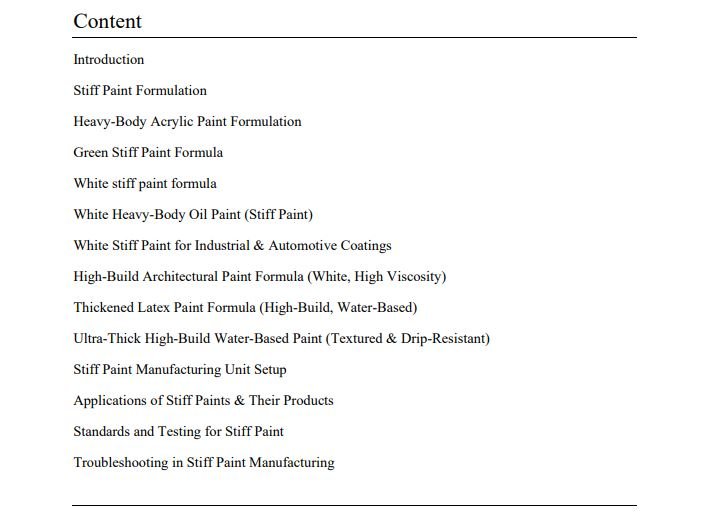
What is inside the Stiff Paint Making Formula guide
The guide explains that a stiff paint making formula, also known as thick paint, is made by adjusting consistency during manufacturing, and that stiff paint is commonly used in artistic techniques such as impasto, where brushstrokes and texture play a significant role. It covers pigment concentration, binder choice, additives, grinding, packing and testing.
Making the paint
Step 1: Pigment concentration
Start with a high pigment-to-binder ratio. Pre-wet pigment with a little binder or wetting agent to form a stiff paste, rather than adding all the binder at once.
Step 2: Add body builders
Blend in fillers and rheology agents. For oil paint, a heated pre-gel of aluminium stearate in oil is added to give a buttery body; for acrylic, thickener is added in steps with checks of viscosity and yield.
Step 3: Grind or disperse
Pass the paste through a three-roll mill or a muller until smooth, with no gritty particles. Small studios use glass muller and slab. Check fineness with a grind gauge or by drawdown.
Step 4: Adjust consistency
Add binder or fillers carefully until the paste has the desired body, tested by applying with a palette knife and watching how well peaks hold.
Step 5: De-aerate and fill
Remove air by resting or vacuum. Fill tubes or tubs using a filling machine, avoiding air pockets, and seal.
Balancing body with colour strength
Too much filler weakens colour and can make paint chalky. Too little yields a loose, buttery paint that flattens. Strong pigments like phthalo blue need lower loading than weak ones such as earth colours. Adjust filler by pigment type, and keep records of each colour’s recipe to keep batches consistent. For good handling, test paint on canvas, panel and paper with both brush and palette knife, and ask artists for feedback.
Testing and quality control
- Consistency and peak retention measured by a cone or simple penetrometer, plus visual peaks.
- Fineness of grind.
- Colour and tinting strength against a standard.
- Drying time for oil and acrylic.
- Cracking of thick films after drying.
- Adhesion to canvas and boards.
- Lightfastness via pigment data and exposure tests.
- Tube stability: separation, skinning, hardening.
Troubleshooting
Paint cracks when dry
Too thick a film, too little binder or fast drying. Add flexible binder, apply in layers and dry slowly.
Paint feels gritty
Poor grinding or agglomerates. Mill longer or use a finer pigment.
Oil separates in the tube
Too much free oil or too little body agent. Add stearate or filler and mix well.
Paint is too sticky
Too much binder or poor rheology. Adjust fillers and thickener.
Skins in the tube
Air in tube or driers too strong. Fill carefully and reduce driers.
Acrylic dries too fast on the palette
Low open time. Add retarder or glycol.
Safety and regulation
Pigments can be toxic. Cadmium, cobalt, chromium, lead and some other pigments need special handling and labelling, and are restricted or banned in some products and markets. Use dust extraction and masks when weighing dry powders. Oily rags used with drying oils can self-heat and ignite, so store them in water-filled metal containers or lay them flat to dry outdoors. Follow art material labelling rules such as ASTM D4236 or European requirements and supply safety data sheets. Do not claim non-toxic without certification.
Packaging and business opportunity
Aluminium or laminate tubes of 20 to 200 millilitres, plastic tubs and jars of 250 to 1000 millilitres, and larger studio tubs. Customers include professional and student artists, art schools, craft stores, decorators and hobbyists. A starter set of eight to twelve colours and a mixing white sells well, and large tubs of white and earth colours are best-sellers. Offer texture mediums, palette knives and canvases as add-ons. Workshop demonstrations and artist testimonials build trust quickly.
Explore more in the Paint Industry, Ink Formulations, Varnish Making and Coating Formulations categories, and see Fluid Acrylic Artist Paint Formula, Acrylic Emulsion Formulations, Color Pigment Pastes Formula, , Paint Oil Varnish Making Formula and .
Getting started
Make a small test batch of a single colour with a high pigment load and body builder. Grind, tube and test with brush and palette knife. Adjust body and colour strength, build a small palette, and share it with artists for honest feedback before investing in larger equipment.
How to get the best results from this guide
Treat the guide as a tested starting point rather than a finished factory. Begin with a small trial batch in the laboratory or on a bench, using the exact raw materials you plan to buy, and record every weight, temperature, mixing time and observation. Compare the result with the quality checks in the guide, change only one thing at a time, and keep a note of what each change did. Once a small batch is consistently good, repeat it several times, then scale up in stages, because mixing, heating and cooling behave differently in larger vessels. Keep retained samples of every batch, write simple standard operating procedures for your team, and build relationships with two suppliers for each key raw material. Finally, check the labelling, safety and product rules in the country where you will sell, and ask a qualified person to review your process. This careful, documented approach is what turns a good formulation into a reliable product and a trusted brand.
Who should buy this guide?
The guide is written for practical readers. It suits manufacturers who want to add a new product to an existing plant, startups choosing their first product, private-label brands that need to understand what they are buying, technical staff who must set specifications and train operators, and consultants and students who want a structured, plain-language reference. It is less suitable for anyone looking for a quick shortcut or a guarantee, because every formulation still needs testing with your own materials, equipment and local rules. If you are unsure whether it matches your project, send a short question through the contact page before you order, and we will tell you honestly whether it fits.
What is inside the Stiff Paint Making Formula guide
Every Product Making Guide in our shop follows the same structure so you know where to look. This guide includes the product formula, the ingredients and materials, the procedure and preparations, the industrial requirements and the technical specifications. In practice you receive:
- The formulation, written so you can follow it at the bench and scale it up.
- Ingredients and materials, with the job of each material and advice on grades and suppliers.
- The manufacturing procedure, including order of addition, mixing and preparations.
- Industrial requirements, covering equipment, space and packaging.
- Technical specifications, describing what a good finished product should look like and how it should behave.
- Troubleshooting for the faults that makers meet most often.
- Business guidance, to help you take the product from the bench to the market.
These Product Making Guides of chemical formulations and formulas are for manufacturers, startups and entrepreneurs. Every guide contains industrially tested, practical formulations. Anyone who buys a guide can make the product by following its step-by-step instructions. Raw materials vary between suppliers, so always confirm your results with a small trial batch before scaling up.
Who stands behind this guide?
Chemical Formulation Services is the trading name of CFS Formulation Services Ltd, registered in England and Wales under company number 16678503, with its office at Unit F, Winston Business Park, Churchill Way, Sheffield S35 2PS. The business was founded by George Enrick and publishes formulation manuals, technical guides and industry reports. You can check our details on the Companies House register, read about us, or contact us with any question before you order.
A written formulation cannot replace testing with your own raw materials, equipment and climate, and we say so plainly. What the guide does give you is a tested, structured starting point that can save you months of trial and error. Our terms and conditions explain what a purchase from us covers.
How to order
- Select Add to cart to keep browsing, or Buy Now to go straight to checkout.
- Pay with PayPal, Stripe, Xoom by PayPal, Payoneer, payment links for debit and credit cards, or Western Union, Ria and all money exchanges.
- If you pay through a money exchange, email your payment slip to Info@chemicalformulationservices.com. After confirmation, your instant download link is emailed to you.
- For online payments, the PDF is available as soon as the payment is confirmed.
All products are digital downloads and all payments are nonrefundable once the file is delivered, so please read the refund policy and the FAQs before you order. You can compare this guide with others in the formula shop or browse our industrial project reports.
Frequently asked questions about stiff paint making formula
What is the Stiff Paint Making Formula guide?
It is a digital PDF Product Making Guide to thick, heavy body paints for impasto, covering pigment load, binders, body builders, grinding, packing and testing.
How do you make paint stiffer?
Increase pigment and filler content, reduce free binder and add body builders such as aluminium stearate or thickener.
Why does thick paint crack?
Films that are too thick or dry too fast, or have too little flexible binder, crack.
Is stiff paint only for oils?
No. Heavy body acrylics also hold peaks, using thickeners and high solids.
What safety rules apply?
Handle toxic pigments carefully, control dust, label correctly and manage oily rags safely.
How do I receive the guide?
You receive an instant PDF download after payment is confirmed. For money exchanges, email your payment slip to Info@chemicalformulationservices.com and the link is emailed after we confirm it.
Is the payment refundable?
All payments are nonrefundable because the product is an instant digital download. See the refund policy for details.
Can you help with a custom formulation?
CFS Formulation Services Ltd offers formulation and product development consultancy. Send a short brief through the Contact page.
Last reviewed: November 2026. This page is general information about a digital product. It is not a safety data sheet or professional advice, and any formulation should be tested and reviewed by a qualified person before commercial use.