Textile Tear Resistance Finish Formulation
USD $70
PDF manual · Instant downloadPayment Methods
Refund Policy
Custom Formulation Services
Formulation Consultation
Contact Us
Textile tear resistance finish formulation is a treatment applied to textiles to enhance their resistance to tearing or ripping. This finish is particularly important in applications where the fabric may be subjected to mechanical stress or abrasion, increasing the risk of tearing.
Methods used to improve the Textile tear resistance finish
- Chemical finishes: Chemical finishes can be applied to textiles to enhance their tear strength. These finishes typically involve the application of specific chemical agents that strengthen the fabric’s structure, improve the intermolecular bonding, or increase the fiber-to-fiber friction. The chemicals used can include resins, cross-linking agents, or bonding agents that improve the cohesion and integrity of the fabric.
- Mechanical treatments: Mechanical treatments, such as calendaring or embossing, can be used to increase the tear resistance of textiles. These processes involve subjecting the fabric to pressure and heat, which helps to compact the fibers, improve their alignment, and enhance the fabric’s strength.
- Fabric construction: The tear resistance of textiles can also be influenced by the fabric’s construction. Fabrics with a tighter weave or knit structure generally exhibit better tear resistance compared to looser or more open structures. Additionally, incorporating stronger or more robust fibers into the fabric composition can enhance tear resistance.
- Fiber selection: The choice of fibers used in the textile can significantly impact tear resistance. Some fibers, such as aramid (e.g., Kevlar®), nylon, or high-tenacity polyester, are known for their high tear strength and are commonly used in applications where tear resistance is critical.
- Lamination or coating: Applying a layer of protective coating or lamination to the fabric’s surface can improve its tear resistance. These additional layers act as a barrier, providing an extra level of protection against tearing and abrasion.
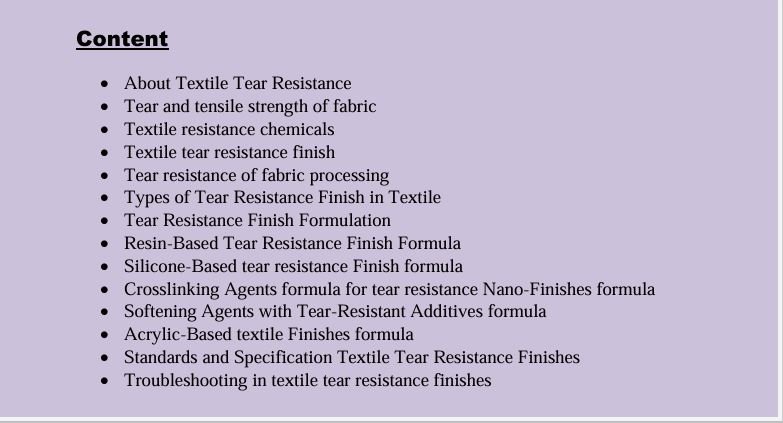
When applying tear resistance finishes to textiles, various issues can arise, affecting the performance, quality, or appearance of the final product. Below are some common troubleshooting areas and recommendations for resolving these issues.
- Inadequate Tear Resistance Improvement
- Stiffness or Hard Hand Feel
- Uneven Application
- Poor Wash Durability
- Yellowing of Fabric
- Foaming Issues During Application
- Tackiness or Stickiness on the Fabric
- Poor Flexibility or Cracking
Textile product making guide
This formula data sheet about to the specific tear resistance finish applied to textiles can vary depending on the intended use, fabric composition, and desired performance requirements. Manufacturers often develop proprietary formulations or combinations of treatments to achieve the desired tear resistance properties.
The textile tear resistance finish formulation should be selected based on factors such as the fabric’s intended application, expected stress levels, durability requirements, and any applicable industry standards or regulations. Testing and evaluation of the finished fabric’s tear strength may be conducted to ensure it meets the desired performance standards. CFS formula data sheet will cover all the requirements of the industry.