
Metal Protective Paint Formula
USD $70
PDF manual · Instant downloadMetal Protective Paint Formula: a PDF guide to anti-rust metal primers and paints, with resins, pigments, manufacturing, application and testing.
Payment Methods
Refund Policy
Custom Formulation Services
Formulation Consultation
Contact Us
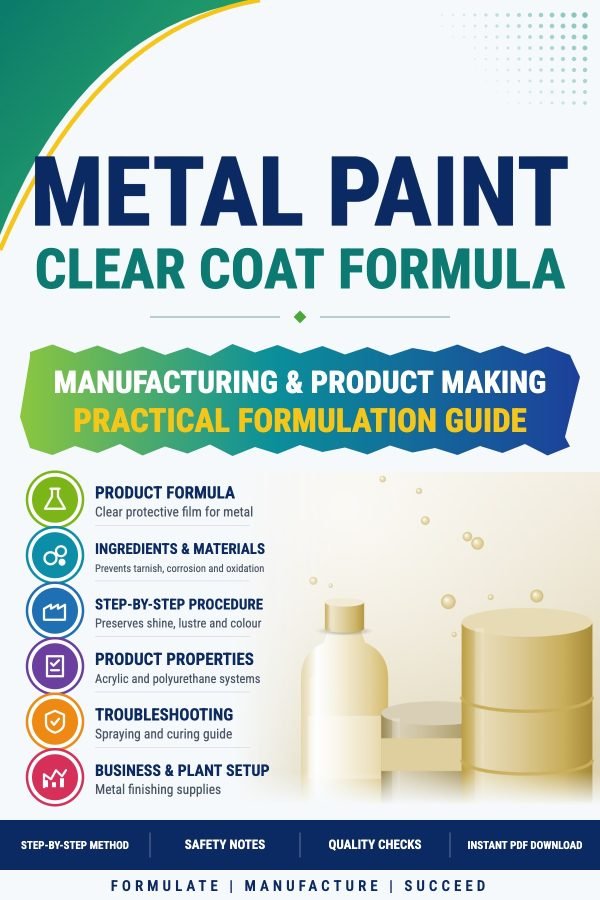
Metal Protective Paint Formula is a practical PDF guide for paint manufacturers, protective-coating suppliers, startups and entrepreneurs who want to make metal protective paint, also known as metal coating or metal primer. It is a paint specifically designed to protect metal surfaces, formulated with special additives and pigments that give corrosion resistance, durability and adhesion to metal substrates. The main purpose is to prevent metal surfaces from rusting and deteriorating. This page explains how a metal protective paint formulation works, what goes into a metal protective paint formula, how it is made, applied and tested, and how to turn it into a profitable paint business.
This guide is published by Chemical Formulation Services, the formulation publishing and consultancy business of CFS Formulation Services Ltd in Sheffield, United Kingdom. It is written for people who want to understand the product from the raw material to the finished pack, and it keeps its claims practical rather than promotional.
At a glance
- Product: Metal Protective Paint Formula, a digital PDF Product Making Guide.
- Also searched as: metal protective paint formulation, anti-rust paint formula, metal primer formula, iron and steel paint, corrosion-resistant paint.
- Types: alkyd, epoxy, polyurethane, zinc-rich and acrylic systems.
- Key goals: corrosion protection, adhesion, durability and easy application.
- Who it is for: paint makers, protective coating suppliers, contractors and entrepreneurs.
- Delivery: instant PDF download after payment is confirmed.
- Publisher: CFS Formulation Services Ltd, England and Wales company number 16678503.
How metal protective paint protects
Steel and iron rust when oxygen, water and electrolytes meet the metal surface. A protective paint system defends in three ways. First, as a barrier, a dense, continuous film keeps oxygen, moisture and salts away from the metal. Second, through inhibition, anti-corrosive pigments such as zinc phosphate release ions that passivate the surface and slow rust formation at damaged spots. Third, through galvanic (sacrificial) protection, zinc-rich primers contain so much metallic zinc that the zinc corrodes in preference to the steel, protecting it even where the paint is scratched. Good systems combine adhesion to the metal, a primer that provides inhibition or sacrificial protection, intermediate coats that build thickness and a topcoat that resists weather, chemicals and abrasion.
Paint types for metal
Alkyd metal paints
Oil-modified alkyd resins dissolved in solvent give economical, easy-to-apply paints, used for general-purpose primers and finishes on structural steel, gates, railings, machinery and farm equipment. They dry by oxidation, have good adhesion and flow and are tolerant of less-than-perfect surfaces, but have limited chemical and weather resistance compared with newer technologies.
Epoxy primers and coatings
Two-pack epoxy systems provide outstanding adhesion, chemical resistance and barrier properties, used in industrial, marine and tank coatings. Epoxies chalk in sunlight, so they are normally overcoated with polyurethane or acrylic topcoats outdoors.
Polyurethane topcoats
Two-pack aliphatic polyurethanes offer high gloss, colour retention and weather resistance, completing a high-performance protection system.
Zinc-rich primers
Contain a high proportion of zinc dust in epoxy or silicate binders, providing galvanic protection for steel in aggressive environments such as bridges, offshore structures and pipelines.
Water-based acrylic metal paints
Low-odour, low-VOC options for light-duty protection on indoor and mild exterior steel. Flash-rust inhibitors are important in these.
Rust-converting and direct-to-rust paints
Contain rust-converting agents or penetrating binders that allow application over tightly adhered rust where complete removal is impractical.
Typical ingredients
- Binders (resins): alkyd, epoxy, polyurethane, acrylic, chlorinated rubber or silicate, which determine the film properties.
- Anti-corrosive pigments: zinc phosphate, modified zinc phosphates, aluminium triphosphate, zinc dust and others. Traditional lead and chromate pigments are restricted and should not be used.
- Colour and opacity pigments: titanium dioxide, iron oxide red, carbon black and organic pigments.
- Extenders: talc, barytes, mica or micronised silica improve barrier, reduce permeability and control cost. Lamellar fillers such as micaceous iron oxide and mica add a strong barrier.
- Solvents: aliphatic and aromatic hydrocarbons, esters or water.
- Additives: driers for alkyds, anti-settling agents, wetting and dispersing agents, anti-skinning agents, flash rust inhibitors for water-based paints and defoamers.
- Hardeners: polyamide or amine for epoxy, isocyanate for polyurethane.
Building a complete coating system
Few protective paints work alone. A typical system for structural steel has a surface preparation step, a primer that provides adhesion and corrosion inhibition, one or two intermediate coats that build thickness and barrier, and a topcoat for colour and weather resistance. Thickness is critical: each coat adds a defined dry film thickness, and the total determines service life. For mild indoor conditions, a single alkyd primer and finish may be enough. For coastal, industrial or immersion service, a three-coat epoxy and polyurethane system, or a zinc-rich primer with epoxy and polyurethane, is normal. Provide customers with a system chart showing recommended coats, film thicknesses, drying times and recoat intervals for each environment category, from mild to severe. Matching thinners, cleaners and touch-up kits complete the offer.
Surface preparation standards and what customers should know
Standards describe how clean a steel surface must be before painting. Hand-tool cleaning removes loose rust and scale but leaves tightly adherent rust. Power-tool cleaning does better. Abrasive blast cleaning to a near-white or white-metal finish, with a defined roughness profile, is the foundation for high-performance systems. Chemical treatments such as phosphating or rust converters can supplement mechanical cleaning on small jobs. Explain on your data sheet which preparation each paint expects. A paint that is excellent over blasted steel can fail within months on poorly prepared surfaces, and the fault is then blamed on the paint rather than the preparation.
Environmental categories and service life
Corrosion environments are classified from very low (heated interiors) through urban and industrial atmospheres to coastal, offshore and immersion. Salt, humidity, pollution and temperature cycles all speed up corrosion. Choose a system and thickness appropriate to the category and the required life, such as five, fifteen or twenty-five years before first maintenance. Use accelerated tests as a guide only, because results depend on the system and on real exposure. When you can show test data and field references for your paints, buyers in industry and government will trust them more.
Water-based and low-VOC options
Regulation and customer preference are pushing metal coatings toward water-based and high-solids technology. Waterborne acrylic and epoxy primers have improved a great deal and are suitable for many applications, provided flash-rust inhibitors are included and the surface is prepared well. High-solids epoxies cut solvent emissions while keeping heavy-duty performance. Offer a low-VOC line alongside conventional products so you can supply customers who face restrictions, and keep technical data on VOC content for tenders and certifications.
Packaging, shelf life and storage
Pack in lacquered or lined metal cans or HDPE pails for water-based paints, with tight lids. Alkyd and solvent-borne paints keep for a year or more if sealed. Two-pack kits should be packaged in the right ratio with clear mixing instructions. Store cans upright, away from heat and frost, and rotate stock. Label with batch number, colour, coverage per litre, drying times, thinner type, safety phrases and recoat information.
What is inside the Metal Protective Paint Formula guide
The guide explains that metal protective paint formula, also known as metal coating or metal primer, is a type of paint specifically designed to protect metal surfaces, formulated with special additives and pigments that offer corrosion resistance, durability and adhesion to metal substrates, with the primary purpose of preventing metal surfaces from rusting and deteriorating. It gives practical formulations for primers and topcoats, manufacturing methods, quality control and application guidance.
How the paint is made
Charging the binder and solvent
Charge the resin solution and part of the solvent to the high-speed disperser, then add wetting and dispersing agents.
Dispersing pigments and extenders
Add anti-corrosive pigment, colour pigment and extender gradually under rising speed, and disperse to the required fineness, checked on a Hegman gauge. Heavy pigments such as zinc dust are added carefully to avoid dusting and caking. Mica and other flakes are added late at lower shear to preserve their structure.
Let-down
Reduce speed and add the remaining resin, driers or additives and solvent. Adjust viscosity and density.
Quality check and filling
Check fineness, viscosity, density, solids, colour and drying time. Filter and fill into cans or drums, filling to the top to minimise skinning. For two-pack systems, fill base and hardener in matched kits.
Surface preparation and application
Surface preparation decides the performance. Remove oil, grease, loose rust and old paint by wire brushing, sanding, abrasive blasting or chemical treatment. Clean dust and moisture. Apply primer by brush, roller or spray at the specified film thickness, allow to dry, then apply intermediate and topcoats within the recoat window. Observe humidity and temperature limits, and avoid painting in rain, fog or when the metal temperature is near the dew point.
Testing and quality control
- Viscosity, density, solids and fineness of grind.
- Drying times: touch dry, hard dry and recoat.
- Adhesion: cross-cut and pull-off tests on steel panels.
- Salt spray (fog) test: hours of resistance with scribed panels.
- Humidity and condensation tests.
- Flexibility and impact resistance.
- Weathering: accelerated UV and outdoor exposure for topcoats.
- Chemical resistance: as required.
- Storage stability: settling and skinning.
Troubleshooting
Rust bleeds through the paint
Poor surface preparation or thin film. Clean better, apply an anti-corrosive primer and build thickness.
Blistering
Moisture or salts under the film, or solvent trapped. Clean salts, dry the surface and avoid thick coats.
Peeling or poor adhesion
Contaminated or smooth surface, or incompatible recoat. Clean, roughen, and follow recoat guidance.
Slow drying
Cold, humid conditions or too thick a film. Adjust driers and application conditions.
Settling in the can
Heavy pigment, weak suspension. Add anti-settling agent and recommend stirring.
Chalking and fading outdoors
Epoxy exposure to UV. Overcoat with a UV-stable topcoat.
Safety, environment and compliance
Solvent-based paints are flammable, with vapours that are harmful and can cause dizziness, so require ventilation, earthing, no ignition sources and respirators. Zinc dust is flammable in fine form. Isocyanate hardeners are respiratory sensitisers, and epoxy hardeners can sensitise skin. Avoid lead, hexavalent chromium and other restricted anti-corrosive pigments. VOC limits apply to many paints, encouraging water-based and high-solids technologies. Provide safety data sheets and labelling, and handle waste paint, solvents and rags correctly.
Business opportunity
Every industry that uses metal needs protective paint: construction, fabrication, agriculture, machinery, transport, shipping, oil and gas, power, water and utilities. A producer can serve hardware stores and trade counters with ready-to-use anti-rust paints, and contractors and factories with epoxy, polyurethane and zinc-rich systems. Selling a matched system of primer, undercoat, topcoat and thinner, with technical data and coverage guidance, builds loyalty. Colour cards, tinting systems, sprays and small cans widen the market. Private label and tender supply are further routes.
Related CFS guides help you build a paint and coatings range. Browse the Paint Industry, Coating Formulations and Metal Treatment categories, and see Epoxy Marine Coating Formula, Solvent-Based PU Top Coat Formulation, Flat Oil Paint Formula, , , and PPG Thinner Formula.
Getting started
Choose a market segment, for instance anti-rust alkyd primer and topcoat for general use. Make small batches using zinc phosphate and iron oxide pigments, apply to prepared steel panels and test adhesion, drying and salt-spray resistance. Compare with leading brands, refine and prepare data sheets with coverage, drying times and surface preparation steps. Supply trial cans to local contractors and hardware shops, and use feedback to improve.
How to get the best results from this guide
Treat the guide as a tested starting point rather than a finished factory. Begin with a small trial batch in the laboratory or on a bench, using the exact raw materials you plan to buy, and record every weight, temperature, mixing time and observation. Compare the result with the quality checks in the guide, change only one thing at a time, and keep a note of what each change did. Once a small batch is consistently good, repeat it several times, then scale up in stages, because mixing, heating and cooling behave differently in larger vessels. Keep retained samples of every batch, write simple standard operating procedures for your team, and build relationships with two suppliers for each key raw material. Finally, check the labelling, safety and product rules in the country where you will sell, and ask a qualified person to review your process. This careful, documented approach is what turns a good formulation into a reliable product and a trusted brand.
Who should buy this guide?
The guide is written for practical readers. It suits manufacturers who want to add a new product to an existing plant, startups choosing their first product, private-label brands that need to understand what they are buying, technical staff who must set specifications and train operators, and consultants and students who want a structured, plain-language reference. It is less suitable for anyone looking for a quick shortcut or a guarantee, because every formulation still needs testing with your own materials, equipment and local rules. If you are unsure whether it matches your project, send a short question through the contact page before you order, and we will tell you honestly whether it fits.
What is inside the Metal Protective Paint Formula guide
Every Product Making Guide in our shop follows the same structure so you know where to look. This guide includes the product formula, the ingredients and materials, the procedure and preparations, the industrial requirements and the technical specifications. In practice you receive:
- The formulation, written so you can follow it at the bench and scale it up.
- Ingredients and materials, with the job of each material and advice on grades and suppliers.
- The manufacturing procedure, including order of addition, mixing and preparations.
- Industrial requirements, covering equipment, space and packaging.
- Technical specifications, describing what a good finished product should look like and how it should behave.
- Troubleshooting for the faults that makers meet most often.
- Business guidance, to help you take the product from the bench to the market.
These Product Making Guides of chemical formulations and formulas are for manufacturers, startups and entrepreneurs. Every guide contains industrially tested, practical formulations. Anyone who buys a guide can make the product by following its step-by-step instructions. Raw materials vary between suppliers, so always confirm your results with a small trial batch before scaling up.
Who stands behind this guide?
Chemical Formulation Services is the trading name of CFS Formulation Services Ltd, registered in England and Wales under company number 16678503, with its office at Unit F, Winston Business Park, Churchill Way, Sheffield S35 2PS. The business was founded by George Enrick and publishes formulation manuals, technical guides and industry reports. You can check our details on the Companies House register, read about us, or contact us with any question before you order.
A written formulation cannot replace testing with your own raw materials, equipment and climate, and we say so plainly. What the guide does give you is a tested, structured starting point that can save you months of trial and error. Our terms and conditions explain what a purchase from us covers.
How to order
- Select Add to cart to keep browsing, or Buy Now to go straight to checkout.
- Pay with PayPal, Stripe, Xoom by PayPal, Payoneer, payment links for debit and credit cards, or Western Union, Ria and all money exchanges.
- If you pay through a money exchange, email your payment slip to Info@chemicalformulationservices.com. After confirmation, your instant download link is emailed to you.
- For online payments, the PDF is available as soon as the payment is confirmed.
All products are digital downloads and all payments are nonrefundable once the file is delivered, so please read the refund policy and the FAQs before you order. You can compare this guide with others in the formula shop or browse our industrial project reports.
Frequently asked questions about metal protective paint formula
What is the Metal Protective Paint Formula guide?
It is a digital PDF Product Making Guide to anti-rust metal primers and paints, covering resins, pigments, manufacturing, application and testing.
How does a protective paint stop rust?
By barrier action, inhibitive pigments and, in zinc-rich primers, sacrificial galvanic protection.
Which pigments should be avoided?
Lead and hexavalent chromium pigments are restricted. Use zinc phosphate and other compliant anti-corrosive pigments.
Why is surface preparation so important?
Rust, oil and dirt under the paint cause blistering and peeling, so clean and prepare the metal first.
Can epoxy be used outdoors?
Epoxy chalks in sunlight, so overcoat it with a UV-stable polyurethane or acrylic topcoat.
How do I receive the guide?
You receive an instant PDF download after payment is confirmed. For money exchanges, email your payment slip to Info@chemicalformulationservices.com and the link is emailed after we confirm it.
Is the payment refundable?
All payments are nonrefundable because the product is an instant digital download. See the refund policy for details.
Can you help with a custom formulation?
CFS Formulation Services Ltd offers formulation and product development consultancy. Send a short brief through the Contact page.
Last reviewed: November 2026. This page is general information about a digital product. It is not a safety data sheet or professional advice, and any formulation should be tested and reviewed by a qualified person before commercial use.