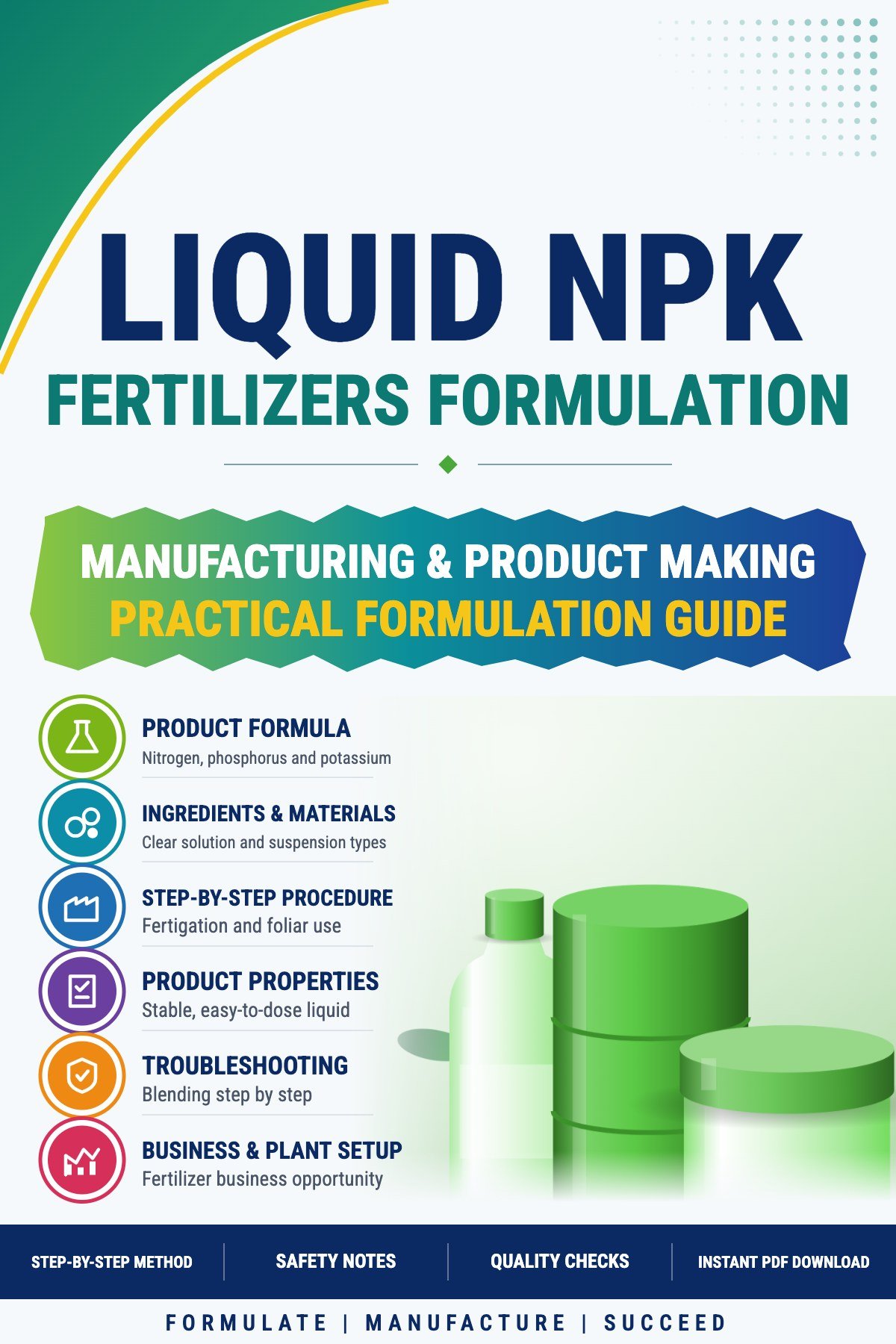

Liquid NPK Fertilizers Formulation
USD $89
PDF manual · Instant downloadLiquid NPK Fertilizers Formulation: a PDF guide to blending clear and suspension liquid nitrogen, phosphorus and potassium fertilizers for fertigation and foliar use.
Payment Methods
Refund Policy
Custom Formulation Services
Formulation Consultation
Contact Us
Liquid NPK Fertilizers Formulation is a practical PDF guide for fertilizer blenders, agri-input suppliers, startups and entrepreneurs who want to make multi-nutrient liquid fertilizers that deliver nitrogen (N), phosphorus (P) and potassium (K) in a ready-to-use liquid form. Farmers and growers like liquid fertilizers because they are easy to measure, mix evenly and apply through irrigation lines, sprayers and drenching equipment. This page explains how a liquid NPK fertilizers formulation works, which raw materials make up a liquid NPK fertilizer formula, how it is blended, tested and stored, and how to turn it into a profitable agri-input business.
This guide is published by Chemical Formulation Services, the formulation publishing and consultancy business of CFS Formulation Services Ltd in Sheffield, United Kingdom. It is written for people who want to understand the product from the raw material to the finished pack, and it keeps its claims practical rather than promotional.
At a glance
- Product: Liquid NPK Fertilizers Formulation, a digital PDF Product Making Guide.
- Also searched as: liquid NPK fertilizer formula, liquid fertilizer blending, NPK solution, suspension fertilizer, fertigation fertilizer.
- Forms covered: clear solution and suspension-based liquid NPK.
- Used for: fertigation, foliar application, soil drenching and liquid blending operations.
- Who it is for: fertilizer blenders, agro-dealers, greenhouse and farm suppliers and entrepreneurs.
- Delivery: instant PDF download after payment is confirmed.
- Publisher: CFS Formulation Services Ltd, England and Wales company number 16678503.
Why liquid NPK fertilizer
Plants need nitrogen for leaf and stem growth, phosphorus for roots, flowers and energy transfer and potassium for water balance, fruit quality and disease resistance. Solid granular fertilizers supply these nutrients, but liquid fertilizers offer several advantages. They are measured by volume or by metering pump, they mix evenly into irrigation water, they can be applied directly to leaves or soil, and they let growers adjust the ratio of nutrients to a crop stage. They are valuable in drip irrigation, greenhouse production, orchards, vegetables, turf and high-value horticulture. For a manufacturer, liquid blending needs less capital than granulation, uses simple tanks and pumps and can be located close to customers.
The central question in every formulation is solubility. Every raw material dissolves only to a limit in water, and that limit changes with temperature. When you mix several salts, they interact and may precipitate. A good liquid fertilizer stays clear at the lowest storage temperature it will see, or stays evenly suspended in the case of suspensions. The guide describes how to choose raw materials and order of addition to reach the desired grade without crystals, sludge or scale.
Understanding the NPK grade
The grade, such as 10-10-10 or 12-4-6, states the percentage by weight of total nitrogen (N), phosphate (P2O5) and potash (K2O). A 10-10-10 liquid contains ten percent of each, thirty percent total nutrients in one hundred kilograms of product. Higher grades are more concentrated and economical to transport but harder to keep in solution. Many liquids are made at moderate grades for stability, while suspensions allow higher analysis by holding some salts as fine solids kept in place by a suspending clay.
Common raw materials
- Nitrogen sources: urea, ammonium nitrate, ammonium sulphate and urea-ammonium nitrate (UAN) solution, each with different solubility, cost and safety considerations.
- Phosphorus sources: phosphoric acid, ammonium phosphates (MAP and DAP) and ammonium polyphosphate liquid, which holds more phosphate in solution and sequesters metals.
- Potassium sources: potassium hydroxide, potassium chloride, potassium sulphate and potassium nitrate. Potassium chloride is cheap but unsuited to chloride-sensitive crops, while potassium nitrate is premium and highly soluble.
- Micronutrients: chelated iron, zinc, manganese, copper, boron and molybdenum for complete products.
- Additives: chelating or sequestering agents, pH adjusters, anti-foam, dyes and, for suspensions, attapulgite or similar suspending clays.
- Water: low-hardness, clean water, preferably softened or deionised, since calcium and magnesium can precipitate phosphates.
Clear solution or suspension
Clear liquid (solution) fertilizers
All nutrients are fully dissolved. They are easy to apply through drip systems and foliar sprayers, but their grade is limited by solubility, so they are best for moderate analysis and where clean, clog-free irrigation matters.
Suspension fertilizers
A portion of the salts is suspended as fine solid particles, held by a suspending agent. Suspensions can hold higher nutrient levels and use cheaper raw materials, but need good agitation and may not suit fine drip emitters. They are common for soil application and broadcast spraying.
Worked example of a balanced liquid blend
A formulator starts from the target grade and works backwards. Suppose the goal is one tonne of a 10-5-5 clear liquid. That needs 100 kg of nitrogen, 50 kg of P2O5 and 50 kg of K2O. Phosphorus is supplied by phosphoric acid or ammonium polyphosphate, and the amount is calculated from its P2O5 content. Potassium comes from potassium hydroxide neutralising part of the acid, or from potassium nitrate. The remaining nitrogen is supplied by urea or UAN. Water makes up the balance and is added in stages. The guide shows how to do this arithmetic carefully, then check it against the solubility limit of each salt at the lowest storage temperature, so the blend does not crystallise on a cold night.
Water quality and cleaning of equipment
Hard or dirty water is a common cause of sludge. Calcium and magnesium react with phosphate to form fine insoluble solids that settle in tanks and block filters. Test your water, soften it if needed, and flush tanks and lines between different products to avoid cross-contamination, especially when switching between chloride and chloride-free grades. Record cleaning, as even a small residue of an incompatible product can cause a batch to precipitate.
Selling and supporting your customers
Growers want clear instructions: dose per hectare or per thousand litres of irrigation water, timing by crop stage, compatibility with other products and safe handling. Prepare a one-page data sheet for each grade, give a small sample for trial and visit the first customers to see the product in use. Photographs of treated and untreated plots, together with simple cost-per-hectare comparisons, are far more convincing than claims about nutrient content.
What is inside the Liquid NPK Fertilizers Formulation guide
The guide describes multi-nutrient fertilizer systems that deliver nitrogen, phosphorus and potassium in soluble or suspension-based liquid form for fertigation, foliar application, soil drenching and liquid blending. It covers selection of raw materials depending on nutrient ratios, formulation worked examples, order of addition, process control, quality testing, packaging and troubleshooting.
The blending process
A liquid fertilizer plant is simple: tanks, pumps, agitators, meters, filters and filling equipment, all made of corrosion-resistant material such as polyethylene, fibreglass or suitable stainless steel.
Charging water and acid or base
Start with a measured amount of water. Where phosphoric acid is used, it is added carefully, since mixing with water releases heat, and neutralisation with ammonia, potassium hydroxide or other bases releases still more heat. Control the temperature and add slowly.
Dissolving nitrogen salts
Urea dissolves with a cooling effect, which slows dissolution and can lower solution temperature enough to cause problems, so gentle warming helps. Ammonium nitrate and UAN follow the rules of their safety data sheets.
Adding potassium
Add potassium salts after the phosphate step, watching for the heat of solution or neutralisation, and adjust pH.
Adding micronutrients and additives
Dissolve chelated micronutrients in a separate small container and add them last, followed by sequestering agent and dye, to avoid precipitation.
Final check and filtering
Check pH, density, nutrient content and clarity. Filter to remove any undissolved matter and fill into clean containers.
Matching the formula to crop and stage
Young seedlings and leafy vegetables respond to higher nitrogen, so ratios such as 3-1-2 suit vegetative growth. Flowering and fruiting crops need more phosphorus early and more potassium later, so ratios such as 1-2-3 or 1-1-2 are common. Turf and orchards often run on programmes that change through the season. Greenhouse growers on drip systems prefer clear, low-chloride formulations with micronutrients included, while broadacre farmers buy cheaper suspensions or lower-cost solutions for soil application. Selling a small family of crop-stage products with a simple dosing chart is easier for customers than a single universal grade, and it justifies a better margin.
Quality control and testing
- Density and pH: quick checks against the formulation target.
- Nutrient analysis: verified by laboratory methods for total nitrogen, phosphate and potash, as required by fertilizer regulations.
- Crystallisation temperature (salting-out): the temperature at which crystals first form on cooling, which should be below the lowest storage temperature.
- Clarity and sediment: for solutions, no cloudiness or sludge after storage.
- Suspension stability: for suspensions, check settling and re-dispersion.
- Compatibility: jar test with typical irrigation water.
- Corrosiveness: compatibility with tank and pipe materials.
Troubleshooting
Crystals form in cold weather
The grade is too high for the temperature. Reduce concentration, change the nitrogen source mix or use polyphosphate to raise solubility.
Cloudiness and sludge
Metal impurities in raw materials or hard water forming insoluble phosphates. Use cleaner materials, softened water and a sequestering agent.
Clogged drip emitters
Particles or precipitates in the fertilizer or reaction with irrigation water. Filter the product and test compatibility with the customer’s water.
Leaf burn after foliar spraying
Too high a concentration or salt index. Recommend dilution rates, use low-chloride sources and spray in cooler hours.
Suspension settles hard
Not enough clay or poor hydration of the clay. Improve shear, increase the clay level and recommend agitation.
Foaming during mixing
Air entrainment or surfactants. Lower agitator speed, add anti-foam and avoid splashing.
Safety, regulations and care
Phosphoric acid and strong bases such as potassium hydroxide are corrosive, and mixing releases heat, so wear gloves, goggles and protective clothing and keep eyewash close by. Ammonium nitrate is an oxidiser with strict storage and security rules in many countries, and some places restrict it heavily, so check legal requirements before using it. Never mix fertilizer concentrates with chlorine bleach or acids in confined spaces, since toxic gases may form. Many countries require fertilizer registration, labelling of guaranteed analysis and limits on heavy metals, so confirm local rules before selling. Handle spills quickly to avoid runoff into waterways, where nutrient pollution harms water quality.
Packaging, storage and shelf life
Use polyethylene drums, jerricans or intermediate bulk containers with tight closures, and avoid mild steel, galvanised and copper fittings, which corrode in acidic fertilizer. Label each pack with grade, guaranteed analysis, batch number, dosing advice and hazard information. Store in a cool, shaded place, away from freezing for high-grade solutions, and keep suspensions agitated or recommend shaking before use. Keep retained samples for each batch so complaints can be traced.
Business opportunity
Demand for liquid fertilizer grows with drip irrigation, greenhouse production and precision agriculture. A small blender can supply farms, nurseries, landscapers, golf courses and garden retailers with drums, jerricans and bulk deliveries. Crop-specific formulas, for example a high-potassium fruiting formula or a high-nitrogen leafy formula, allow premium pricing. Technical advice on dosing, compatibility and stage-based programmes builds loyalty. Add related products such as micronutrient mixes, humic and seaweed blends or pH correctors to increase sales per customer. Packaging in a range of sizes opens retail and wholesale channels.
Related CFS guides help you develop a fertilizer range. Browse the Fertilizers category, and see Magnesium Fertilizers Formulation, Herbicide Formulations and Poultry Veterinary Livestock for related agricultural products. For process know-how in water-based blending and surfactants, explore the Detergent Formulations category.
Getting started
Pick a balanced starter grade, for example a moderate 8-8-8 or 10-5-5 clear liquid, and prove it in small batches. Test crystallisation temperature in a refrigerator, check clarity after several weeks and run a jar test with local irrigation water. Have it analysed by an accredited laboratory to confirm the guaranteed analysis. Arrange registration and labelling, set up safe storage and begin with a few local growers, using their trial feedback to refine formulas and expand the range.
How to get the best results from this guide
Treat the guide as a tested starting point rather than a finished factory. Begin with a small trial batch in the laboratory or on a bench, using the exact raw materials you plan to buy, and record every weight, temperature, mixing time and observation. Compare the result with the quality checks in the guide, change only one thing at a time, and keep a note of what each change did. Once a small batch is consistently good, repeat it several times, then scale up in stages, because mixing, heating and cooling behave differently in larger vessels. Keep retained samples of every batch, write simple standard operating procedures for your team, and build relationships with two suppliers for each key raw material. Finally, check the labelling, safety and product rules in the country where you will sell, and ask a qualified person to review your process. This careful, documented approach is what turns a good formulation into a reliable product and a trusted brand.
Who should buy this guide?
The guide is written for practical readers. It suits manufacturers who want to add a new product to an existing plant, startups choosing their first product, private-label brands that need to understand what they are buying, technical staff who must set specifications and train operators, and consultants and students who want a structured, plain-language reference. It is less suitable for anyone looking for a quick shortcut or a guarantee, because every formulation still needs testing with your own materials, equipment and local rules. If you are unsure whether it matches your project, send a short question through the contact page before you order, and we will tell you honestly whether it fits.
What is inside the Liquid NPK Fertilizers Formulation guide
Every Product Making Guide in our shop follows the same structure so you know where to look. This guide includes the product formula, the ingredients and materials, the procedure and preparations, the industrial requirements and the technical specifications. In practice you receive:
- The formulation, written so you can follow it at the bench and scale it up.
- Ingredients and materials, with the job of each material and advice on grades and suppliers.
- The manufacturing procedure, including order of addition, mixing and preparations.
- Industrial requirements, covering equipment, space and packaging.
- Technical specifications, describing what a good finished product should look like and how it should behave.
- Troubleshooting for the faults that makers meet most often.
- Business guidance, to help you take the product from the bench to the market.
These Product Making Guides of chemical formulations and formulas are for manufacturers, startups and entrepreneurs. Every guide contains industrially tested, practical formulations. Anyone who buys a guide can make the product by following its step-by-step instructions. Raw materials vary between suppliers, so always confirm your results with a small trial batch before scaling up.
Who stands behind this guide?
Chemical Formulation Services is the trading name of CFS Formulation Services Ltd, registered in England and Wales under company number 16678503, with its office at Unit F, Winston Business Park, Churchill Way, Sheffield S35 2PS. The business was founded by George Enrick and publishes formulation manuals, technical guides and industry reports. You can check our details on the Companies House register, read about us, or contact us with any question before you order.
A written formulation cannot replace testing with your own raw materials, equipment and climate, and we say so plainly. What the guide does give you is a tested, structured starting point that can save you months of trial and error. Our terms and conditions explain what a purchase from us covers.
How to order
- Select Add to cart to keep browsing, or Buy Now to go straight to checkout.
- Pay with PayPal, Stripe, Xoom by PayPal, Payoneer, payment links for debit and credit cards, or Western Union, Ria and all money exchanges.
- If you pay through a money exchange, email your payment slip to Info@chemicalformulationservices.com. After confirmation, your instant download link is emailed to you.
- For online payments, the PDF is available as soon as the payment is confirmed.
All products are digital downloads and all payments are nonrefundable once the file is delivered, so please read the refund policy and the FAQs before you order. You can compare this guide with others in the formula shop or browse our industrial project reports.
Frequently asked questions about liquid npk fertilizers formulation
What is the Liquid NPK Fertilizers Formulation guide?
It is a digital PDF Product Making Guide to blending clear and suspension liquid NPK fertilizers for fertigation, foliar use and soil drenching.
What does NPK 10-10-10 mean?
It means the product contains ten percent nitrogen, ten percent phosphate as P2O5 and ten percent potash as K2O by weight.
Why do crystals form in liquid fertilizer?
The grade is too concentrated for the storage temperature, so salts come out of solution when it cools.
Can liquid NPK go through drip irrigation?
Clear, well-filtered solutions can, but suspensions may clog fine emitters, so test compatibility with your water.
Are there legal requirements?
Yes. Many countries require registration, guaranteed analysis labelling and limits on contaminants, and some restrict ammonium nitrate.
How do I receive the guide?
You receive an instant PDF download after payment is confirmed. For money exchanges, email your payment slip to Info@chemicalformulationservices.com and the link is emailed after we confirm it.
Is the payment refundable?
All payments are nonrefundable because the product is an instant digital download. See the refund policy for details.
Can you help with a custom formulation?
CFS Formulation Services Ltd offers formulation and product development consultancy. Send a short brief through the Contact page.
Last reviewed: November 2026. This page is general information about a digital product. It is not a safety data sheet or professional advice, and any formulation should be tested and reviewed by a qualified person before commercial use.