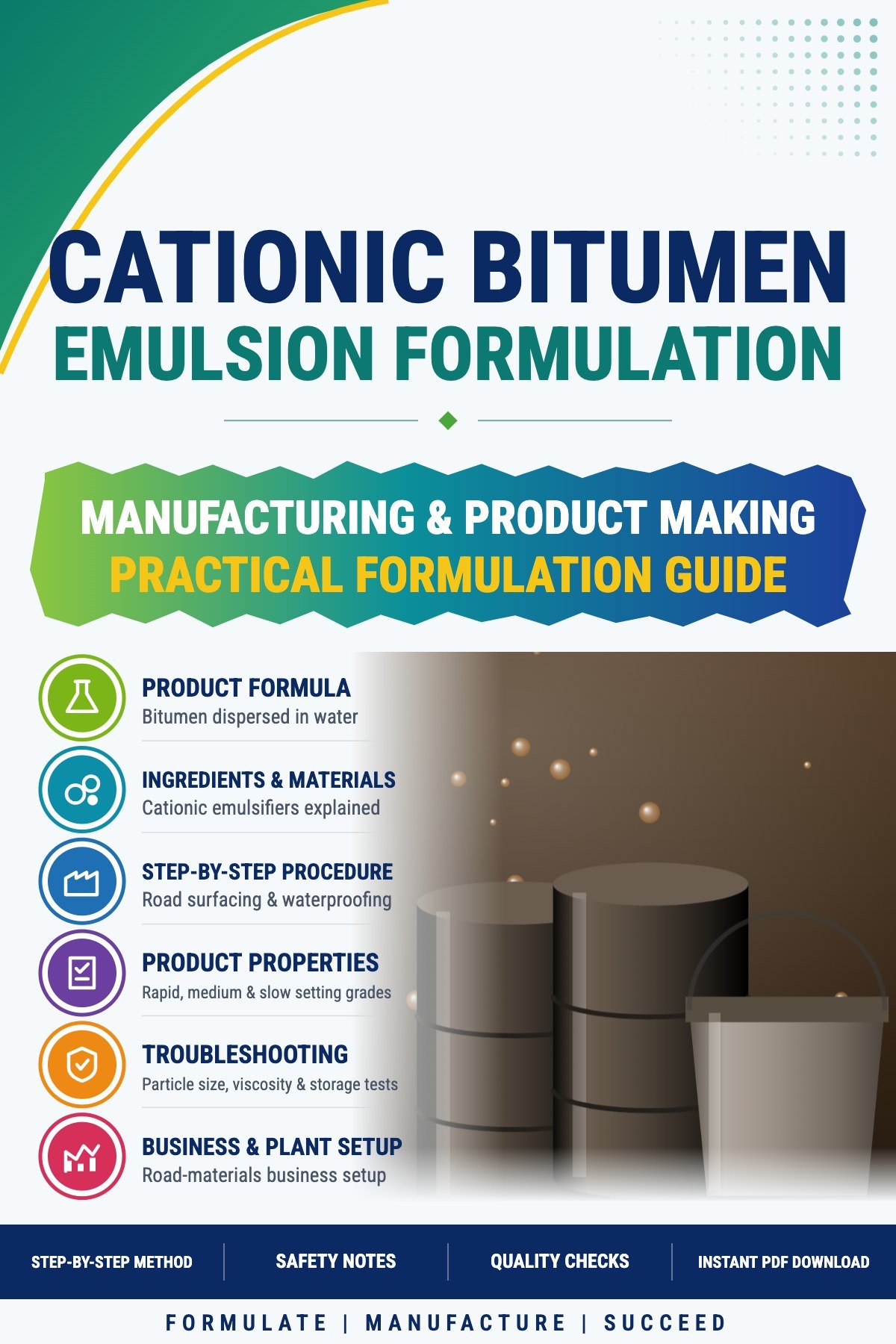


Cationic Bitumen Emulsion Formulation
USD $65
PDF manual · Instant downloadCationic Bitumen Emulsion Formulation: a PDF guide to making cationic bitumen emulsions for roads and waterproofing, with emulsifiers, process, grades, testing and troubleshooting.
Payment Methods
Refund Policy
Custom Formulation Services
Formulation Consultation
Contact Us
Cationic Bitumen Emulsion Formulation is a practical PDF guide for road-materials manufacturers, waterproofing and coating companies, civil contractors and entrepreneurs who want to make bitumen emulsions that can be applied cold without heating. A cationic bitumen emulsion is a mixture of bitumen, a black, sticky substance derived from petroleum, and water, held together by a positively charged emulsifying agent. This page explains how a cationic bitumen emulsion formulation works, what the guide covers and how a cationic bitumen emulsion formula is designed, produced and tested, so you can decide whether it fits your plans.
This guide is published by Chemical Formulation Services, the formulation publishing and consultancy business of CFS Formulation Services Ltd in Sheffield, United Kingdom. It is written for people who want to understand the product from the raw material to the finished pack, and it keeps its claims practical rather than promotional.
At a glance
- Product: Cationic Bitumen Emulsion Formulation, a digital PDF Product Making Guide.
- Also searched as: cationic bitumen emulsion formula, bitumen emulsion, cationic emulsifier for bitumen, tack coat emulsion.
- What it covers: bitumen selection, emulsifiers, acid and water phase, colloid mill process, grades, testing and troubleshooting.
- Key goals: stable emulsion, controlled breaking time, strong adhesion and easy cold application.
- Who it is for: road-materials makers, waterproofing companies, contractors and entrepreneurs.
- Delivery: instant PDF download after payment is confirmed.
- Publisher: CFS Formulation Services Ltd, England and Wales company number 16678503.
What a bitumen emulsion is
Bitumen is a thick, black, sticky material left from refining crude oil. It is an excellent waterproofing agent and binder, which is why it is used to hold together the stones in road surfaces and to seal roofs, foundations and pipes. The difficulty is that bitumen is too stiff to use at ordinary temperatures. Traditional paving uses hot bitumen, heated to well over a hundred degrees, which takes energy, creates fumes and demands careful handling. A bitumen emulsion offers a cold alternative. The bitumen is broken into tiny droplets, typically a few microns across, and dispersed in water with an emulsifier. The result is a free-flowing brown liquid that can be pumped, sprayed or mixed with aggregate at normal temperatures. When the emulsion is applied, the water leaves, the droplets come together and the bitumen returns as a continuous binder film.
Why cationic emulsifiers
Emulsifiers are molecules with a water-loving end and an oil-loving end. They sit at the surface of each bitumen droplet and give it an electrical charge, which keeps droplets from joining together. In a cationic emulsion, the emulsifier gives the droplets a positive charge. Most mineral aggregates, such as granite, basalt, quartzite and many others, carry a negative surface charge when wet. Positive droplets are therefore attracted to these surfaces, and the emulsion breaks and sticks quickly even in damp or cool conditions. This gives cationic emulsions fast setting, good adhesion to a wide range of aggregates and better performance in wet weather than anionic emulsions. They are the most widely used type in many road-building markets for tack coats, chip seals, slurry seals, micro-surfacing, cold mix and spray applications.
Main components of a cationic bitumen emulsion
Bitumen
The base bitumen, commonly of a penetration grade around 60/70 to 80/100, is typically 55 to 70 percent of the emulsion by weight. Its source, acid content and viscosity influence how easily it emulsifies and how the final emulsion behaves. Some emulsions use polymer-modified bitumen for added elasticity and durability.
Cationic emulsifier
Fatty amines, diamines, amidoamines, imidazolines and quaternary ammonium compounds are the main types. Each has its own effect on break speed and stability. Rapid-setting grades use less emulsifier or types that break quickly, while slow-setting grades use more and more stable emulsifiers.
Acid
Most cationic emulsifiers need acid, usually hydrochloric acid, to turn them into their active, water-soluble salt form. The amount of acid sets the pH of the soap solution, usually in the range of two to three or more, and affects stability and break behaviour.
Water
Clean water, free from excessive hardness, is mixed with the emulsifier and acid to make the soap solution. Poor water quality can disturb the process.
Stabilisers and additives
Calcium chloride or other salts help control viscosity, polymers (latex) improve flexibility and adhesion, and small amounts of fluxing oils or adhesion promoters may be used for specific uses. Stabilisers prevent settling or coagulation in storage.
Grades and uses
- Rapid-setting (RS or CRS): breaks quickly on contact with aggregate. Used for chip seals, spray applications, tack coats and surface dressing.
- Medium-setting (MS or CMS): used for open-graded mixes, patching and cold-mix work where some mixing time is needed.
- Slow-setting (SS or CSS): very stable. Used in slurry seals, dense-graded cold mixes, soil stabilisation and tack coats where long working time is needed.
- Polymer-modified emulsions: used for micro-surfacing, premium chip seals and high-performance waterproofing.
- Waterproofing and protective coatings: thick cold-applied coatings for roofs, foundations and pipes.
What is inside the Cationic Bitumen Emulsion Formulation guide
The guide is a technical formulation data sheet that explains the principles of bitumen emulsification, the roles of each ingredient, practical formulations for the main grades, a step-by-step manufacturing process using a colloid mill, quality control methods, troubleshooting and the business side of emulsion production. It follows the CFS approach of clear, industrially minded instructions for manufacturers and entrepreneurs.
How the emulsion is made
The outline below shows the general sequence. The guide gives the full details.
Step 1: Prepare the soap solution
Water is heated to a moderate temperature, the emulsifier and acid are added with stirring, and the solution is brought to the target pH and temperature. This aqueous phase is often called the soap solution.
Step 2: Heat the bitumen
Bitumen is heated to a temperature where it is fluid enough to be pumped and sheared, typically between 120 and 160 degrees Celsius depending on grade. Overheating damages bitumen and increases safety risks.
Step 3: Emulsify in a colloid mill
Both streams are pumped at controlled rates into a colloid mill, a high-shear device with a rotor and stator and a very small gap. The mill breaks the bitumen into fine droplets that are immediately coated with emulsifier.
Step 4: Cool and store
The emulsion leaves the mill at a temperature below the boiling point of water, usually around 80 to 95 degrees Celsius, and is pumped to a storage tank with gentle agitation as it cools.
Step 5: Test
Samples are tested for bitumen content, viscosity, particle size, sieve residue and breaking behaviour. Adjustments are made for future batches.
Step 6: Store and deliver
The emulsion is stored in suitable tanks, which should be clean and free of contamination, and delivered in drums, tankers or sprayers.
Equipment requirements
A basic plant includes a bitumen storage and heating tank, a soap-solution mixing tank, metering pumps, a colloid mill, heat exchangers or cooling, storage tanks and a laboratory. Laboratory equipment includes viscometers, sieves, a particle size tool, a distillation or evaporation set-up for bitumen content, breaking-index tests and storage stability tools. Smaller, batch-scale units exist for startups and on-site production. Hot bitumen systems need safe design, with insulated lines, temperature controls and fire protection.
Quality control for every batch
- Residue by evaporation or distillation: confirms bitumen content.
- Viscosity: measured to specification for pumping and spraying.
- Sieve test: checks for coarse particles that could block spray nozzles.
- Particle size distribution: finer droplets generally give higher viscosity and better stability.
- Breaking behaviour: demulsibility or breaking-index tests with standard aggregate or reagents.
- Storage stability: settlement tests after a day or longer.
- Adhesion: coating and water resistance tests with typical aggregates.
- pH and charge: check particle charge and acidity.
- Residue properties: penetration and softening point of the recovered bitumen.
Troubleshooting
Emulsion breaks in the tank
Too little emulsifier, wrong pH, contamination, excessive temperature or poor-quality water. Check the soap solution and avoid contamination from other emulsion types.
Coarse particles or high sieve residue
Mill gap too wide, wrong temperature or poor bitumen compatibility. Adjust the mill settings, temperature and emulsifier.
Viscosity too high or too low
Change the bitumen content, particle size, emulsifier level or salt addition.
Poor adhesion to aggregate
Dusty or dirty aggregate, wrong emulsifier or aggregate with a positive charge. Clean aggregate, test compatibility and consider adhesion agents.
Setting too fast or too slow
Adjust emulsifier type and dose, acid level and mixing procedure to suit the application.
Settling or creaming in storage
Droplet size too large or viscosity too low. Improve milling and consider stabilisers.
Skinning or coagulation in pipes
Temperature changes, air exposure or contamination. Keep equipment clean, and avoid unnecessary agitation or heat.
Safety, health and environment
Hot bitumen causes severe burns and releases fumes, so use heat-resistant gloves, face protection, protective clothing and ventilation. Emulsifier and acid solutions are corrosive and irritating, requiring chemical-resistant gloves and goggles. Never mix cationic and anionic emulsions, as this breaks both. Water that touches hot bitumen can foam and boil violently, so equipment must be dry and carefully managed. Emulsions are safer than hot bitumen in many ways, as they reduce fumes and fire risk, but they still require proper handling. Comply with environmental rules on wastewater, spills and disposal, and ensure road works follow local standards and specifications.
The business opportunity
Roads, pavements, car parks, roofs, foundations and pipelines all depend on bitumen. Emulsions are favoured where energy savings, safety and cold application matter, including rural road maintenance, patching and sealing. Producers can supply highway authorities, contractors, municipalities, waterproofing companies and distributors. Building a local emulsion plant can reduce transport costs because emulsions can be made near the work site. Consistent quality, technical support to contractors and conformity with national specifications are central to winning contracts.
Related CFS guides cover protective and waterproofing products. Browse the Construction Chemicals category for waterproofing and building products, Transparent Waterproofing Agent Formula for masonry protection, and Coating Formulations and Paint Industry for coatings. The Industrial Adhesive Formulations category lists related binders and adhesives.
Getting started
Begin by learning your national specifications for emulsion grades, then source suitable bitumen and a cationic emulsifier. Make small laboratory batches with a laboratory colloid mill if possible, test them against the specification, and adjust. Run trials on a small patch of road or roof with a local contractor, record the results and refine your formula. Scale up with proper heating systems, safety controls and quality procedures.
How to get the best results from this guide
Treat the guide as a tested starting point rather than a finished factory. Begin with a small trial batch in the laboratory or on a bench, using the exact raw materials you plan to buy, and record every weight, temperature, mixing time and observation. Compare the result with the quality checks in the guide, change only one thing at a time, and keep a note of what each change did. Once a small batch is consistently good, repeat it several times, then scale up in stages, because mixing, heating and cooling behave differently in larger vessels. Keep retained samples of every batch, write simple standard operating procedures for your team, and build relationships with two suppliers for each key raw material. Finally, check the labelling, safety and product rules in the country where you will sell, and ask a qualified person to review your process. This careful, documented approach is what turns a good formulation into a reliable product and a trusted brand.
Who should buy this guide?
The guide is written for practical readers. It suits manufacturers who want to add a new product to an existing plant, startups choosing their first product, private-label brands that need to understand what they are buying, technical staff who must set specifications and train operators, and consultants and students who want a structured, plain-language reference. It is less suitable for anyone looking for a quick shortcut or a guarantee, because every formulation still needs testing with your own materials, equipment and local rules. If you are unsure whether it matches your project, send a short question through the contact page before you order, and we will tell you honestly whether it fits.
What is inside the Cationic Bitumen Emulsion Formulation guide
Every Product Making Guide in our shop follows the same structure so you know where to look. This guide includes the product formula, the ingredients and materials, the procedure and preparations, the industrial requirements and the technical specifications. In practice you receive:
- The formulation, written so you can follow it at the bench and scale it up.
- Ingredients and materials, with the job of each material and advice on grades and suppliers.
- The manufacturing procedure, including order of addition, mixing and preparations.
- Industrial requirements, covering equipment, space and packaging.
- Technical specifications, describing what a good finished product should look like and how it should behave.
- Troubleshooting for the faults that makers meet most often.
- Business guidance, to help you take the product from the bench to the market.
These Product Making Guides of chemical formulations and formulas are for manufacturers, startups and entrepreneurs. Every guide contains industrially tested, practical formulations. Anyone who buys a guide can make the product by following its step-by-step instructions. Raw materials vary between suppliers, so always confirm your results with a small trial batch before scaling up.
Who stands behind this guide?
Chemical Formulation Services is the trading name of CFS Formulation Services Ltd, registered in England and Wales under company number 16678503, with its office at Unit F, Winston Business Park, Churchill Way, Sheffield S35 2PS. The business was founded by George Enrick and publishes formulation manuals, technical guides and industry reports. You can check our details on the Companies House register, read about us, or contact us with any question before you order.
A written formulation cannot replace testing with your own raw materials, equipment and climate, and we say so plainly. What the guide does give you is a tested, structured starting point that can save you months of trial and error. Our terms and conditions explain what a purchase from us covers.
How to order
- Select Add to cart to keep browsing, or Buy Now to go straight to checkout.
- Pay with PayPal, Stripe, Xoom by PayPal, Payoneer, payment links for debit and credit cards, or Western Union, Ria and all money exchanges.
- If you pay through a money exchange, email your payment slip to Info@chemicalformulationservices.com. After confirmation, your instant download link is emailed to you.
- For online payments, the PDF is available as soon as the payment is confirmed.
All products are digital downloads and all payments are nonrefundable once the file is delivered, so please read the refund policy and the FAQs before you order. You can compare this guide with others in the formula shop or browse our industrial project reports.
Frequently asked questions about cationic bitumen emulsion formulation
What is the Cationic Bitumen Emulsion Formulation guide?
It is a digital PDF Product Making Guide to formulating and making cationic bitumen emulsions, with ingredients, grades, colloid mill process, testing and troubleshooting.
What is a cationic bitumen emulsion?
It is a dispersion of fine bitumen droplets in water stabilised by a positively charged emulsifier, usable cold for road surfacing and waterproofing.
Why are cationic emulsions favoured for roads?
Their positively charged droplets bond quickly to the negatively charged surface of most aggregates, giving fast setting and good adhesion, even in damp conditions.
What does the colloid mill do?
It shears hot bitumen into micron-sized droplets in the soap solution, creating the emulsion.
Can I mix cationic and anionic emulsions?
No. Mixing opposite charges breaks the emulsion, so tanks, pipes and sprayers must be kept separate or thoroughly cleaned.
How do I receive the guide?
You receive an instant PDF download after payment is confirmed. For money exchanges, email your payment slip to Info@chemicalformulationservices.com and the link is emailed after we confirm it.
Is the payment refundable?
All payments are nonrefundable because the product is an instant digital download. See the refund policy for details.
Can you help with a custom formulation?
CFS Formulation Services Ltd offers formulation and product development consultancy. Send a short brief through the Contact page.
Last reviewed: November 2026. This page is general information about a digital product. It is not a safety data sheet or professional advice, and any formulation should be tested and reviewed by a qualified person before commercial use.