Textile Dye Thickener Formula
USD $45
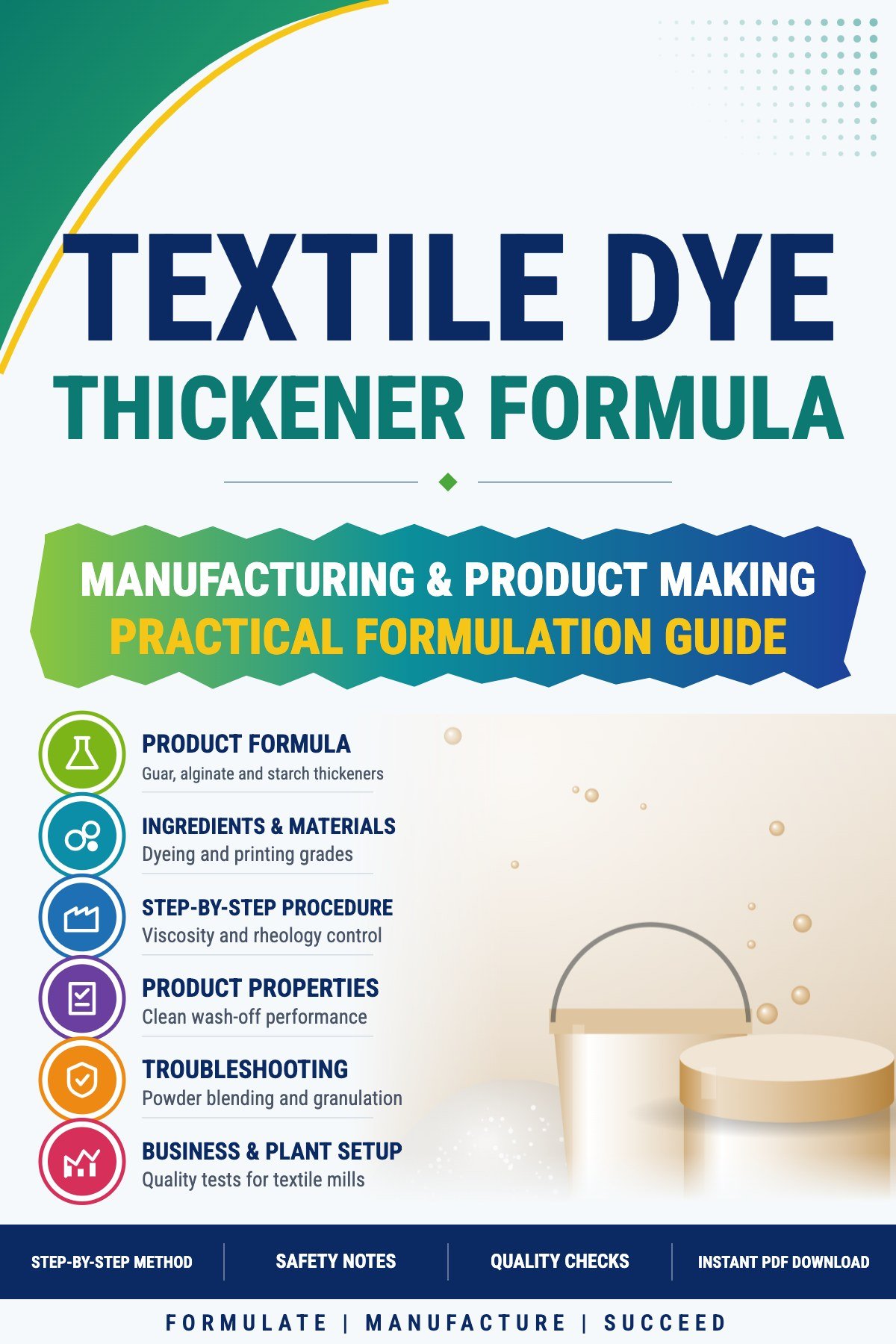
PDF manual · Instant downloadTextile Dye Thickener Formula: a PDF guide to guar, alginate, starch and synthetic thickeners for textile dyeing and printing, with blending, testing and troubleshooting.
Payment Methods
Refund Policy
Custom Formulation Services
Formulation Consultation
Contact Us
The Textile Dye Thickener Formula book is a structured, industry-focused reference for the formulation and manufacture of textile dye thickening agents used in dyeing and printing operations. It is developed for manufacturers, textile chemical suppliers and technical consultants who need practical, execution-ready guidance. This page explains what a textile dye thickener formulation is, how guar, alginate, starch, cellulose and synthetic thickeners differ, how thickener powders and pastes are manufactured, which tests mills use, and how to sell thickeners to printers.
This guide is published by Chemical Formulation Services, the formulation publishing and consultancy business of CFS Formulation Services Ltd in Sheffield, United Kingdom. It is written for people who want to understand the product from the raw material to the finished pack, and it keeps its claims practical rather than promotional.
At a glance
- Product: Textile Dye Thickener Formula, a digital PDF Product Making Guide.
- Also searched as: textile dye thickener formulation, print paste thickener, guar gum thickener, sodium alginate thickener, synthetic thickener for textile printing.
- Types: natural gum, modified starch, cellulose ether, alginate and synthetic acrylic thickeners.
- Key goals: viscosity, shear thinning, print sharpness, wash-off and shelf life.
- Who it is for: textile chemical makers, auxiliary suppliers, print houses and technical consultants.
- Delivery: instant PDF download after payment is confirmed.
- Publisher: CFS Formulation Services Ltd, England and Wales company number 16678503.
The role of a thickener
A thickener turns a dye liquor into a paste that can be printed. In textile printing, the paste must be fluid enough to pass through the screen under squeegee pressure, then thick enough to stay put on the fabric until it is dried and fixed. Good thickeners are shear-thinning: viscosity drops under the high stress of the squeegee, which lets the paste flow, then recovers at rest, so edges stay sharp. They must also be compatible with dyes and chemicals, give good colour yield, wash off cleanly and leave the fabric soft. For dyeing operations such as pad dyeing, thickeners or anti-migrants control dye movement during drying.
Thickener families
Guar gum and derivatives
Guar is obtained from guar beans and consists mainly of galactomannan. Raw guar swells quickly in cold water to give high viscosity, but it can leave residues and ferment. Carboxymethyl guar and hydroxypropyl guar are modified to improve solubility, stability, clarity and compatibility with electrolytes and many dye classes, including acid, disperse and reactive dyes under controlled conditions.
Locust bean gum and tamarind kernel powder
Locust bean gum gives smooth, high-viscosity pastes with good print sharpness. Tamarind kernel powder and its derivatives are used widely in India for disperse, vat and pigment printing, and have a long track record.
Sodium alginate
Extracted from brown seaweed, alginate is the standard thickener for reactive dye printing on cellulose because it lacks groups that react with the dye. It is sensitive to calcium and to low pH, so soft water and attention to chemicals are needed. Different viscosity grades fit different print styles.
Starch and modified starch
Native, roasted (British gum) and etherified starches give bulk viscosity and a cheaper option for pigment and some disperse printing, though they may reduce colour yield and be harder to wash out.
Cellulose ethers
Carboxymethyl cellulose and hydroxyethyl cellulose give stable, uniform pastes with good print definition, used in various systems.
Synthetic thickeners
Polyacrylate and related polymers, supplied as powders, emulsions or liquid concentrates, provide high viscosity at low dosage with excellent reproducibility. They are widely used in pigment printing, where they replace large volumes of kerosene-based emulsions, but need correct neutralisation and compatibility checks.
Specifying thickener grades for mill customers
Mills buy against a specification, not a trade name. A practical data sheet lists the viscosity of a defined concentration at a stated temperature and spindle speed, with a tolerance band; the moisture and ash limits; the particle size range; the recommended dispersion method; and the compatible dye classes. It also states the pH of the paste, the storage conditions and the shelf life. Add a short list of recommended starting concentrations, such as three to six percent for natural gums depending on the grade, and tell users to confirm by trial. Clear specifications let purchasing staff approve substitutes confidently and reduce arguments when a lot varies.
Cost per metre and the economics of thickener choice
Printers care about cost per metre of printed fabric, not price per kilogram of powder. A premium thickener that gives higher colour yield, so less dye is needed, or a stronger thickening effect, so lower dosage works, may be cheaper in use than a cheap one. Help customers calculate this by running side-by-side prints at equal viscosity, measuring colour depth and washing time, and tallying thickener, dye and water costs. Mills that see the numbers often stay loyal for years, and the data also supports price discussions during raw material swings.
Handling, storage and sustainability
Gum powders take up moisture and degrade if stored damp or hot. Store in sealed bags, off the floor, in a cool dry store, and use oldest stock first. Mills increasingly track the environmental footprint of auxiliaries, so supply information on biodegradability, bio-based content and any restricted substances. Natural thickeners are renewable and biodegradable, which supports sustainability claims, while synthetic thickeners offer high efficiency at low dosage. Being honest about both sides helps customers choose the right product for their goals.
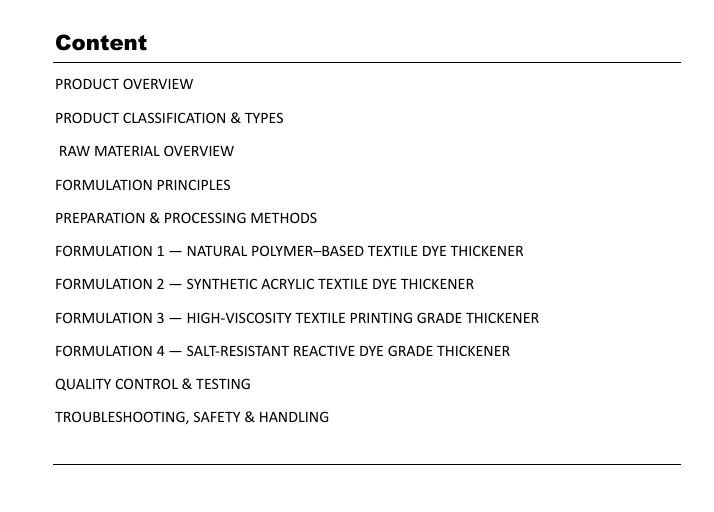
What is inside the Textile Dye Thickener Formula book
The book provides a structured, industry-focused reference for the formulation and manufacture of textile dye thickening agents used in dyeing and printing, developed for manufacturers, textile chemical suppliers and technical consultants seeking practical, execution-ready formulation guidance, and covers multiple commercial grades. It adds grade tables, blending procedures, specifications and troubleshooting.
Making thickener products
Powder blends
Blend natural gum powders of controlled particle size with dispersing aids, sodium bicarbonate or sodium carbonate where pH adjustment is required, and anti-caking agents. Granulated or agglomerated forms disperse into water without lumps and are preferred by mills.
Derivatisation
For manufacturers who modify raw gums, guar splits are reacted with reagents such as monochloroacetic acid or propylene oxide in a controlled slurry process, neutralised, washed, dried and milled. This step needs proper chemical plant, safety systems and effluent treatment, so many small producers buy derivatives rather than make them.
Ready-to-use stock pastes
Disperse powder in water under controlled agitation, allow it to hydrate, then adjust pH and add preservative. Pack in drums for use directly by printers. Shelf life is short for natural gum pastes, so synthetic or pre-preserved systems are often supplied for long storage.
Emulsion and liquid synthetic thickeners
Usually bought from polymer makers and blended with defoamer, ammonia or amine neutralisers and biocide for sale as ready-to-use auxiliaries.
Selecting the right thickener
For reactive dye printing on cotton, sodium alginate of medium to high viscosity is standard, sometimes blended with guar or starch derivatives for economy. For disperse dyes on polyester, locust bean, tamarind or guar derivatives and synthetic thickeners are used. For acid dyes on wool, silk and nylon, guar or locust bean derivatives and cellulose ethers work well. For pigment printing, synthetic thickeners dominate. For vat and sulphur dyes, specially chosen thickeners compatible with strong reducing or alkaline conditions are required. Always test the thickener with the chosen dye, chemicals and fixation method.
Testing and quality control
- Viscosity using a rotational viscometer at standard concentration and shear rates.
- Dispersion and hydration time.
- pH, moisture and ash content.
- Particle size and bulk density.
- Insolubles and residue on screens.
- Print test: sharpness, colour yield, levelness and handle.
- Wash-off test and fabric stiffness.
- Stability on storage and microbial resistance.
Troubleshooting
Lumps in the paste
Powder added too fast. Add slowly under agitation, or use granulated grades.
Viscosity drifts down
Enzymatic or microbial attack, high pH or electrolyte. Add preservative, control pH and use stable grades.
Poor print sharpness
Wrong rheology. Select a more shear-thinning thickener and adjust concentration.
Reduced colour yield
Thickener interfering with dye. Use a compatible grade and reduce film-forming content.
Stiff handle after wash
Thickener residue. Choose easy-wash grades and improve washing.
Specks in prints
Undissolved particles. Sieve the paste and ensure full hydration.
Safety and environment
Gum powders are combustible dusts and can form explosive clouds, so use dust extraction, bonding and grounding. Fine dust irritates the respiratory tract, so provide masks and good housekeeping. Some derivatisation reagents are hazardous and require trained staff. Thickeners add to wastewater organic load, so manage effluent properly. Follow textile restricted-substance requirements and give safety data sheets with products.
Business opportunity
Textile mills and print houses use thickeners every day, and consistency matters more than price alone. Suppliers can offer a graded range: economy blends, standard guar-based thickeners, premium alginate, and synthetic thickeners, with technical support and print trials. Customers include screen printing mills, small design studios, handloom clusters and exporters. A modest blending plant, sieving and packing equipment, and a laboratory with a viscometer are enough to start. Stock in 25 kilogram bags and 200 kilogram drums, and ship quickly to retain loyal customers.
Extend your textile chemical range with the Textile auxiliaries, Ink Formulations, Paint Industry and Detergent Formulations categories, and see Thickening Dye Paste acid Dye Dispersed Dye Formulation, Silicone Textile Printing Inks Formula, Sublimation Ink for Textile & Mug Formula, , Textile Waterproofing Formulation and .
Getting started
Pick two or three thickeners, such as a guar derivative, a sodium alginate and a synthetic grade. Prepare standard pastes, measure viscosity, and run print trials on cotton and polyester. Record results, specify product grades, and share samples with local mills to refine according to their needs.
How to get the best results from this guide
Treat the guide as a tested starting point rather than a finished factory. Begin with a small trial batch in the laboratory or on a bench, using the exact raw materials you plan to buy, and record every weight, temperature, mixing time and observation. Compare the result with the quality checks in the guide, change only one thing at a time, and keep a note of what each change did. Once a small batch is consistently good, repeat it several times, then scale up in stages, because mixing, heating and cooling behave differently in larger vessels. Keep retained samples of every batch, write simple standard operating procedures for your team, and build relationships with two suppliers for each key raw material. Finally, check the labelling, safety and product rules in the country where you will sell, and ask a qualified person to review your process. This careful, documented approach is what turns a good formulation into a reliable product and a trusted brand.
Who should buy this guide?
The guide is written for practical readers. It suits manufacturers who want to add a new product to an existing plant, startups choosing their first product, private-label brands that need to understand what they are buying, technical staff who must set specifications and train operators, and consultants and students who want a structured, plain-language reference. It is less suitable for anyone looking for a quick shortcut or a guarantee, because every formulation still needs testing with your own materials, equipment and local rules. If you are unsure whether it matches your project, send a short question through the contact page before you order, and we will tell you honestly whether it fits.
What is inside the Textile Dye Thickener Formula guide
Every Product Making Guide in our shop follows the same structure so you know where to look. This guide includes the product formula, the ingredients and materials, the procedure and preparations, the industrial requirements and the technical specifications. In practice you receive:
- The formulation, written so you can follow it at the bench and scale it up.
- Ingredients and materials, with the job of each material and advice on grades and suppliers.
- The manufacturing procedure, including order of addition, mixing and preparations.
- Industrial requirements, covering equipment, space and packaging.
- Technical specifications, describing what a good finished product should look like and how it should behave.
- Troubleshooting for the faults that makers meet most often.
- Business guidance, to help you take the product from the bench to the market.
These Product Making Guides of chemical formulations and formulas are for manufacturers, startups and entrepreneurs. Every guide contains industrially tested, practical formulations. Anyone who buys a guide can make the product by following its step-by-step instructions. Raw materials vary between suppliers, so always confirm your results with a small trial batch before scaling up.
Who stands behind this guide?
Chemical Formulation Services is the trading name of CFS Formulation Services Ltd, registered in England and Wales under company number 16678503, with its office at Unit F, Winston Business Park, Churchill Way, Sheffield S35 2PS. The business was founded by George Enrick and publishes formulation manuals, technical guides and industry reports. You can check our details on the Companies House register, read about us, or contact us with any question before you order.
A written formulation cannot replace testing with your own raw materials, equipment and climate, and we say so plainly. What the guide does give you is a tested, structured starting point that can save you months of trial and error. Our terms and conditions explain what a purchase from us covers.
How to order
- Select Add to cart to keep browsing, or Buy Now to go straight to checkout.
- Pay with PayPal, Stripe, Xoom by PayPal, Payoneer, payment links for debit and credit cards, or Western Union, Ria and all money exchanges.
- If you pay through a money exchange, email your payment slip to Info@chemicalformulationservices.com. After confirmation, your instant download link is emailed to you.
- For online payments, the PDF is available as soon as the payment is confirmed.
All products are digital downloads and all payments are nonrefundable once the file is delivered, so please read the refund policy and the FAQs before you order. You can compare this guide with others in the formula shop or browse our industrial project reports.
Frequently asked questions about textile dye thickener formula
What is the Textile Dye Thickener Formula book?
It is a digital PDF Product Making Guide to thickening agents for textile dyeing and printing, covering types, blending, testing and troubleshooting.
Which thickener suits reactive dyes?
Sodium alginate, because it does not react with the dye.
What is shear thinning?
Viscosity drops under squeegee force and recovers at rest, which keeps print edges sharp.
Why do natural gum pastes lose viscosity?
Microbial or enzyme attack, or unsuitable pH. Preservatives and stable grades help.
Are gum powders hazardous?
They are combustible dusts, so extraction, grounding and housekeeping are needed.
How do I receive the guide?
You receive an instant PDF download after payment is confirmed. For money exchanges, email your payment slip to Info@chemicalformulationservices.com and the link is emailed after we confirm it.
Is the payment refundable?
All payments are nonrefundable because the product is an instant digital download. See the refund policy for details.
Can you help with a custom formulation?
CFS Formulation Services Ltd offers formulation and product development consultancy. Send a short brief through the Contact page.
Last reviewed: November 2026. This page is general information about a digital product. It is not a safety data sheet or professional advice, and any formulation should be tested and reviewed by a qualified person before commercial use.