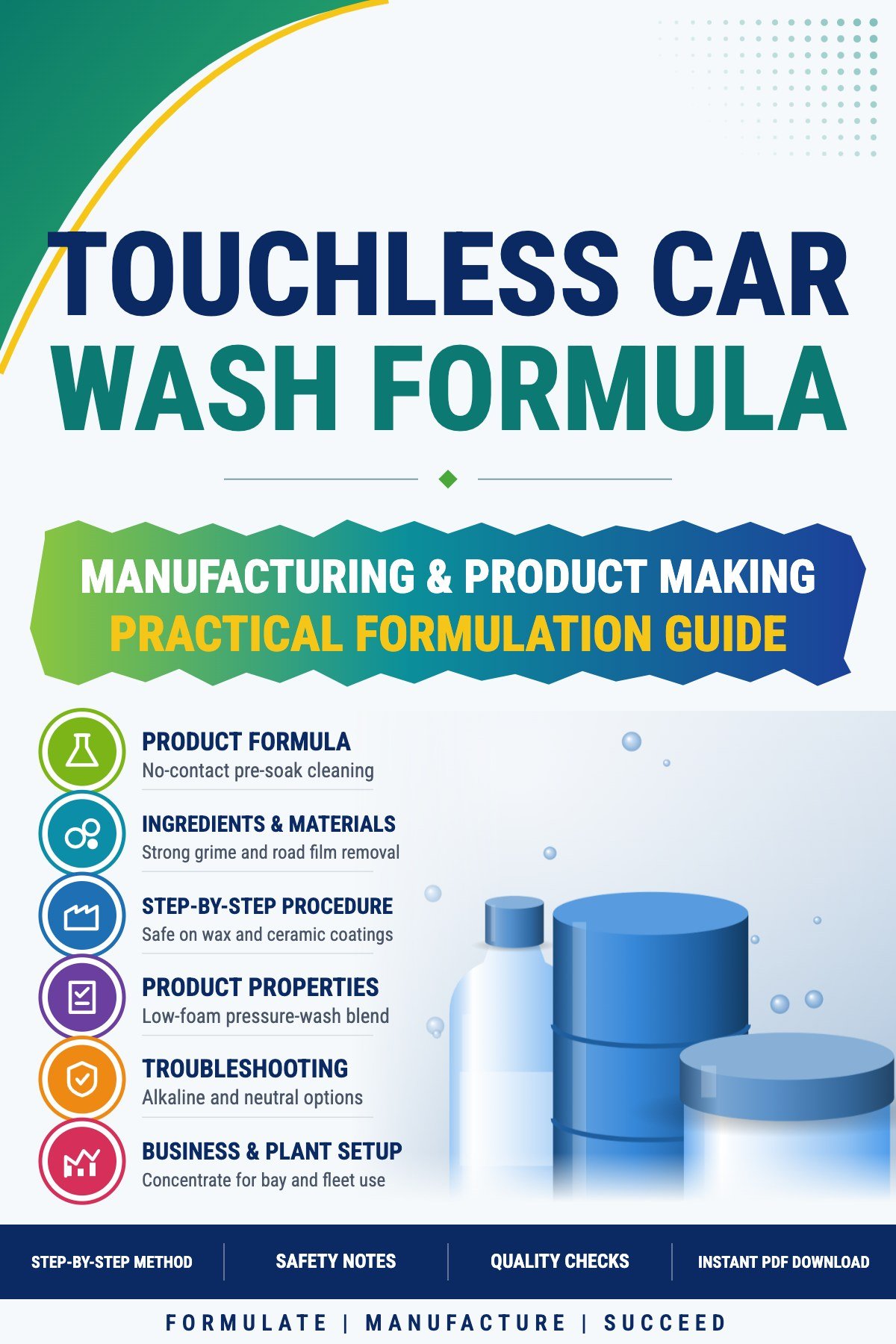

Touchless Car Wash Formula
USD $75
PDF manual · Instant downloadTouchless Car Wash Formula: a PDF guide to touchless car wash chemicals, with two-step pre-soak systems, ingredients, making, testing, safety and business tips.
Payment Methods
Refund Policy
Custom Formulation Services
Formulation Consultation
Contact Us
CFS proudly presents its Touchless Car Wash Formula, engineered for professional detailers, fleet operators and automotive care businesses seeking superior cleaning with minimal effort. A modern touchless car wash formulation delivers strong results without harsh scrubbing, protecting delicate paint, wax coatings and ceramic treatments. This practical PDF Product Making Guide is for manufacturers, startups and entrepreneurs. This page explains how touchless chemistry works, which ingredients are used, how to make, test and pack it, and how to build a car care business.
This guide is published by Chemical Formulation Services, the formulation publishing and consultancy business of CFS Formulation Services Ltd in Sheffield, United Kingdom. It is written for people who want to understand the product from the raw material to the finished pack, and it keeps its claims practical rather than promotional.
At a glance
- Product: Touchless Car Wash Formula, a digital PDF Product Making Guide.
- Also searched as: touchless car wash formulation, touchless wash soap, pre-soak, traffic film remover, automatic car wash chemicals.
- Typical system: two-step alkaline pre-soak and mildly acidic or neutral second step, with rinse aid.
- Key goals: soil release, paint safety, rinsing, and foam or no-foam control.
- Who it is for: car wash operators, detailing suppliers, fleet cleaners and entrepreneurs.
- Delivery: instant PDF download after payment is confirmed.
- Publisher: CFS Formulation Services Ltd, England and Wales company number 16678503.
How touchless washing works
In a touchless wash no brush or cloth touches the vehicle. Cleaning relies on chemistry, water pressure and time. Road dirt on a car is a layer of traffic film: oily soils, soot, brake dust, insects, salt and mineral deposits, bonded loosely to the paint through electrostatic and van der Waals forces. The chemistry must loosen that film so a high-pressure rinse sweeps it away. Because there is no mechanical scrubbing, the chemistry works harder than in a soft-touch wash, and a good touchless formula separates professional operators from poor ones.
The two-step system
Step 1: Alkaline pre-soak
An alkaline product with surfactants and builders, applied first, attacks oily soil and organic matter. Alkalinity from sodium hydroxide, potassium hydroxide, sodium metasilicate or amines, plus chelating agents and solvents, breaks the soil’s grip. Contact time of about 20 to 60 seconds is typical.
Step 2: Acidic or neutral second step
A mildly acidic detergent, often with surfactants and acids such as phosphoric or citric, neutralises alkali, removes mineral films, brake dust and water spots, and brightens wheels and trim. When the alkaline and acid products meet on the surface, the pH swing assists soil release. Some brands use a neutral second step for sensitive finishes.
Rinse aid and drying agent
A final spray of rinse aid reduces surface tension so water sheets off, shortening drying time, and a spot-free rinse using purified water prevents mineral marks.
Ingredients and their jobs
- Surfactants: non-ionic alcohol ethoxylates, amphoteric betaines and selected anionics for wetting, emulsifying and foam control.
- Alkaline builders: caustic soda or potash, silicates, carbonates and amine alkalis.
- Chelating agents: EDTA, GLDA, MGDA or gluconates to bind calcium and magnesium and boost detergency in hard water.
- Solvents and hydrotropes: glycol ethers and sodium xylene sulfonate to dissolve oily soils and keep the concentrate clear.
- Acids: phosphoric, citric or specialist acid blends for the second step.
- Corrosion inhibitors: protect aluminium, chrome and automatic wash equipment.
- Defoamers or foam boosters: depending on the wash design.
- Colour and fragrance: to give the wash a branded identity.
Wheel, trim and underbody add-on products
Once the base wash works, add-on products raise the average sale. A wheel and tyre cleaner must remove brake dust, which contains iron particles, without damaging clear-coated alloys, so it is usually a mild acid or a neutral iron remover with a colour-change indicator that customers enjoy watching. An underbody and chassis cleaner is a stronger alkaline degreaser with solvent, used in winter regions to flush road salt. A bug and tar remover with solvent and surfactant helps in summer. A drying agent or spray wax gives water-beading and shine for the last stage of an automatic wash. Because these share the same tanks, pumps and filling lines as the main wash chemistry, they add little production complexity but lift revenue per customer.
Water quality, hardness and reclaim systems
Many commercial washes reclaim water to cut cost and discharge. Reclaimed water carries oils, surfactants and fine solids that can reduce detergent efficiency or leave odours. Formulas for reclaim systems use biodegradable surfactants that break cleanly in separators, and avoid heavy cationic or silicone ingredients that foul filters. Hardness is another variable: very hard water consumes detergent, so a stronger chelant package or a softener can rescue performance. Ask each customer for water hardness and reclaim details, and give two or three dosage options in the technical sheet.
Marketing to wash operators
Operators buy results and reliability. Offer trial drums, simple on-site tests, such as washing the same dirty van half with your chemistry and half with a competitor, and clear cost-per-wash figures. Provide a dilution chart, a troubleshooting card and a contact number. Photographs of clean vehicles, short videos and written case studies from early customers carry more weight than claims. Clear safety training for staff handling concentrates builds credibility with larger fleet buyers.
What is inside the Touchless Car Wash Formula guide
The guide is presented for professional detailers, fleet operators and automotive care businesses that want exceptional cleaning with minimal effort, using an advanced formulation that protects delicate paint, wax coatings and ceramic treatments without harsh scrubbing. It includes example formulas, manufacturing steps, dilution guidance and testing methods.
How the products are made
Alkaline pre-soak
Fill the mixing tank with soft water. Add chelating agent and stir until dissolved. Add alkali slowly with cooling, because dilution is exothermic. Add silicate, surfactants and solvent, then hydrotrope until clear. Adjust pH, add colour and fragrance, filter and pack.
Acid second step
Add water and acid carefully, then surfactants, inhibitors and hydrotrope. Add colour, check pH and filter. Use acid-resistant tanks and pumps.
Rinse aid
Blend water with low-foam non-ionic surfactant, a little polymer and preservative as needed.
Protecting paint, wax and ceramic coatings
Modern vehicles often have ceramic or polymer coatings. Very high pH or aggressive acids can degrade them. Good touchless formulas for coated cars use moderate pH, effective surfactants and chelants, and avoid strong solvents. Offer a coating-safe line with pH close to neutral, and test on painted panels and coated samples for dulling, staining and gloss loss after repeated cycles. Always avoid hydrofluoric acid and ammonium bifluoride in consumer-adjacent products, as they are extremely hazardous and can etch glass and damage vehicles.
Dilution, dosing and equipment compatibility
Touchless products are sold as concentrates, diluted at the wash through dosing pumps at ratios from 1:10 to 1:100 depending on the product. Provide dilution charts for hard and soft water. Test compatibility with typical wash equipment: seals, hoses, nozzles and metal fittings. Foam, if any, must not clog pumps or reduce rinse efficiency, so some operators prefer low-foam products.
Testing and quality control
- pH of concentrate and use dilution.
- Density and clarity.
- Cleaning performance: soiled test panels, compared against a benchmark.
- Rinsing and spotting: look for residue after drying.
- Foam height and stability.
- Material compatibility: aluminium, chrome, rubber and paint.
- Freeze-thaw and storage stability.
- Hard-water tolerance.
Troubleshooting
Cloudy or separated concentrate
Not enough hydrotrope or poor mixing order. Add hydrotrope and reorder additions.
Water spots after drying
Hard water or weak rinse aid. Use spot-free rinse water and improve the rinse aid.
Hazy film on glass
Residual surfactant or silicate. Adjust rinse step and reduce silicate.
Dull aluminium trim
Alkalinity or acid too strong. Add inhibitors and lower strength.
Poor cleaning in winter
Cold water slows soil release. Increase dose or add solvent, or extend contact time.
Safety and compliance
Alkaline pre-soaks and acid products are corrosive. Wear gloves, goggles and aprons, label correctly with hazard pictograms, and provide safety data sheets. Never mix acid and alkali concentrates in drums or send them to the same drain without dilution. Check local rules on wash water discharge, phosphate limits and biodegradability, and prefer biodegradable surfactants and phosphate-free builders where regulations require. Do not make claims such as “safe on all surfaces” without testing.
Packaging and business opportunity
Pack concentrates in 20 litre pails, 200 litre drums and 1000 litre IBCs with dosing-friendly closures, and retail sizes for enthusiasts. Customers include self-service and automatic car wash sites, fleet depots, bus and truck washes, dealerships and mobile detailers. Offer a complete system: pre-soak, second step, wax, rinse aid and wheel cleaner, supported by dilution charts and technical support. Recurring orders and supply contracts make this a stable business.
Build a larger range with the Auto Care Products, Cleaning Products, Detergent Formulations and Wood Polish Formulation categories, and see , , , , and Power Steering Fluid Formula.
Getting started
Begin with a pre-soak and an acid second step. Test them on dirty cars and panels, adjust pH and surfactant level, and gather feedback from wash operators. Prepare dilution charts, labels and safety data, then offer trial drums to a few local sites before scaling up.
How to get the best results from this guide
Treat the guide as a tested starting point rather than a finished factory. Begin with a small trial batch in the laboratory or on a bench, using the exact raw materials you plan to buy, and record every weight, temperature, mixing time and observation. Compare the result with the quality checks in the guide, change only one thing at a time, and keep a note of what each change did. Once a small batch is consistently good, repeat it several times, then scale up in stages, because mixing, heating and cooling behave differently in larger vessels. Keep retained samples of every batch, write simple standard operating procedures for your team, and build relationships with two suppliers for each key raw material. Finally, check the labelling, safety and product rules in the country where you will sell, and ask a qualified person to review your process. This careful, documented approach is what turns a good formulation into a reliable product and a trusted brand.
Who should buy this guide?
The guide is written for practical readers. It suits manufacturers who want to add a new product to an existing plant, startups choosing their first product, private-label brands that need to understand what they are buying, technical staff who must set specifications and train operators, and consultants and students who want a structured, plain-language reference. It is less suitable for anyone looking for a quick shortcut or a guarantee, because every formulation still needs testing with your own materials, equipment and local rules. If you are unsure whether it matches your project, send a short question through the contact page before you order, and we will tell you honestly whether it fits.
What is inside the Touchless Car Wash Formula guide
Every Product Making Guide in our shop follows the same structure so you know where to look. This guide includes the product formula, the ingredients and materials, the procedure and preparations, the industrial requirements and the technical specifications. In practice you receive:
- The formulation, written so you can follow it at the bench and scale it up.
- Ingredients and materials, with the job of each material and advice on grades and suppliers.
- The manufacturing procedure, including order of addition, mixing and preparations.
- Industrial requirements, covering equipment, space and packaging.
- Technical specifications, describing what a good finished product should look like and how it should behave.
- Troubleshooting for the faults that makers meet most often.
- Business guidance, to help you take the product from the bench to the market.
These Product Making Guides of chemical formulations and formulas are for manufacturers, startups and entrepreneurs. Every guide contains industrially tested, practical formulations. Anyone who buys a guide can make the product by following its step-by-step instructions. Raw materials vary between suppliers, so always confirm your results with a small trial batch before scaling up.
Who stands behind this guide?
Chemical Formulation Services is the trading name of CFS Formulation Services Ltd, registered in England and Wales under company number 16678503, with its office at Unit F, Winston Business Park, Churchill Way, Sheffield S35 2PS. The business was founded by George Enrick and publishes formulation manuals, technical guides and industry reports. You can check our details on the Companies House register, read about us, or contact us with any question before you order.
A written formulation cannot replace testing with your own raw materials, equipment and climate, and we say so plainly. What the guide does give you is a tested, structured starting point that can save you months of trial and error. Our terms and conditions explain what a purchase from us covers.
How to order
- Select Add to cart to keep browsing, or Buy Now to go straight to checkout.
- Pay with PayPal, Stripe, Xoom by PayPal, Payoneer, payment links for debit and credit cards, or Western Union, Ria and all money exchanges.
- If you pay through a money exchange, email your payment slip to Info@chemicalformulationservices.com. After confirmation, your instant download link is emailed to you.
- For online payments, the PDF is available as soon as the payment is confirmed.
All products are digital downloads and all payments are nonrefundable once the file is delivered, so please read the refund policy and the FAQs before you order. You can compare this guide with others in the formula shop or browse our industrial project reports.
Frequently asked questions about touchless car wash formula
What is the Touchless Car Wash Formula guide?
It is a digital PDF Product Making Guide to touchless car wash chemicals, covering pre-soaks, second-step products, rinse aids, making, testing and troubleshooting.
Why use a two-step system?
The alkaline and acid pH swing helps lift traffic film that a single product cannot remove without scrubbing.
Is it safe for ceramic coatings?
A moderate pH, coating-safe version can be formulated, but always test on coated panels first.
How is the concentrate diluted?
Usually through dosing pumps at ratios from about 1:10 to 1:100, depending on the product.
Are the products hazardous?
Alkaline and acid concentrates are corrosive, so use protective equipment and correct labelling.
How do I receive the guide?
You receive an instant PDF download after payment is confirmed. For money exchanges, email your payment slip to Info@chemicalformulationservices.com and the link is emailed after we confirm it.
Is the payment refundable?
All payments are nonrefundable because the product is an instant digital download. See the refund policy for details.
Can you help with a custom formulation?
CFS Formulation Services Ltd offers formulation and product development consultancy. Send a short brief through the Contact page.
Last reviewed: November 2026. This page is general information about a digital product. It is not a safety data sheet or professional advice, and any formulation should be tested and reviewed by a qualified person before commercial use.