
TDI Curing Agents Formula
USD $75
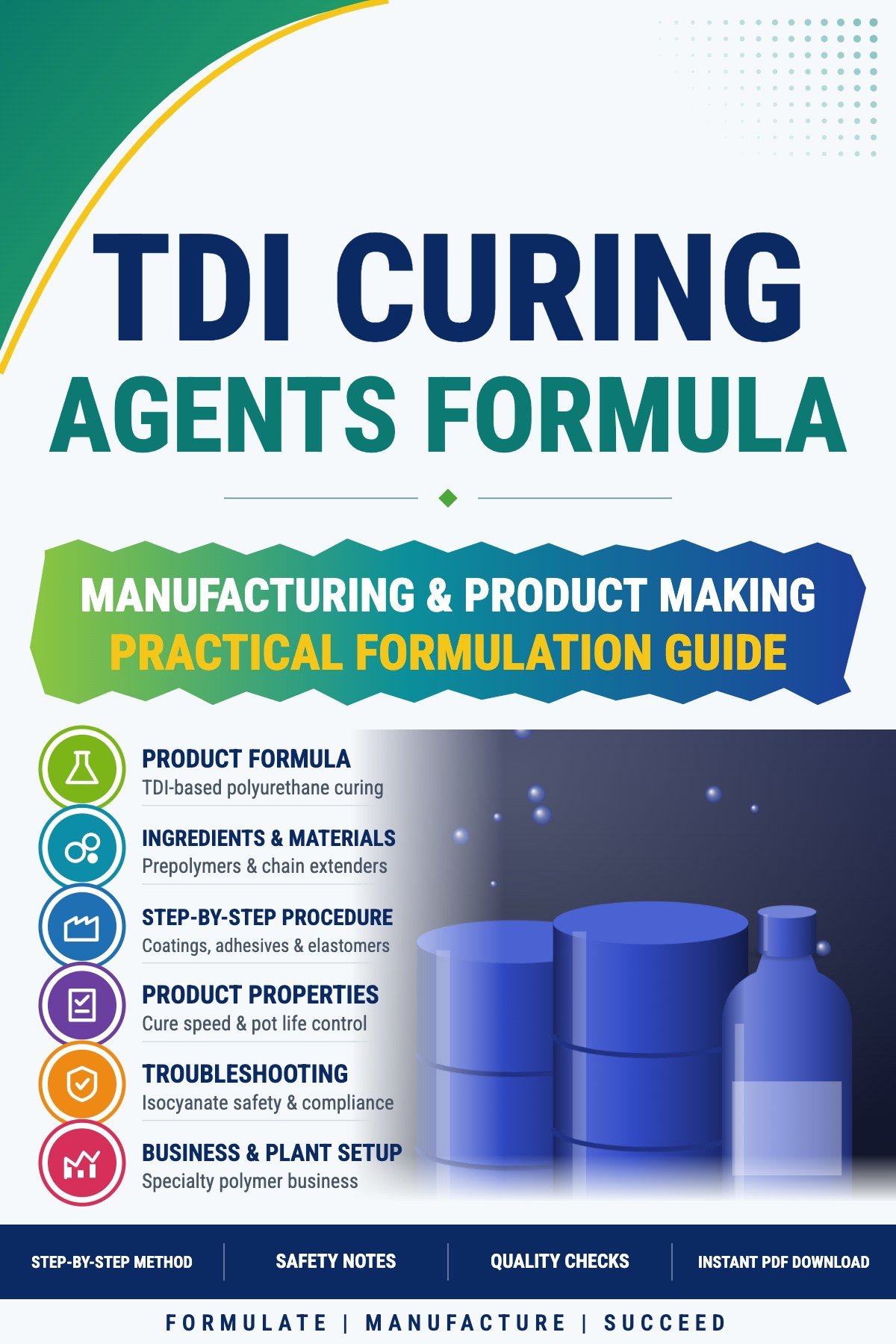
PDF manual · Instant downloadTDI Curing Agents Formula: a PDF guide to TDI-based polyurethane curing agents for coatings, adhesives and elastomers, with chemistry, formulation, testing and safety.
Payment Methods
Refund Policy
Custom Formulation Services
Formulation Consultation
Contact Us
TDI Curing Agents Formula is a practical PDF guide for polyurethane formulators, coating and adhesive manufacturers, elastomer producers and technical teams who want to understand curing systems built on toluene diisocyanate. TDI remains one of the most versatile and powerful raw materials in polyurethane chemistry, and TDI-based curing agents continue to set the standard for mechanical strength, chemical resistance and fast, controllable cure in flexible elastomers, adhesives, heat-resistant coatings and specialty hybrid polymers. This page explains how a TDI curing agents formula works, what the guide covers and how a TDI curing agents formulation is designed, made and handled, so you can decide whether it fits your operation. Because isocyanates are hazardous, safety and compliance are treated as seriously as performance.
This guide is published by Chemical Formulation Services, the formulation publishing and consultancy business of CFS Formulation Services Ltd in Sheffield, United Kingdom. It is written for people who want to understand the product from the raw material to the finished pack, and it keeps its claims practical rather than promotional.
At a glance
- Product: TDI Curing Agents Formula, a digital PDF Product Making Guide.
- Also searched as: TDI curing agents formulation, toluene diisocyanate hardener, TDI prepolymer, polyurethane curing agent.
- What it covers: TDI chemistry, prepolymers, adducts, chain extenders, catalysts, manufacturing, testing and safety.
- Key goals: controlled cure, strength, chemical resistance, stable storage and safe handling.
- Who it is for: polyurethane formulators, coating, adhesive and elastomer makers and technical teams, with proper safety systems.
- Delivery: instant PDF download after payment is confirmed.
- Publisher: CFS Formulation Services Ltd, England and Wales company number 16678503.
What a curing agent does
Polyurethane materials are formed when isocyanate groups react with hydroxyl groups, creating urethane links. In a two-component system, the polyol or resin component and the isocyanate component are kept apart until use. The isocyanate side acts as the hardener or curing agent. When the two are mixed, the reaction builds a cross-linked polymer network, and the material changes from a liquid to a tough solid. The properties of the finished polymer, including hardness, flexibility, abrasion resistance, chemical resistance and heat resistance, depend on both sides, but the curing agent has a major influence on reactivity, pot life and cross-link density.
Why TDI
Toluene diisocyanate is an aromatic diisocyanate supplied mainly as an 80:20 or 65:35 mixture of the 2,4 and 2,6 isomers, or as pure 2,4-TDI. It is highly reactive, which gives fast cure and strong final properties, and it is economical compared with many alternatives. These qualities have made TDI-based systems a mainstay in flexible foams, cast and sprayed elastomers, adhesives, sealants, primers and industrial coatings. Aromatic isocyanates such as TDI tend to yellow and chalk on outdoor exposure, so they are most common indoors, under topcoats or in applications where colour stability is not critical. Light-stable aliphatic isocyanates fill the outdoor role.
The role of free monomer and why curing agents are modified
Pure TDI is volatile and toxic, with a significant vapour hazard. For this reason, most commercial TDI curing agents are not supplied as free monomer. They are modified into adducts, prepolymers or other derivatives in which TDI has been reacted with polyols or other compounds so that most of the monomer is consumed. These derivatives have lower vapour pressure, better handling safety, controlled viscosity and reactivity, and improved compatibility. Reducing residual free TDI to very low levels is a central aim of modern curing agent design, and regulations increasingly demand it.
Types of TDI-based curing agents
TDI-trimethylolpropane adducts
The reaction of TDI with a triol such as trimethylolpropane produces a multifunctional adduct, widely used as a hardener in coatings, inks and adhesives. It provides fast cure, hardness and good adhesion.
TDI prepolymers
Reacting excess TDI with long-chain polyols such as polyether or polyester diols or triols gives isocyanate-terminated prepolymers. These are used in elastomers, sealants and adhesives, and they give flexibility and elasticity depending on the polyol.
Low-free-monomer prepolymers
Special processing, including distillation or thin-film evaporation to remove unreacted TDI, produces prepolymers with very low free TDI, valued for safety and for use with certain curing partners.
TDI trimers and isocyanurates
Trimerised TDI forms a highly cross-linked ring structure that delivers excellent heat and chemical resistance and is used in some coatings and adhesives.
Blocked TDI
Blocked isocyanates are TDI derivatives whose reactive groups are temporarily capped. They stay inert until heated, at which point the blocking agent is released and cure begins. They are used in one-component baking systems, wire enamels and powder coatings.
Hybrid and specialty curing systems
TDI-based hardeners may be combined with other chemistries, such as moisture-cure, epoxy hybrids and silane-modified polymers, to create specialty systems.
Curing partners and chain extenders
The other half of the system matters equally. Polyols with different molecular weights and functionalities give anything from rigid to flexible polymers. For elastomers, aromatic diamines such as MOCA or less hazardous alternatives such as certain diethyltoluenediamine and methylene bis ortho-chloroaniline replacements are widely used as chain extenders with TDI prepolymers, producing tough, high-performance polyurethane-urea elastomers. Short-chain diols, such as 1,4-butanediol, act as chain extenders in other systems. The guide explains how curing agent and partner are balanced using the NCO to OH ratio.
Main components of a formulation
- TDI or TDI derivative: the reactive isocyanate component.
- Polyols: polyether, polyester or polycaprolactone polyols for backbone properties.
- Chain extenders and cross-linkers: diols, triols and diamines to build hardness and strength.
- Solvents (for coatings and adhesives): dry, urethane-grade solvents free of water and alcohols.
- Catalysts: organotin or amine catalysts to adjust cure speed and pot life.
- Stabilisers: acid stabilisers and antioxidants for storage stability.
- Moisture scavengers: protect the system from water, which reacts with isocyanate and generates carbon dioxide.
- Fillers, pigments and additives: dried carefully before use.
What is inside the TDI Curing Agents Formula guide
The guide is a technical formulation data sheet that explains TDI-based curing systems for coatings, adhesives and elastomers. It covers the chemistry, types of curing agents, formulation approaches, step-by-step preparation methods, quality control, application guidance, troubleshooting, and the safety and regulatory framework that goes with isocyanate chemistry. It follows the CFS style of clear, industrially minded instructions, written for qualified technical teams.
How a TDI-based curing agent is prepared
The outline below shows the general sequence. The guide gives full details, which should be carried out only in facilities designed for isocyanates.
Step 1: Prepare dry reactors and raw materials
Reactors, lines and containers are cleaned and thoroughly dried. Polyols and solvents are dried to very low moisture levels, because water consumes isocyanate and forms urea and gas.
Step 2: Charge TDI under nitrogen
TDI is charged to the reactor under a dry nitrogen blanket, with temperature control and vapour containment.
Step 3: Add polyol or triol gradually
The polyol is fed slowly, with stirring and cooling, because the reaction is exothermic. Temperature is held within the specified range to prevent side reactions.
Step 4: React to target NCO content
The reaction is continued until the isocyanate content reaches the target, measured by titration. Reaction time and temperature determine the structure and viscosity.
Step 5: Reduce free monomer, if required
For low-free-TDI products, unreacted monomer is removed by thin-film evaporation or another suitable method, with proper capture and handling of the recovered monomer.
Step 6: Dilute, stabilise and filter
The product is diluted with dry solvent if needed, stabilised, filtered and sampled for testing.
Step 7: Pack under dry conditions
The curing agent is packed in dry, sealed containers under nitrogen, labelled with hazard information, NCO content, batch and shelf life.
Equipment requirements
An isocyanate plant requires sealed reactors with jacketed temperature control, nitrogen supply, scrubbers or vapour containment, accurate metering, filtration, dry packaging lines and a laboratory with NCO titration, viscosity and moisture analysis, plus free monomer analysis by chromatography where required. Spill containment, gas monitoring, emergency showers and respiratory protection are essential. Many smaller companies purchase ready-made TDI derivatives and formulate with them instead of reacting TDI themselves, which is often wiser from a safety standpoint.
Quality control for every batch
- NCO content: by titration, the key measure of reactivity and the basis for mix ratios.
- Free TDI monomer: measured, especially for low-monomer grades.
- Viscosity and solids: to specification.
- Colour and clarity: consistent between batches.
- Moisture content: very low in raw materials and product.
- Reactivity and pot life: measured with the standard polyol partner.
- Cure and mechanical properties: hardness, tensile strength, elongation and adhesion on cured samples.
- Storage stability: monitored for viscosity rise and NCO loss.
Troubleshooting
Gelling during manufacture
Excessive temperature, contamination, moisture or wrong stoichiometry. Control temperature and charge ratios, and keep materials dry.
NCO content lower than expected
Moisture contamination or side reactions. Dry raw materials, and check storage and handling.
Bubbles and foaming in cured material
Water reacting with isocyanate releases carbon dioxide. Dry polyols, fillers and substrates, and use moisture scavengers.
Cure too fast or too slow
Adjust catalyst, temperature, or choose a more or less reactive curing agent.
Yellowing and chalking
Typical for aromatic isocyanates in light. Use aliphatic systems for outdoor clear or light-coloured coatings, or topcoat.
Poor adhesion
Dirty or damp substrate, or unsuitable primer. Improve preparation and use primers.
Viscosity increase in storage
Moisture, heat or insufficient stabiliser. Improve packaging and store cool and dry.
Safety, health and regulation
This is a hazardous area, and it demands training, engineering controls and compliance. TDI is toxic by inhalation, a respiratory sensitiser that can cause asthma, even at very low exposure, and it irritates the eyes and skin. It is suspected of causing cancer in some classifications. Workplace exposure limits are extremely low, and in many jurisdictions, use of isocyanates requires special training, risk assessment, health surveillance and approved respiratory equipment. Spraying is especially hazardous and calls for ventilated booths and supplied-air respirators. Wet the raw materials only under controlled conditions, never seal wet material in closed containers, and handle waste and spills according to hazardous waste rules. Transport is regulated as dangerous goods, and chemical registration under REACH, TSCA and similar systems applies. In some regions, additional restrictions apply to consumer and professional use of products containing free diisocyanates, including mandatory training. Obtain permits and a qualified safety review before you handle any TDI, and consider buying low-free-monomer derivatives instead of reacting TDI yourself.
The business opportunity
Polyurethane is everywhere, in flooring, wheels, rollers, seals, mining screens, shoe soles, wood and metal coatings, adhesives, sealants and insulation. Formulators who understand curing agents can supply tailored hardeners, prepolymers and complete two-pack systems to industrial customers. Specialty markets such as roller covering, wheel casting, cable potting and flexible packaging adhesives value technical support, consistent NCO content and quick service. A realistic start is to formulate with purchased TDI derivatives, build a solid testing laboratory and focus on one or two applications where you can offer clear benefits.
Related CFS guides explain connected chemistry. Browse the Resin Manufacturing category for resin chemistry, Industrial Adhesive Formulations for adhesives, and Rubber Goods Making and Plastics Products for elastomers and plastics. See Solvent-Based PU Top Coat Formulation for a polyurethane top coat, CR Rubber Additives Formulation for another elastomer system and Artificial Grass Adhesive Formula for polyurethane adhesives in use.
Getting started
Begin with learning and compliance: complete isocyanate safety training, set up suitable ventilation and monitoring and register your materials. Start in the laboratory with purchased low-monomer curing agents and polyols, mix small samples, measure pot life, cure and properties, and build knowledge. Develop one application, validate it with customers and only then consider scaling or more advanced manufacturing steps.
How to get the best results from this guide
Treat the guide as a tested starting point rather than a finished factory. Begin with a small trial batch in the laboratory or on a bench, using the exact raw materials you plan to buy, and record every weight, temperature, mixing time and observation. Compare the result with the quality checks in the guide, change only one thing at a time, and keep a note of what each change did. Once a small batch is consistently good, repeat it several times, then scale up in stages, because mixing, heating and cooling behave differently in larger vessels. Keep retained samples of every batch, write simple standard operating procedures for your team, and build relationships with two suppliers for each key raw material. Finally, check the labelling, safety and product rules in the country where you will sell, and ask a qualified person to review your process. This careful, documented approach is what turns a good formulation into a reliable product and a trusted brand.
Who should buy this guide?
The guide is written for practical readers. It suits manufacturers who want to add a new product to an existing plant, startups choosing their first product, private-label brands that need to understand what they are buying, technical staff who must set specifications and train operators, and consultants and students who want a structured, plain-language reference. It is less suitable for anyone looking for a quick shortcut or a guarantee, because every formulation still needs testing with your own materials, equipment and local rules. If you are unsure whether it matches your project, send a short question through the contact page before you order, and we will tell you honestly whether it fits.
What is inside the TDI Curing Agents Formula guide
Every Product Making Guide in our shop follows the same structure so you know where to look. This guide includes the product formula, the ingredients and materials, the procedure and preparations, the industrial requirements and the technical specifications. In practice you receive:
- The formulation, written so you can follow it at the bench and scale it up.
- Ingredients and materials, with the job of each material and advice on grades and suppliers.
- The manufacturing procedure, including order of addition, mixing and preparations.
- Industrial requirements, covering equipment, space and packaging.
- Technical specifications, describing what a good finished product should look like and how it should behave.
- Troubleshooting for the faults that makers meet most often.
- Business guidance, to help you take the product from the bench to the market.
These Product Making Guides of chemical formulations and formulas are for manufacturers, startups and entrepreneurs. Every guide contains industrially tested, practical formulations. Anyone who buys a guide can make the product by following its step-by-step instructions. Raw materials vary between suppliers, so always confirm your results with a small trial batch before scaling up.
Who stands behind this guide?
Chemical Formulation Services is the trading name of CFS Formulation Services Ltd, registered in England and Wales under company number 16678503, with its office at Unit F, Winston Business Park, Churchill Way, Sheffield S35 2PS. The business was founded by George Enrick and publishes formulation manuals, technical guides and industry reports. You can check our details on the Companies House register, read about us, or contact us with any question before you order.
A written formulation cannot replace testing with your own raw materials, equipment and climate, and we say so plainly. What the guide does give you is a tested, structured starting point that can save you months of trial and error. Our terms and conditions explain what a purchase from us covers.
How to order
- Select Add to cart to keep browsing, or Buy Now to go straight to checkout.
- Pay with PayPal, Stripe, Xoom by PayPal, Payoneer, payment links for debit and credit cards, or Western Union, Ria and all money exchanges.
- If you pay through a money exchange, email your payment slip to Info@chemicalformulationservices.com. After confirmation, your instant download link is emailed to you.
- For online payments, the PDF is available as soon as the payment is confirmed.
All products are digital downloads and all payments are nonrefundable once the file is delivered, so please read the refund policy and the FAQs before you order. You can compare this guide with others in the formula shop or browse our industrial project reports.
Frequently asked questions about tdi curing agents formula
What is the TDI Curing Agents Formula guide?
It is a digital PDF Product Making Guide explaining TDI-based curing agents for polyurethane coatings, adhesives and elastomers, covering chemistry, formulation, preparation, testing and safety.
Why are TDI curing agents usually modified?
Free TDI is volatile and toxic, so it is reacted into adducts or prepolymers with very low free monomer for safer handling and controlled reactivity.
Why do TDI-based coatings yellow outdoors?
TDI is aromatic and yellows and chalks in sunlight, so aliphatic isocyanates are preferred for outdoor clear and light-coloured coatings.
What causes bubbles in polyurethane?
Water reacts with isocyanate to release carbon dioxide, so polyols, fillers and substrates must be dry and moisture scavengers can help.
Is TDI hazardous?
Yes. It is a respiratory sensitiser and toxic by inhalation, so it requires training, engineering controls, protective equipment and regulatory compliance.
How do I receive the guide?
You receive an instant PDF download after payment is confirmed. For money exchanges, email your payment slip to Info@chemicalformulationservices.com and the link is emailed after we confirm it.
Is the payment refundable?
All payments are nonrefundable because the product is an instant digital download. See the refund policy for details.
Can you help with a custom formulation?
CFS Formulation Services Ltd offers formulation and product development consultancy. Send a short brief through the Contact page.
Last reviewed: November 2026. This page is general information about a digital product. It is not a safety data sheet or professional advice, and any formulation should be tested and reviewed by a qualified person before commercial use.