
Car Ceramic Spray Sealant Formula
USD $85
PDF manual · Instant downloadCar Ceramic Spray Sealant Formula: a step-by-step PDF guide to making a silica-based ceramic spray sealant, with materials, process, quality control, troubleshooting and safety notes.
Payment Methods
Refund Policy
Custom Formulation Services
Formulation Consultation
Contact Us
A Car Ceramic Spray Sealant Formula is the recipe behind one of the fastest-growing products in auto care: a spray-on, wipe-off protective layer that leaves paint glossy, slick and water-repellent. This guide gives you a complete car ceramic spray sealant formulation in practical form, so a manufacturer, a startup or a detailing entrepreneur can move from raw materials to a filled trigger bottle with a clear method in front of them.
This page explains what a ceramic spray sealant is, how it works on a car’s paint, which families of raw materials are involved, how the manufacturing process is organised, how to test and troubleshoot a batch, and what you need to know about safety, labelling and honest product claims. It is written by the team at Chemical Formulation Services, the publishing and consultancy business of CFS Formulation Services Ltd in Sheffield, United Kingdom, to help you decide whether this guide fits your plans.
Quick facts about this guide
- Product: Car Ceramic Spray Sealant Formula, a digital PDF Product Making Guide.
- Also searched as: car ceramic spray sealant formulation, SiO2 spray sealant formula, ceramic spray wax, ceramic detailer spray.
- What it makes: a ready-to-use trigger-spray sealant for car paint, glass, plastics and metal trim.
- Who it is for: manufacturers, startups and entrepreneurs entering the auto care market.
- Typical properties listed in the guide: low-to-medium viscosity, touch-dry in 10 to 30 minutes, full cure in 24 to 48 hours at room temperature, shelf life of 12 to 24 months when stored properly.
- Delivery: instant download once payment is confirmed. For money exchanges, your link is emailed after we confirm your payment slip.
- Publisher: CFS Formulation Services Ltd, England and Wales company number 16678503.
What is a car ceramic spray sealant?
A ceramic spray sealant is a liquid you spray onto a clean vehicle, spread with a microfibre cloth and buff to a shine. It leaves a thin, invisible film that makes the surface smoother and more water-repellent. Car owners use it as a quick top-up after washing, and professional detailers use it as a maintenance layer over a longer-lasting coating. In the market it competes with traditional waxes, polymer paint sealants and the harder, professionally applied ceramic coatings.
The word “ceramic” in this context refers to silicon-based chemistry. Most spray sealants rely on silicon dioxide (silica, SiO2) chemistry, built from silane or siloxane building blocks that cure into a glass-like network, often combined with polymers and functional silicones that add slickness and gloss. Descriptions of these products sometimes also mention other ceramic particles such as silicon carbide. What the buyer sees and feels is simple: water beads and rolls off, dirt does not cling as hard, and the paint feels slippery.
It is important to be clear about what a spray sealant is not. It is a thinner, easier layer than a full ceramic coating, and its durability is measured in months of maintenance protection, not years. That honesty matters for your business as well: products that promise more than they can deliver generate returns and bad reviews, while a well-tuned spray sealant that does what it says earns repeat customers.
How a ceramic spray sealant works on paint
Lower surface energy and water beading
Clear coat on a car is a polymer with a relatively high surface energy, so water spreads across it. A sealant film lowers that surface energy. Water forms rounded beads with a high contact angle and runs off easily, carrying loose dirt with it. This is the hydrophobic effect that customers describe as beading and sheeting.
Cure and bonding
Silane and siloxane ingredients react with moisture and with each other as the film dries, forming a cross-linked Si–O–Si network. Some of these molecules can also bond to hydroxyl groups on the paint, glass or plastic surface. The result is a film that stays put through normal washing for a while instead of rinsing off immediately. The guide lists typical touch-dry and full cure times so you can set directions for your customers.
Slickness, gloss and cleaning ease
Functional silicones and polymers in the formula create the slick feel and the deep gloss. A smoother surface also reduces the friction of a wash mitt, which is one reason these products are marketed for reducing wash marring. They help dirt release more easily, but they do not make a car self-cleaning, and responsible claims should say so.
The raw material families behind the formula
A formulation guide has to name materials and proportions. On a public page, the helpful thing is to explain the families of ingredients and what each one is for, so you can judge whether you can source and handle them. The exact materials, percentages and order of addition are in the guide.
- Silane and siloxane precursors. These are the cure chemistry. They are the main reason a spray sealant bonds and forms a durable film. They are sensitive to moisture, which affects how you store and handle them.
- Silica (SiO2) dispersions or nanoparticles. Some formulas include colloidal silica to add hardness and a glassy feel. Particle size and stability in the carrier matter a great deal.
- Functional silicone fluids and polymers. These deliver slickness, gloss and water-repellency, and they influence how easily the product spreads and buffs off.
- Carrier solvent or water phase. Spray sealants may be solvent-based, water-based or a hybrid. The carrier controls evaporation, flash time and flammability, and it decides whether you need emulsifiers.
- Surfactants and emulsifiers. Used in water-based or emulsified versions to keep the oily and watery phases together and to help the product wet the surface evenly.
- Additives. Light stabilisers, gloss enhancers, anti-streaking agents, fragrance and a preservative in water-based versions all fine-tune the finished product.
If you want to see how these ideas apply to related products, compare this guide with our Ceramic 3-in-1 Polish & Coat Formula, the 9H 10H Car Ceramics Coating Formulations, the TiO2 Based Car Coating Formula and the Car Glass Coating Hydrophobic Formula. Each is a different product with its own chemistry, but together they map out the surface-protection range.
Typical properties of the finished sealant
The guide lists the properties a finished car ceramic spray sealant is expected to have. They are typical values to aim for and to check against your own batches, not guarantees for every raw material combination.
| Property | Typical target |
|---|---|
| Viscosity | Low to medium, easy to spray and wipe |
| Touch-dry time | About 10 to 30 minutes |
| Full cure | About 24 to 48 hours at room temperature |
| Adhesion | Strong adhesion to car paint surfaces |
| Chemical resistance | Good resistance to water, oils and most solvents |
| Hydrophobicity | High water-beading effect |
| Shelf life | 12 to 24 months when stored properly |
Treat claims about temperature resistance or scratch resistance with care. They depend on the film thickness, the surface underneath and how the product is used, and any statement on your label should be backed by your own testing.
What you get in the Car Ceramic Spray Sealant Formula guide
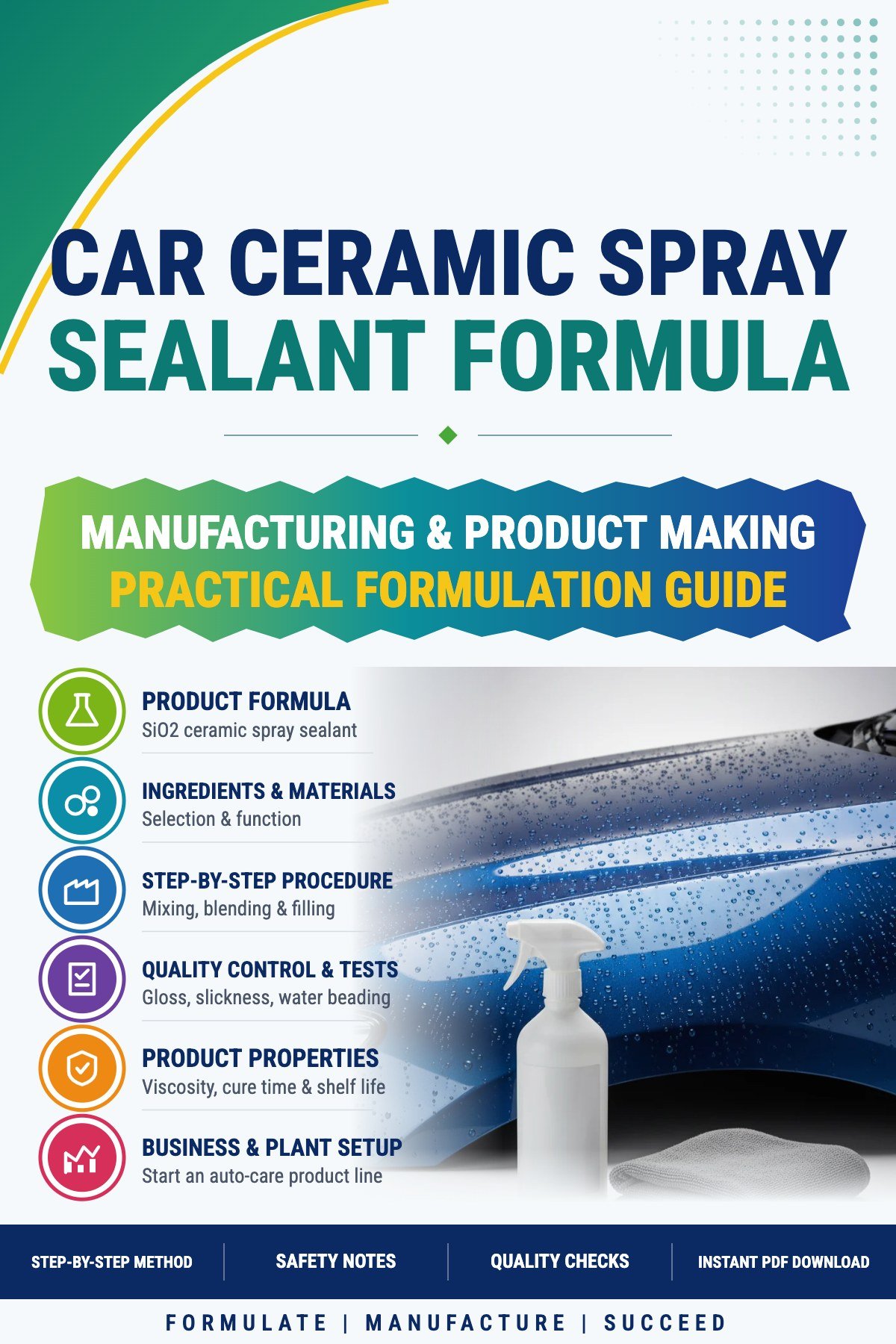
Every Product Making Guide in our shop follows a consistent structure. The guide’s cover lists the product formula, the ingredients and materials, the procedure and preparations, the industrial requirements and the technical specifications. In practice you receive:
- The formulation, written so you can follow it at the bench.
- Ingredients and materials, explaining what each material does and how to choose a supplier.
- Procedure and preparations, setting out the manufacturing steps in order.
- Industrial requirements, covering equipment, space and supplies.
- Technical specifications and properties, so you know what the finished product should achieve.
- A business overview for entering the car ceramic spray sealant market, from raw material sourcing to finished product.
These Product Making Guides of chemical formulations and formulas are for manufacturers, startups and entrepreneurs. Every guide contains industrially tested, practical formulations. Anyone who buys a guide can make the product by following its step-by-step instructions. As always, treat the formula as a starting point: raw materials differ between suppliers, so confirm performance with a trial batch before you scale up.
How a ceramic spray sealant is manufactured
The full method is in the guide, but the shape of the process is worth understanding before you buy, because it shows what skills and equipment you will need.
1. Raw material receipt and storage
Silane and siloxane materials react with moisture, so containers must be kept tightly closed and dry. Record batch numbers, check the safety data sheet and store solvents and reactive materials in the right conditions from the start.
2. Pre-mixing the carrier and additives
The carrier solvent or water phase is charged first, together with any surfactant or stabiliser. In water-based versions the order of addition and temperature matter, because the emulsion has to be stable.
3. Adding the active ingredients
The silane, siloxane, polymer and silica components are added in the sequence specified, under low-shear mixing. Excessive shear traps air and can destabilise dispersions. Many formulas call for a defined mixing time to allow the components to blend or begin to react before filling.
4. Adjusting and finishing
Fragrance, colour and any final additives are added, and the batch is checked for appearance, viscosity and, where relevant, pH.
5. Filtration, filling and packing
The batch is filtered to remove particles that would clog a trigger sprayer, then filled into bottles, sealed and labelled. Compatibility between the formula and the bottle and sprayer materials should be confirmed, because some solvents attack certain plastics and seals.
Equipment and industrial requirements
A ceramic spray sealant can be produced in a modest facility. Typical requirements are accurate scales, closed mixing vessels made of materials compatible with the formula, a low-shear mixer, a filtration stage, a bottle-filling set-up, a capping and labelling area and a ventilated, tidy production space. If your formula uses flammable solvents, you also need suitable explosion-proof equipment, earthing and storage. Moisture control and clean, dry vessels are especially important with silane chemistry.
Many manufacturers add this product to an existing car care range. If you are planning one, see our Touchless Car Wash Formula, Snow Foam Color Car Wash Formula, Car Luster Shampoo Formula, Colored Active Foam Cleaners Formulation and Wheel and Tire Cleaner Spray Formula. A sealant sells best as part of a wash, protect and maintain routine.
Quality control: how to judge a good batch
- Appearance. The liquid should be clear or uniformly milky as designed, free of particles, gel lumps or separation.
- Viscosity and spray pattern. Check that the product sprays in a fine, even pattern and does not drip or clog.
- pH (water-based versions). Confirm pH is within the range your specification sets.
- Water beading test. Apply to a test panel, allow the stated cure, then compare water beading and sheeting against a reference batch.
- Slickness and gloss. Judge the feel under a gloved finger or cloth and compare gloss on a dark panel.
- Ease of application. Test spreading, flash time and buffing. Streaks and high spots are the most common customer complaints.
- Compatibility. Test on paint, glass, plastic trim and metal to confirm there is no staining or hazing.
- Stability. Keep retention samples and test at different temperatures, so you know how the product behaves in storage and in a hot or cold warehouse.
Good record keeping makes everything easier. When a customer reports a problem, a batch number tied to your test results lets you find the cause quickly.
Directions for your customers
A sealant is only as good as its preparation and application, and clear directions on the bottle reduce complaints. The usual advice is to wash and dry the vehicle, remove embedded contamination if needed, wipe the surface to remove oils or old protection, spray a small amount onto a microfibre cloth or the panel, spread it evenly, and buff off any excess with a second clean cloth. Work one section at a time, avoid direct sunlight and hot panels, and keep the treated surface away from water and harsh chemicals until it has cured. Always recommend a small test area first.
Troubleshooting ceramic spray sealant production and use
Streaking or high spots
This usually comes from over-application, application on a hot panel or insufficient buffing. In production, check that the solvent balance and flash time suit the climate where the product will be used.
Poor water beading
Weak beading can come from a contaminated surface, a low level of active ingredient or a formula that did not cure properly. Test against a reference batch and review the mixing and moisture control steps.
Short durability
If protection fades quickly, review the cure conditions, the film thickness the directions encourage and the level of cross-linking chemistry in the formula. Customer washing habits also matter.
Hazing or smearing
Hazing points to too heavy a layer, a surface not properly prepared or incompatible additives. Adjust the directions and the formula, and test on different paint colours.
Gelling or thickening in the bottle
Silane-based products can gel if moisture gets in or if the formula is out of balance. Check raw material dryness, closure quality and shelf-life stability testing.
Separation or cloudiness
In emulsified versions, separation signals an unstable emulsion. Review the emulsifier, the mixing order and the temperature at which you blend.
Sprayer clogging or leaking
Filter the batch, choose a sprayer designed for the solvent system and test full bottles over time.
Safety, labelling and honest claims
Some ingredients in ceramic spray sealants are flammable, some are irritating to skin or eyes and some release alcohol or other vapours as they cure. Read the safety data sheet for every raw material, provide adequate ventilation, wear suitable gloves and eye protection and store flammable materials correctly. Label the finished product in line with the rules where you sell, which typically means hazard labelling, batch codes, contents and contact details, and check any limits on volatile organic compounds in your market.
Claims deserve the same care as chemistry. Avoid promising permanent protection, scratch-proof paint or specific hardness ratings unless you can support them with testing. Customers value a manufacturer who says what the product does, how long it typically lasts and how to apply it. You remain responsible for meeting the safety, labelling and regulatory rules where you manufacture and sell, and a qualified person should review your process before production begins. Our terms and conditions explain what a purchase from us covers.
The market opportunity
Demand for easy-to-use, long-lasting car care products continues to grow, driven by car owners who want a professional look without a professional price, mobile detailers, car wash operators and retailers who need reliable private-label products. A ceramic spray sealant is attractive because it is a low-volume, higher-value product that is quick to apply, repeat-purchased and easy to ship.
New manufacturers usually succeed by focusing on consistency, clear directions and a good bottle and sprayer, and by building a small range around the sealant. Related protection products such as a car wet coat, a colour restorer and polish and a tyre coating make natural additions. To explore the full group of products, browse the auto care products category and the coating formulations category.
If you are still evaluating which project to start with, our industrial project reports cover raw materials, plant set-up, costing and the business case for a range of chemical products.
Who is behind this guide?
Chemical Formulation Services is the trading name of CFS Formulation Services Ltd, a company registered in England and Wales under company number 16678503, with its registered office at Unit F, Winston Business Park, Churchill Way, Sheffield S35 2PS. The business was founded by George Enrick, a chemist and entrepreneur, and publishes formulation manuals, technical guides and industry reports for people who make chemical products. You can verify the company on the Companies House register, read more about us, or contact the team before you buy.
We try to be plain about what a guide can and cannot do. A written formulation cannot replace testing with your own raw materials, equipment and climate. What it can do is save you months of trial and error by giving you a tested starting point and a clear method.
How to buy and what happens next
- Choose Add to cart if you want to keep browsing, or Buy Now to go straight to checkout.
- Pay with PayPal, Stripe, Xoom by PayPal, Payoneer, a payment link for your debit or credit card, or Western Union, Ria and all money exchanges.
- For money exchanges, email your payment slip to Info@chemicalformulationservices.com. Once we confirm it, your instant download link is emailed to you.
- Online payments unlock the PDF download as soon as payment is confirmed.
Because every product is a digital download, refunds are not available once the file has been downloaded. Please read the refund policy and our FAQs before you order. If you are unsure whether this guide suits you, ask us first, or explore the full formula shop to compare it with other car care guides.
Frequently asked questions about car ceramic spray sealant formula
What is the Car Ceramic Spray Sealant Formula guide?
It is a digital PDF Product Making Guide that explains how to formulate and manufacture a car ceramic spray sealant, including materials, procedure, properties and the business opportunity.
Is a ceramic spray sealant the same as a ceramic coating?
No. A spray sealant is a thinner, easier-to-apply maintenance layer, while a ceramic coating is typically applied more carefully and is designed to last longer. Many people use a spray sealant on top of a coating to refresh it.
What chemistry does the formula use?
Spray sealants of this type are based on silicon chemistry, with silane or siloxane building blocks that cure into a silica-like network, combined with polymers or functional silicones for slickness and gloss.
Do I need a laboratory to follow it?
You need accurate scales, suitable closed mixing vessels, good ventilation and basic testing capability. You do not need a research laboratory, but you should run small trial batches before production.
How long does the sealant take to cure and how long does it last?
The guide lists a typical touch-dry time of 10 to 30 minutes and a full cure of 24 to 48 hours at room temperature. Real-world durability depends on preparation, application and washing habits, so test and state it honestly.
What is the shelf life of the finished product?
The guide lists a shelf life of 12 to 24 months when the product is stored properly in closed containers.
How do I receive the guide?
You get an instant PDF download once your payment is confirmed. If you pay by Western Union, Ria or another money exchange, email your payment slip to Info@chemicalformulationservices.com and your download link is emailed after we confirm it.
Can I get a refund?
Refunds are not available once the file has been downloaded, because it is a digital product. Technical access problems are always helped, and duplicate purchases can be reviewed within seven days. See the refund policy.
Do you offer help with custom formulations?
Yes. CFS Formulation Services Ltd offers technical consultancy on formulation and product development. Send a short brief through the Contact page.
Last reviewed: November 2026. This page is general information about a digital product. It is not a safety data sheet or professional advice, and the formulation should be tested and reviewed by a qualified person before commercial use.