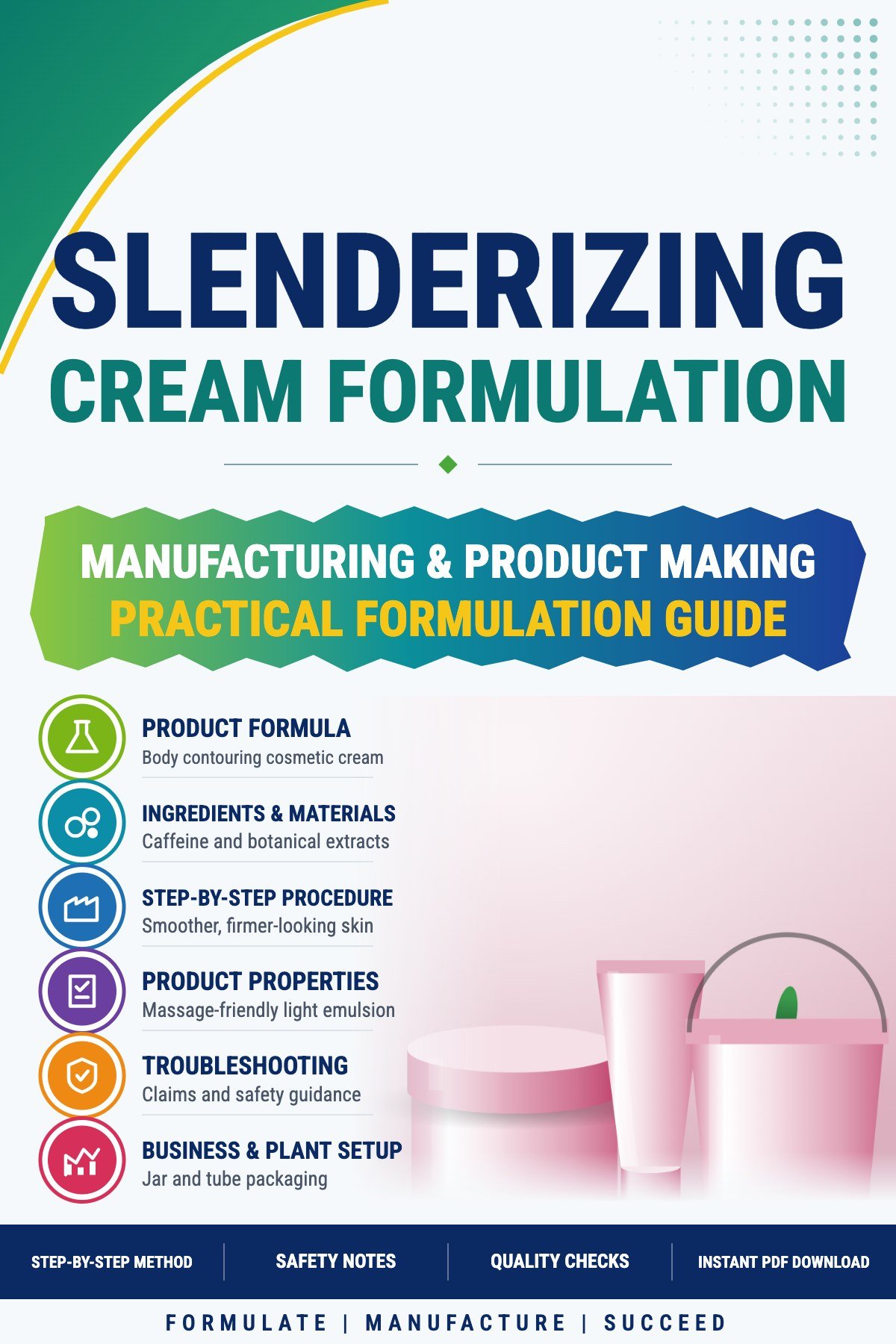
Slenderizing Cream Formulation
USD $60
PDF manual · Instant downloadSlenderizing Cream Formulation: a PDF guide to cosmetic body contouring creams, with caffeine and botanical actives, base emulsion, making, testing and compliant claims.
Payment Methods
Refund Policy
Custom Formulation Services
Formulation Consultation
Contact Us
Slenderizing Cream Formulation describes a topical cosmetic product marketed to improve the look of cellulite, firm the skin and promote a smoother, more toned appearance. Slenderizing creams typically combine ingredients that are believed to support the appearance of the skin. This practical PDF guide is for cosmetic manufacturers, private-label brands, startups and entrepreneurs. This page explains how a slenderizing cream formula is built, which ingredients are used and what they can realistically do, how the cream is made and tested, and how to write honest, compliant claims.
This guide is published by Chemical Formulation Services, the formulation publishing and consultancy business of CFS Formulation Services Ltd in Sheffield, United Kingdom. It is written for people who want to understand the product from the raw material to the finished pack, and it keeps its claims practical rather than promotional.
At a glance
- Product: Slenderizing Cream Formulation, a digital PDF Product Making Guide.
- Also searched as: slenderizing cream formula, body contouring cream, anti-cellulite cream, firming body cream, toning body lotion.
- Base: light oil-in-water emulsion or gel-cream for massage.
- Key goals: smooth skin feel, hydration, comfortable massage glide and compliant claims.
- Who it is for: cosmetic start-ups, spa and salon suppliers, private-label brands and entrepreneurs.
- Delivery: instant PDF download after payment is confirmed.
- Publisher: CFS Formulation Services Ltd, England and Wales company number 16678503.
An honest starting point
A cosmetic cream cannot remove body fat, change body shape or cure cellulite. Cellulite is a structural feature of the skin and underlying connective tissue, influenced by genetics, hormones and body composition, and it cannot be eliminated by a topical product. What a well-made cream can do is hydrate the skin, improve its smoothness and softness, make it look firmer and more even for a time, support massage routines that improve circulation, and give the user a pleasant daily ritual. Selling the product on this honest basis protects customers and protects your business from regulators and complaints.
Typical active and functional ingredients
Caffeine
A widely used ingredient in body contouring products. Applied to skin, it is thought to act as a mild stimulant and to temporarily tighten and de-puff the surface. Effects are modest and short-lived.
Botanical extracts
Green tea, ivy, horse chestnut, centella (gotu kola), ginkgo, seaweed and algae extracts, ginger and cayenne-derived warming agents are common, marketed for toning, circulation support and skin smoothing. Their evidence varies, and strong warming agents can irritate.
Humectants and moisturisers
Glycerin, hyaluronic acid, panthenol and urea hydrate the skin and improve apparent smoothness.
Firming and conditioning agents
Peptides, retinol-type compounds at permitted levels, vitamin C derivatives and film-forming polymers that create a temporary tightening feel.
Cooling or warming sensory agents
Menthol or capsicum-type extracts can create sensations that users associate with activity, but must be used at safe, regulated levels.
The base formulation
- Water phase: deionised water, glycerin, humectants and water-soluble actives.
- Oil phase: light emollients, such as caprylic triglyceride, sweet almond oil or esters, for glide during massage.
- Emulsifier: a stable non-ionic system with fatty alcohol.
- Gelling polymer: carbomer or natural gum for gel-cream textures.
- Preservative system and chelating agent.
- pH adjuster and fragrance.
Body-care routines that support a slenderizing cream
Customers get the best results when the cream is part of a routine rather than a miracle. Dry brushing before a shower, a gentle exfoliating scrub twice a week, a firm upward massage with the cream, drinking enough water, regular exercise and sun protection all help skin look smoother and healthier. Offering a small kit with a body scrub, a cream and a massage tool, with a short leaflet explaining the routine, gives buyers realistic expectations and a reason to keep using the product long enough to see cosmetic benefit. Loyal users value honest guidance more than dramatic promises.
Gel-cream, oil and serum variants
The same active ideas can appear in several formats. A gel-cream with a cooling feel is liked in hot weather and absorbs quickly. A massage oil with light plant oils and a small amount of botanical extract provides glide for longer sessions, though caffeine is not oil-soluble and needs a different approach. A concentrated serum applied before the cream adds an extra layer for dedicated users. A body butter with a richer, nourishing feel appeals in winter. Each format requires its own stability tests, preservative choice and safety check, but they share raw materials and marketing story.
Working with salons, spas and clinics
Professional customers value consistent texture, a pleasant scent and clear protocols. Provide a treatment guide with massage steps, product amounts and aftercare, supply larger tubs for professional use and retail tubes for clients to take home. Keep an eye on ingredient allergen declarations, because therapists must be able to answer clients’ questions about fragrance and botanicals. Training sessions, simple data sheets and prompt delivery turn salons into long-term customers and ambassadors.
What is inside the Slenderizing Cream Formulation guide
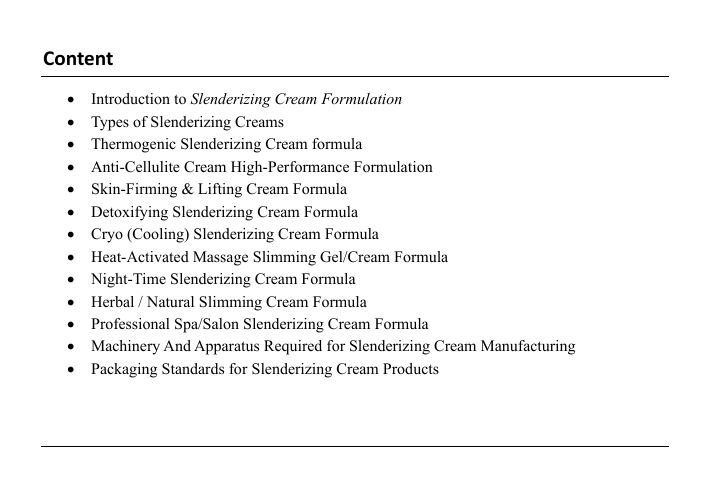
The guide describes slenderizing cream formulation as a topical product that is claimed to help reduce the appearance of cellulite, firm the skin and promote a more toned and slimmer appearance, typically containing a combination of ingredients believed to target cellulite and improve the overall appearance of the skin. It adds a general formulation, ingredient lists, procedures and practical advice.
Making the cream
Step 1: Prepare phases
Weigh and heat the water phase, with humectants and heat-stable actives, and the oil phase, with emollients and emulsifiers, to about 70 to 75 degrees Celsius.
Step 2: Emulsify
Combine under high-shear mixing, then switch to gentle stirring while cooling.
Step 3: Add sensitive actives
Below 40 degrees Celsius, add caffeine solution, botanical extracts, peptides, fragrance and preservative. Dissolve caffeine in a portion of warm water first, since it dissolves slowly and can crystallise at high levels.
Step 4: Adjust and fill
Adjust pH to about 5.5 to 6.5, check viscosity, rest the batch and fill into clean jars or tubes.
Texture and use for massage
Users usually massage slimming creams into thighs, hips, abdomen and arms, so the cream should have enough slip to glide without drying quickly, yet absorb in a few minutes without leaving a sticky film. Gel-creams with a cooling feel are popular in warm climates, while richer creams are popular in winter. Include use directions: apply to clean, dry skin, massage upwards with moderate pressure, and use consistently as part of a daily routine alongside balanced eating, activity and sun protection.
Testing and quality control
- Appearance, odour, pH and viscosity.
- Emulsion stability by centrifuge and temperature cycling.
- Caffeine and active content where analytical methods are available.
- Microbial testing and preservative efficacy.
- Skin compatibility: patch testing under qualified supervision.
- Consumer perception panels for texture, absorption and scent.
- Instrumental measures such as skin hydration where claims depend on them.
Troubleshooting
Cream feels sticky
Too much humectant or film-former. Lower the level and add a light ester.
Caffeine crystals appear
Too high a level or poor dissolving. Reduce level and pre-dissolve.
Redness or itching
Irritating botanicals or warming agents. Reduce them and test on sensitive volunteers.
Separation or thinning
Weak emulsion. Increase emulsifier and homogenise.
Strong herbal odour
Botanical extracts dominate. Adjust fragrance or use deodorised extracts.
Colour darkens
Oxidation. Add antioxidant and opaque packaging.
Claims, regulation and safety
Cosmetic claims must be truthful and supportable. Phrases such as “helps improve the appearance of skin smoothness” or “leaves skin feeling firmer” are acceptable if you have data, while “burns fat”, “melts cellulite”, “reduces body size” or “slimming” in the sense of weight loss are likely to be treated as drug or misleading claims and are prohibited in many markets. Keep marketing images realistic and avoid body-shaming language. Check ingredient restrictions and concentration limits, especially for retinoids, menthol, capsicum extracts and essential oils. Provide warnings: for external use only, avoid broken skin and eyes, discontinue if irritation develops, and seek medical advice if pregnant or under treatment. Follow good manufacturing practice and keep batch records.
Packaging and business opportunity
Jars, tubes and pump bottles of 150 to 250 millilitres suit retail, with large tubs for salons and spas. Customers include beauty clinics, spas, pharmacies, wellness stores and online buyers. Combine the cream with massage tools, body brushes and body scrubs for a complete body-care routine. Private-label supply to salons is attractive. Build trust with realistic expectations, user instructions and transparent ingredient lists, rather than before-and-after exaggeration.
Extend your body-care range with the Cosmetics Industry, Personal Care Products, Soap Formula and Poultry Veterinary Livestock categories, and see , Anti-Ageing Treatment Cream Formula, Sport Cream Formulation, , and Moisturizing Bathing Soap.
Getting started
Prepare a light massage-friendly base and add caffeine and one or two botanicals at conservative levels. Test stability, skin feel and tolerance, adjust texture and scent, and write honest directions. Check local claim rules before labelling, and run a small pilot with salons and shops before scaling up.
How to get the best results from this guide
Treat the guide as a tested starting point rather than a finished factory. Begin with a small trial batch in the laboratory or on a bench, using the exact raw materials you plan to buy, and record every weight, temperature, mixing time and observation. Compare the result with the quality checks in the guide, change only one thing at a time, and keep a note of what each change did. Once a small batch is consistently good, repeat it several times, then scale up in stages, because mixing, heating and cooling behave differently in larger vessels. Keep retained samples of every batch, write simple standard operating procedures for your team, and build relationships with two suppliers for each key raw material. Finally, check the labelling, safety and product rules in the country where you will sell, and ask a qualified person to review your process. This careful, documented approach is what turns a good formulation into a reliable product and a trusted brand.
Who should buy this guide?
The guide is written for practical readers. It suits manufacturers who want to add a new product to an existing plant, startups choosing their first product, private-label brands that need to understand what they are buying, technical staff who must set specifications and train operators, and consultants and students who want a structured, plain-language reference. It is less suitable for anyone looking for a quick shortcut or a guarantee, because every formulation still needs testing with your own materials, equipment and local rules. If you are unsure whether it matches your project, send a short question through the contact page before you order, and we will tell you honestly whether it fits.
What is inside the Slenderizing Cream Formulation guide
Every Product Making Guide in our shop follows the same structure so you know where to look. This guide includes the product formula, the ingredients and materials, the procedure and preparations, the industrial requirements and the technical specifications. In practice you receive:
- The formulation, written so you can follow it at the bench and scale it up.
- Ingredients and materials, with the job of each material and advice on grades and suppliers.
- The manufacturing procedure, including order of addition, mixing and preparations.
- Industrial requirements, covering equipment, space and packaging.
- Technical specifications, describing what a good finished product should look like and how it should behave.
- Troubleshooting for the faults that makers meet most often.
- Business guidance, to help you take the product from the bench to the market.
These Product Making Guides of chemical formulations and formulas are for manufacturers, startups and entrepreneurs. Every guide contains industrially tested, practical formulations. Anyone who buys a guide can make the product by following its step-by-step instructions. Raw materials vary between suppliers, so always confirm your results with a small trial batch before scaling up.
Who stands behind this guide?
Chemical Formulation Services is the trading name of CFS Formulation Services Ltd, registered in England and Wales under company number 16678503, with its office at Unit F, Winston Business Park, Churchill Way, Sheffield S35 2PS. The business was founded by George Enrick and publishes formulation manuals, technical guides and industry reports. You can check our details on the Companies House register, read about us, or contact us with any question before you order.
A written formulation cannot replace testing with your own raw materials, equipment and climate, and we say so plainly. What the guide does give you is a tested, structured starting point that can save you months of trial and error. Our terms and conditions explain what a purchase from us covers.
How to order
- Select Add to cart to keep browsing, or Buy Now to go straight to checkout.
- Pay with PayPal, Stripe, Xoom by PayPal, Payoneer, payment links for debit and credit cards, or Western Union, Ria and all money exchanges.
- If you pay through a money exchange, email your payment slip to Info@chemicalformulationservices.com. After confirmation, your instant download link is emailed to you.
- For online payments, the PDF is available as soon as the payment is confirmed.
All products are digital downloads and all payments are nonrefundable once the file is delivered, so please read the refund policy and the FAQs before you order. You can compare this guide with others in the formula shop or browse our industrial project reports.
Frequently asked questions about slenderizing cream formulation
What is the Slenderizing Cream Formulation guide?
It is a digital PDF Product Making Guide to cosmetic body contouring creams, covering ingredients, base emulsions, making, testing, claims and packaging.
Can a cream remove cellulite or fat?
No. A cosmetic cream can hydrate and improve the look and feel of skin, but it cannot remove fat or eliminate cellulite.
What is caffeine used for?
It is a common ingredient marketed for temporary toning and de-puffing of the skin surface.
What claims are allowed?
Claims about appearance and feel that you can support. Weight loss or fat-burning claims are usually prohibited.
Why test for irritation?
Some botanicals and warming agents can irritate, so patch testing is important.
How do I receive the guide?
You receive an instant PDF download after payment is confirmed. For money exchanges, email your payment slip to Info@chemicalformulationservices.com and the link is emailed after we confirm it.
Is the payment refundable?
All payments are nonrefundable because the product is an instant digital download. See the refund policy for details.
Can you help with a custom formulation?
CFS Formulation Services Ltd offers formulation and product development consultancy. Send a short brief through the Contact page.
Last reviewed: November 2026. This page is general information about a digital product. It is not a safety data sheet or professional advice, and any formulation should be tested and reviewed by a qualified person before commercial use.