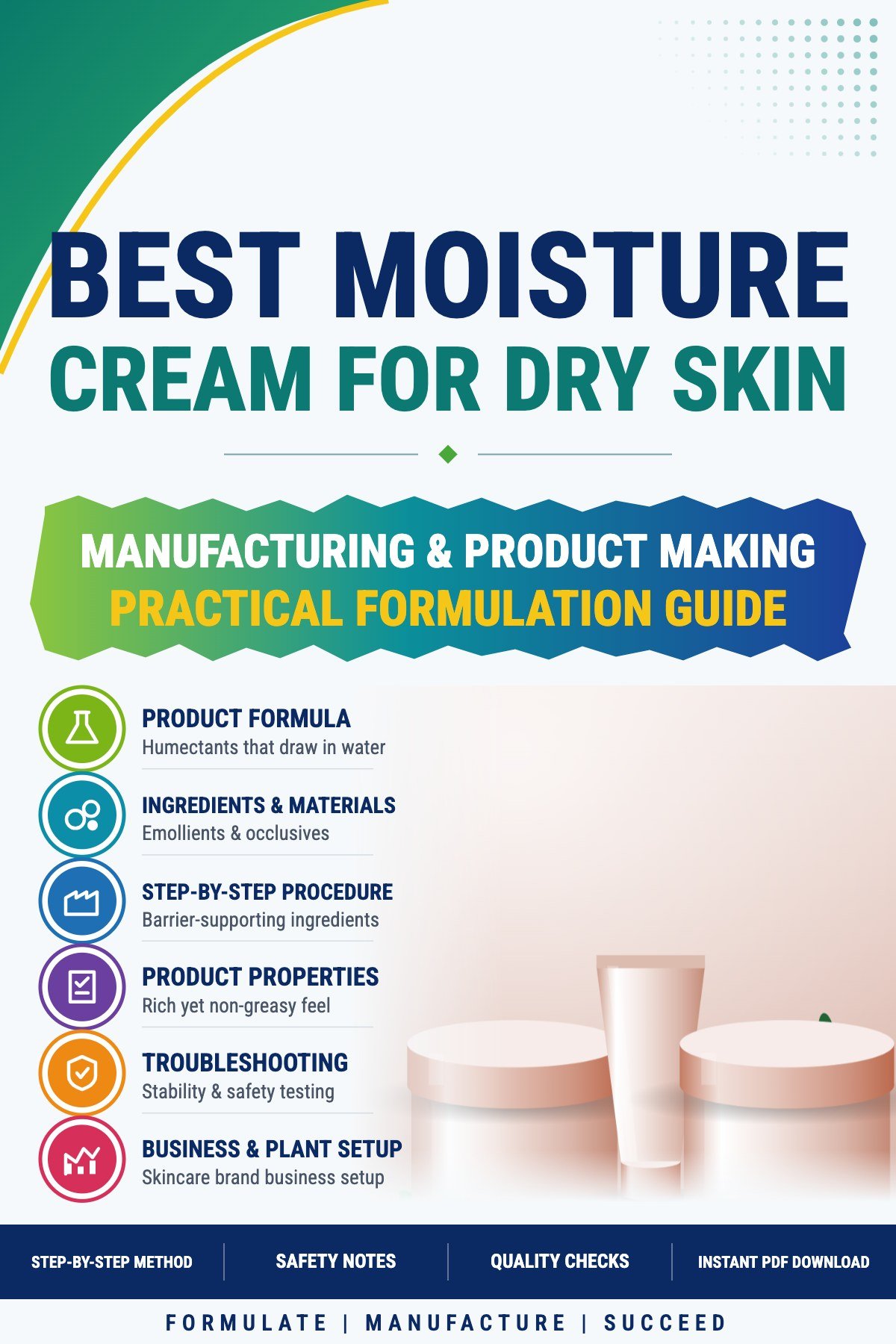

Best Moisture Cream for Dry Skin
USD $50
PDF manual · Instant downloadBest Moisture Cream for Dry Skin: a PDF guide to formulating and making a rich, hydrating cream, with ingredients, step-by-step method, quality control and business advice.
Payment Methods
Refund Policy
Custom Formulation Services
Formulation Consultation
Contact Us
Best Moisture Cream for Dry Skin is a practical PDF guide for cosmetic manufacturers, private-label brands, skincare startups and home-based entrepreneurs who want to make a rich, comfortable moisturiser that hydrates and nourishes dry skin. Dry skin lacks natural oils and holds too little water, which leads to flaking, tightness and discomfort, and a well-built cream must tackle all of those problems together. This page explains how a best moisture cream for dry skin formula is designed, what the guide covers and how a moisture cream is made and tested, so you can decide whether it fits your business.
This guide is published by Chemical Formulation Services, the formulation publishing and consultancy business of CFS Formulation Services Ltd in Sheffield, United Kingdom. It is written for people who want to understand the product from the raw material to the finished pack, and it keeps its claims practical rather than promotional.
At a glance
- Product: Best Moisture Cream for Dry Skin, a digital PDF Product Making Guide.
- Also searched as: best moisture cream for dry skin formula, dry skin moisturiser formulation, hydrating cream recipe, hyaluronic acid cream.
- What it covers: humectants, emollients, occlusives, emulsifier systems, manufacturing method and quality control.
- Key goals: deep hydration, softer skin, a supported barrier and a pleasant, non-greasy feel.
- Who it is for: cosmetic manufacturers, skincare startups, private-label brands and entrepreneurs.
- Delivery: instant PDF download after payment is confirmed.
- Publisher: CFS Formulation Services Ltd, England and Wales company number 16678503.
Understanding dry skin
Skin feels dry when its outer layer, the stratum corneum, does not hold enough water. Healthy skin keeps this layer supple through two things: natural moisturising factors inside the cells that attract and bind water, and a lipid barrier made of ceramides, cholesterol and fatty acids that stops water from escaping. In dry skin one or both of these are weakened. The causes include genetics, ageing, cold or dry weather, indoor heating, frequent washing with harsh cleansers, sun exposure and some medical conditions. The skin then looks dull and flaky, feels rough and tight and may itch or crack.
A good moisture cream works on three fronts at once. It adds water-binding ingredients, it supplies oils that soften the skin and fill gaps between cells, and it forms a light film that slows water loss. This three-part approach is the heart of the formulation.
The three pillars of moisturisation
Humectants: attract and hold water
Humectants pull water from the air and from deeper skin layers into the surface. Glycerin is the workhorse, effective and economical. Hyaluronic acid is a powerful humectant that can bind many times its weight in water and gives a plump, smooth feel. Others include sodium PCA, urea at low levels, panthenol and propylene glycol or butylene glycol. Humectants work best when they are paired with ingredients that keep the water in, because in very dry air a humectant used alone can draw water out of the skin.
Emollients: soften and smooth
Emollients fill the spaces between skin cells, making the surface smooth and flexible. Examples include plant oils such as sweet almond, jojoba, sunflower and argan, butters such as shea and cocoa, esters, squalane and fatty alcohols. The selection decides how rich or light the cream feels and how well it spreads.
Occlusives: slow water loss
Occlusives form a thin film on the skin that reduces evaporation. Petrolatum is the most effective, and others include dimethicone, beeswax, lanolin and heavier butters. Used in the right amount, they keep the cream effective for hours without leaving the skin greasy.
Barrier-supporting ingredients
Modern moisturisers go beyond simple oils and water. Ceramides, cholesterol and fatty acids resemble the skin’s own barrier lipids and help restore its structure. Niacinamide supports barrier function and improves the look of the skin. Colloidal oatmeal, allantoin and bisabolol soothe irritation. Panthenol helps skin repair itself. Plant extracts and antioxidants such as vitamin E add comfort and some protection. The guide explains which of these are useful for dry skin and how to use them at sensible levels.
How the cream is built: an oil-in-water emulsion
Most moisture creams are emulsions, which combine water-based and oil-based ingredients that would normally separate. Emulsifiers sit at the surface of tiny oil droplets and keep them evenly dispersed in the water. Richer creams for very dry skin carry a higher proportion of oil phase, while lighter lotions have more water. Thickeners, such as fatty alcohols, waxes and polymers, give the cream its body, and the cooling and mixing process sets its final texture. The skill of the formulator lies in balancing richness, spreadability, absorption and stability.
What is inside the Best Moisture Cream for Dry Skin guide
The guide is a technical formulation data sheet with a practical formula, ingredient roles, a step-by-step manufacturing method and advice on quality control, packaging and troubleshooting. It also outlines how to adapt the formula for different textures, such as lighter day creams or richer night creams, and gives tips on labelling and presenting a skincare range. It follows the CFS style of clear, industrially minded instructions that manufacturers and startups can follow from first batch to finished product.
How a moisture cream is made
The outline below shows the general sequence. The guide has the full method.
Step 1: Prepare the water phase
Purified water, glycerin and other water-soluble ingredients are weighed into a clean vessel and heated gently with stirring.
Step 2: Prepare the oil phase
Oils, butters, waxes, fatty alcohols and oil-soluble emulsifiers are weighed into a separate vessel and heated until completely melted and uniform.
Step 3: Emulsify
The two phases, at similar temperatures, are combined under steady mixing, with homogenising where available, until a fine, smooth emulsion forms.
Step 4: Cool with gentle stirring
Stirring continues at lower speed while the batch cools, and the cream gradually thickens.
Step 5: Add heat-sensitive ingredients
Hyaluronic acid solution, ceramides where suitable, vitamins, plant extracts, preservatives and fragrance are added when the batch has cooled to the safe temperature.
Step 6: Adjust, test and fill
pH is checked and adjusted, appearance and texture are judged, and the cream is filled into clean jars or tubes and sealed.
Equipment and hygiene
A small production set-up needs an accurate scale, stainless steel or heat-resistant vessels, a heating source such as a water bath or jacketed kettle, a high-shear mixer or homogeniser, a stirrer, thermometer, pH meter and filling tools. Good manufacturing practice matters because creams contain water and can support microbial growth. Equipment is sanitised, staff wear clean clothing, records are kept for every batch, and raw materials and finished goods are stored apart.
Quality control for every batch
- Appearance and texture: smooth, uniform, glossy and free from lumps or separation.
- Odour and colour: consistent between batches.
- pH: in the skin-friendly range.
- Viscosity: consistent thickness suited to the container.
- Stability testing: samples stored hot, cold and at room temperature, and checked for separation, smell and colour changes.
- Preservative efficacy: confirms the product resists microbial contamination.
- Skin compatibility: patch tests or volunteer trials carried out with appropriate care.
- Packaging compatibility: check there is no leakage, discolouration or interaction with the container.
Troubleshooting
Cream separates
Not enough emulsifier, the wrong emulsifier type, poor mixing or temperature mismatch between phases are common causes. Rebalance the emulsifier system and improve homogenising.
Too greasy or heavy
Reduce heavy oils and butters or replace part with lighter esters. A small amount of silicone or powder can improve the afterfeel.
Cream feels thin
Increase fatty alcohols, wax or polymer thickener. Remember that thickening continues for a day after making.
Grainy texture
Butters and waxes that cool too slowly or unevenly may crystallise. Heat adequately and cool at a steady pace.
Sticky feel
Too much glycerin or humectant can feel tacky. Reduce the level or add a silky emollient.
Skin irritation or stinging
Check fragrance, preservative and active levels, and keep formulas simple for sensitive skin.
Microbial growth
Review hygiene, preservative choice and level, and pH.
Safety, labelling and regulation
Cosmetics are regulated across the world. In the UK and EU, products must be assessed for safety by a qualified person, registered on the official notification portal, made under good manufacturing practice and labelled with ingredients in INCI names, batch codes and required warnings. Other markets, such as the United States, Canada, India and the Gulf region, have their own requirements. Only permitted ingredients may be used within allowed limits, and claims must be truthful and supportable. A cosmetic must not claim to treat a medical condition, because that may classify it as a medicine. Dry skin can sometimes be a sign of a skin condition, so customers with severe or persistent symptoms should seek advice from a doctor or pharmacist. You remain responsible for compliance wherever you sell.
The business opportunity
Moisturisers are among the best-selling skincare products worldwide, and dry-skin creams have an especially loyal following because people with dry skin use them every day, often twice. Pharmacies, salons, spas, online stores and private-label customers all buy them. You can create a range of textures, such as a light daily cream, a rich night cream and a hand or body version, and differentiate with packaging, fragrance and story. Honest claims and consistent quality are the keys to repeat purchases and good reviews.
Related CFS guides will help you complete a range. See for a gentle cleanser that suits dry skin, and browse the Cosmetics Industry and Personal Care Products categories for more creams, lotions and care products. For cleansing bars and washes, the Soap Formula category is also useful.
Getting started
Start with small batches of one to two litres, follow the formula exactly and keep full records. Compare the result with creams you admire, adjust the texture and scent, and run stability tests before offering samples to volunteers. When you are satisfied, scale up gradually and have your final formula and labels reviewed by a qualified cosmetic safety professional.
How to get the best results from this guide
Treat the guide as a tested starting point rather than a finished factory. Begin with a small trial batch in the laboratory or on a bench, using the exact raw materials you plan to buy, and record every weight, temperature, mixing time and observation. Compare the result with the quality checks in the guide, change only one thing at a time, and keep a note of what each change did. Once a small batch is consistently good, repeat it several times, then scale up in stages, because mixing, heating and cooling behave differently in larger vessels. Keep retained samples of every batch, write simple standard operating procedures for your team, and build relationships with two suppliers for each key raw material. Finally, check the labelling, safety and product rules in the country where you will sell, and ask a qualified person to review your process. This careful, documented approach is what turns a good formulation into a reliable product and a trusted brand.
Who should buy this guide?
The guide is written for practical readers. It suits manufacturers who want to add a new product to an existing plant, startups choosing their first product, private-label brands that need to understand what they are buying, technical staff who must set specifications and train operators, and consultants and students who want a structured, plain-language reference. It is less suitable for anyone looking for a quick shortcut or a guarantee, because every formulation still needs testing with your own materials, equipment and local rules. If you are unsure whether it matches your project, send a short question through the contact page before you order, and we will tell you honestly whether it fits.
What is inside the Best Moisture Cream for Dry Skin guide
Every Product Making Guide in our shop follows the same structure so you know where to look. This guide includes the product formula, the ingredients and materials, the procedure and preparations, the industrial requirements and the technical specifications. In practice you receive:
- The formulation, written so you can follow it at the bench and scale it up.
- Ingredients and materials, with the job of each material and advice on grades and suppliers.
- The manufacturing procedure, including order of addition, mixing and preparations.
- Industrial requirements, covering equipment, space and packaging.
- Technical specifications, describing what a good finished product should look like and how it should behave.
- Troubleshooting for the faults that makers meet most often.
- Business guidance, to help you take the product from the bench to the market.
These Product Making Guides of chemical formulations and formulas are for manufacturers, startups and entrepreneurs. Every guide contains industrially tested, practical formulations. Anyone who buys a guide can make the product by following its step-by-step instructions. Raw materials vary between suppliers, so always confirm your results with a small trial batch before scaling up.
Who stands behind this guide?
Chemical Formulation Services is the trading name of CFS Formulation Services Ltd, registered in England and Wales under company number 16678503, with its office at Unit F, Winston Business Park, Churchill Way, Sheffield S35 2PS. The business was founded by George Enrick and publishes formulation manuals, technical guides and industry reports. You can check our details on the Companies House register, read about us, or contact us with any question before you order.
A written formulation cannot replace testing with your own raw materials, equipment and climate, and we say so plainly. What the guide does give you is a tested, structured starting point that can save you months of trial and error. Our terms and conditions explain what a purchase from us covers.
How to order
- Select Add to cart to keep browsing, or Buy Now to go straight to checkout.
- Pay with PayPal, Stripe, Xoom by PayPal, Payoneer, payment links for debit and credit cards, or Western Union, Ria and all money exchanges.
- If you pay through a money exchange, email your payment slip to Info@chemicalformulationservices.com. After confirmation, your instant download link is emailed to you.
- For online payments, the PDF is available as soon as the payment is confirmed.
All products are digital downloads and all payments are nonrefundable once the file is delivered, so please read the refund policy and the FAQs before you order. You can compare this guide with others in the formula shop or browse our industrial project reports.
Frequently asked questions about best moisture cream for dry skin
What is the Best Moisture Cream for Dry Skin guide?
It is a digital PDF Product Making Guide with a practical formula, ingredient explanations, step-by-step method, quality control and business advice for making a rich moisture cream for dry skin.
What ingredients make a cream good for dry skin?
A balance of humectants such as glycerin and hyaluronic acid, emollients such as plant oils and butters, and occlusives such as petrolatum or dimethicone, often with barrier lipids and soothing ingredients.
What is the difference between humectants and occlusives?
Humectants attract and bind water, while occlusives form a film that slows water loss. Together they hold more moisture in the skin.
Why does a cream need a preservative?
Creams contain water, which supports bacteria, yeast and mould, so a suitable preservative system is needed for safety and shelf life.
Can I claim the cream treats skin conditions?
No. Cosmetics should not claim to treat medical conditions. Persistent or severe dryness should be checked by a doctor or pharmacist.
How do I receive the guide?
You receive an instant PDF download after payment is confirmed. For money exchanges, email your payment slip to Info@chemicalformulationservices.com and the link is emailed after we confirm it.
Is the payment refundable?
All payments are nonrefundable because the product is an instant digital download. See the refund policy for details.
Can you help with a custom formulation?
CFS Formulation Services Ltd offers formulation and product development consultancy. Send a short brief through the Contact page.
Last reviewed: November 2026. This page is general information about a digital product. It is not a safety data sheet or professional advice, and any formulation should be tested and reviewed by a qualified person before commercial use.