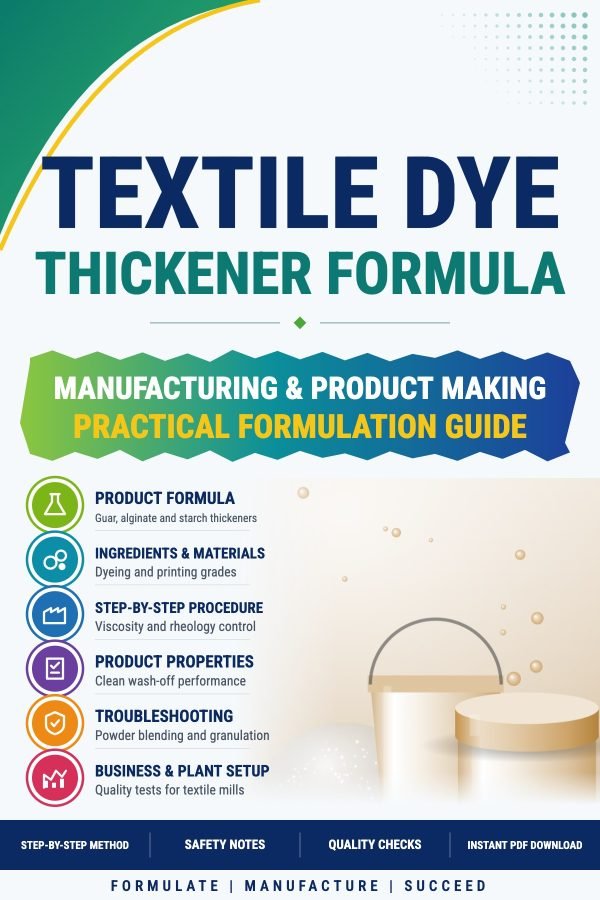
PU Thickener Formulation
USD $70
PDF manual · Instant downloadPayment Methods
Refund Policy
Custom Formulation Services
Formulation Consultation
Contact Us
PU Thickener Formulation refers to a substance or additive used to increase the viscosity or thickness of polyurethane (PU) coatings, adhesives, or other PU-based formulations. The addition of a thickener modifies the rheological properties of the PU system, enhancing its flow control and allowing for better application and performance. Here’s an overview of PU thickener:
PU Thickener functions
- Viscosity control: PU thickener is added to PU thickener formulation to increase their viscosity and provide a more suitable consistency for specific applications.
- Sag resistance: The thickener helps prevent sagging or dripping of the PU material when applied vertically or on inclined surfaces.
- Thixotropy: Some PU thickeners exhibit thixotropic properties, meaning they reduce viscosity under shear forces (e.g., during stirring or application) and regain their viscosity when the shear force is removed. This property facilitates ease of application and leveling.
Types of Thickeners
- Organic thickeners: These thickeners are typically based on organic compounds, such as cellulose derivatives (e.g., hydroxyethyl cellulose), polyacrylic acids, or associative thickeners. They function by creating a network structure within the PU formulation, increasing viscosity and improving flow control.
- Inorganic thickeners: Inorganic materials, such as fumed silica or clay, can be used as thickeners for PU formulations. They function by absorbing and trapping the liquid component of the PU system, resulting in increased viscosity.
Applications:
- Coatings: PU thickener is commonly used in the formulation of PU-based coatings, such as paints, varnishes, sealants, and protective coatings. It helps control the flow and leveling properties, preventing excessive sagging or running of the coating material.
- Adhesives: In PU-based adhesives, the thickener improves the tackiness, gap-filling ability, and vertical hold of the adhesive material. It also facilitates controlled application and prevents excessive adhesive flow.
- Sealants: PU sealants, used for sealing joints and gaps in construction or automotive applications, benefit from the addition of a thickener to control their flow and improve adhesion to substrates.
- Printing inks: PU thickeners can be utilized in the formulation of PU-based inks, including flexographic and gravure inks, to control their viscosity and improve printability.
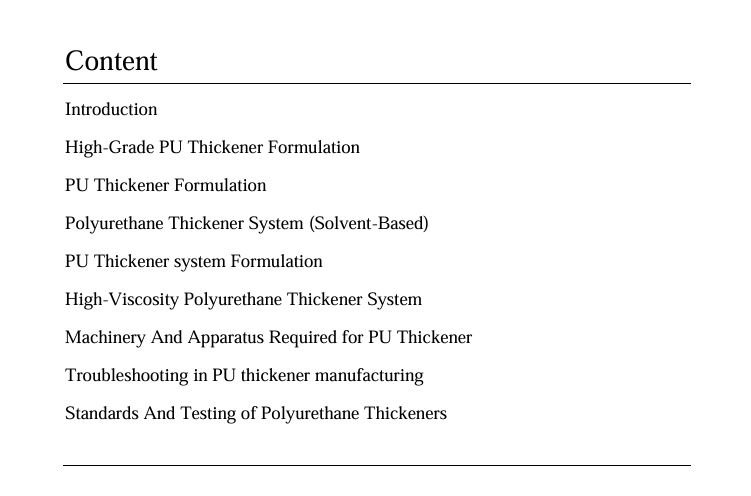
It’s important to note that the selection of a suitable PU thickener depends on various factors, including the specific PU thickener formulation, desired rheological properties, application method, and performance requirements. Manufacturers often provide guidelines and recommendations on the appropriate thickener type and dosage for their PU products. Your all requirements have been composed in this formula product pdf data sheet.