
White Grease Lubricant Formula
USD $65
PDF manual · Instant downloadWhite Grease Lubricant Formula: a PDF guide to making white lithium and calcium soap grease, with base oils, thickeners, kettle process, testing and business advice.
Payment Methods
Refund Policy
Custom Formulation Services
Formulation Consultation
Contact Us
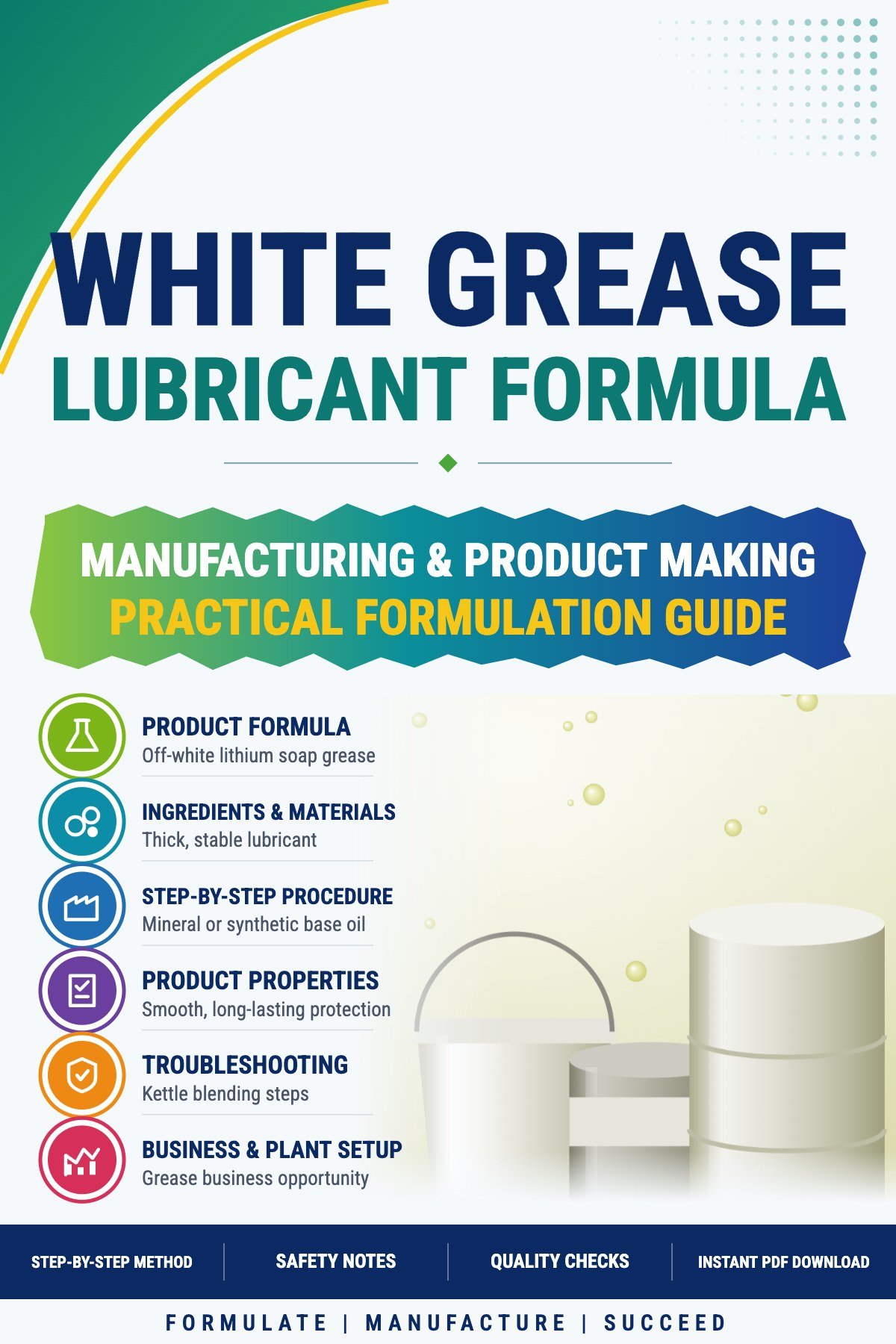
White Grease Lubricant Formula is a practical PDF guide for grease manufacturers, lubricant blenders, workshop-supply brands, startups and entrepreneurs who want to make white grease, a thick, viscous lubricant with a white or off-white colour. White grease is typically made from petroleum or synthetic oil and a thickening agent such as lithium or calcium soap, and it is used in many applications from hinges and gears to bearings and household mechanisms. This page explains how a white grease lubricant formulation works, what goes into a white grease lubricant formula, how the grease is made, tested and packaged, and how to turn it into a profitable lubricant line.
This guide is published by Chemical Formulation Services, the formulation publishing and consultancy business of CFS Formulation Services Ltd in Sheffield, United Kingdom. It is written for people who want to understand the product from the raw material to the finished pack, and it keeps its claims practical rather than promotional.
At a glance
- Product: White Grease Lubricant Formula, a digital PDF Product Making Guide.
- Also searched as: white grease lubricant formulation, white lithium grease formula, white grease recipe, light-coloured grease, hinge and door lubricant.
- Thickener: lithium or calcium soap, sometimes with PTFE or other solids.
- Key goals: smooth, clean, water-resistant lubrication with a white appearance.
- Who it is for: grease makers, lubricant blenders, hardware and automotive suppliers and entrepreneurs.
- Delivery: instant PDF download after payment is confirmed.
- Publisher: CFS Formulation Services Ltd, England and Wales company number 16678503.
What white grease is
White grease is not a separate chemistry but a colour and quality choice. A lubricating grease is a base oil thickened into a semi-solid by a soap or another thickener, plus additives. Most greases are amber, brown, green or red, depending on the oil, additives and dyes. White grease uses a refined, water-white base oil and a white soap thickener, such as lithium 12-hydroxystearate, with additives chosen not to darken the product. The result is a clean, light-coloured grease that does not stain surfaces, which is a benefit in many uses: household hinges and door tracks, sliding window and garage-door mechanisms, bicycle and exercise equipment, sewing machines, appliances, toys, furniture mechanisms, plastic gears, electrical contacts and light industrial machines. White greases made with food-grade base oils and approved additives can also serve in food processing equipment (so-called H1 greases), where accidental contact with food is possible.
Main types of white grease
White lithium grease
The best known type. Lithium soap thickener gives a smooth texture, good water resistance, wide temperature range and mechanical stability. White lithium grease often contains a white mineral oil, light additives and sometimes zinc oxide or PTFE for extra slip. It is the typical aerosol or tube grease for hinges and household use.
Calcium soap white grease
Calcium greases resist water well, but have a lower operating temperature range. They are cheaper and used for chassis points and basic lubrication.
PTFE-enhanced white grease
Contains fine PTFE (polytetrafluoroethylene) particles that give extra slip and reduce friction on plastic and metal surfaces, making it suitable for sliding parts.
Food-grade white grease
Made with approved food-grade white oil, approved thickener and additives, registered or certified for incidental food contact. Requires strict controls and documentation.
Aluminium complex and calcium sulfonate white greases
Premium products with higher temperature and water performance, covered in related guides.
Core components
- Base oil: highly refined white mineral oil (technical or food grade) or synthetic oil such as polyalphaolefin. Viscosity depends on the application: low for light, fast mechanisms and higher for heavy loads.
- Thickener: lithium 12-hydroxystearate made by reacting lithium hydroxide with 12-hydroxystearic acid in the oil, or calcium stearate for calcium greases.
- Additives: antioxidants (phenolic or aminic types that do not discolour), rust and corrosion inhibitors, anti-wear and light extreme-pressure agents, tackifiers and, where desired, PTFE or zinc oxide.
- Whitening and filler agents: zinc oxide or titanium dioxide may be added in small amounts to brighten the grease and make it opaque white.
- Water: used temporarily in saponification then removed.
Choosing viscosity and consistency for the job
White greases are sold in different consistencies, and the right grade depends on how the grease is applied and the mechanism it serves. A soft NLGI 0 or 1 grease flows easily and suits centralised lubrication systems, small gears, low-temperature use and light-duty mechanisms where a thick grease would drag. A medium NLGI 2 grease is the general-purpose standard for hinges, bearings and household use, firm enough to stay put, soft enough to spread. A firm NLGI 3 grease suits vertical shafts, vibrating machinery and worn bearings where grease must resist slumping. The base oil viscosity matters too: low-viscosity oils reduce drag on small, fast parts such as sewing machines and fan motors, while higher-viscosity oils carry heavier loads on slower, larger parts such as garage doors and conveyor pivots. State the NLGI grade and the base oil viscosity on the data sheet so buyers can match the grease to the application.
Lithium complex and other high-performance white greases
Simple lithium grease has a dropping point near 190 degrees Celsius and works well to around 120 degrees Celsius continuous. For hotter or heavier duty, lithium complex greases, made by adding a dicarboxylic acid such as azelaic acid to the soap, raise the dropping point above 260 degrees Celsius and improve mechanical stability. Complex greases are slightly more difficult to make but sell at higher prices for industrial and automotive customers. Polyurea and calcium sulfonate thickeners, while not naturally white, can be produced in light shades with suitable base oils and are used in specialist white greases. Offer a standard white lithium grease for household and light industrial customers and, as you gain expertise, premium complex products for more demanding uses.
Performance additives: PTFE, zinc oxide and extreme-pressure agents
PTFE powder gives the grease a slick, low-friction surface layer, valuable for sliding plastics, drawers and tracks, but it must be well dispersed and used at moderate levels to avoid settling and abrasion. Zinc oxide adds whiteness, opacity and mild anti-wear action. Light extreme-pressure additives protect gears and bearings under shock load, but many are dark or smelly, so choose additives compatible with white appearance. Molybdenum disulphide and graphite give excellent lubrication but turn the grease grey or black, so they belong in dark greases, not white ones. Always test that additives do not discolour the product during storage.
Packaging and presentation
Customers judge white grease by look. Pack it in clean tubes, tins, cartridges, tubs and pails, filled free of air pockets and dark specks. Squeeze tubes with fine nozzles suit hinges and locks. Cartridges suit grease guns. Aerosol versions deliver a thin, penetrating film that sets to a white coating. Use clear labelling showing NLGI grade, temperature range, base oil type, suitability for plastics and rubber and any food-grade certification. Add a short usage guide with pictograms for hinges, chains, bearings and tracks.
Marketing to households and workshops
Households respond to simple benefits: stops squeaks, protects against rust, long lasting. Workshops respond to technical data: dropping point, water washout, temperature range, load capacity. Provide both. Display packs in hardware stores, point-of-sale demonstrations and short online videos showing a squeaky hinge being fixed are effective. Offer sample tubes to garages, caretakers and maintenance teams, and accept feedback on performance and packaging to refine your range.
What is inside the White Grease Lubricant Formula guide
The guide explains that white grease lubricant is commonly used in various applications and is a thick, viscous substance with a white or off-white colour, typically made from a combination of petroleum or synthetic oil and a thickening agent such as lithium or calcium soap. It provides formulations, kettle procedures, quality control, packaging and troubleshooting.
How white grease is made
Production uses a heated kettle with an agitator in a batch process, a technique shared by most soap-based greases.
Charging and saponifying
Charge part of the white oil and 12-hydroxystearic acid to the kettle and heat, stirring, until the acid melts. Add lithium hydroxide solution slowly, controlling foam and temperature. The reaction forms lithium soap.
Dehydrating
Raise the temperature to drive off water, reaching a peak temperature that dissolves the soap into the oil, often around 190 to 210 degrees Celsius for lithium greases. Hold for the required time to develop the structure.
Cooling and finishing
Add the remaining oil gradually to cool the batch while stirring. Below about 80 to 100 degrees Celsius, add the additives such as antioxidant, rust inhibitor, PTFE and whitening agents.
Milling and deaerating
Pass the grease through a homogeniser or three-roll mill to give a smooth, uniform texture and remove air.
Filling
Fill into tubes, cartridges, tins, tubs, pails and drums. For aerosol white lithium grease, the product is thinned with solvent and propellant by a specialist filler.
Testing and quality control
- Penetration (NLGI grade): worked penetration to check consistency, typically NLGI 1 or 2 for white grease.
- Dropping point: heat resistance, with lithium greases typically around 180 to 200 degrees Celsius.
- Water washout: water resistance.
- Oil separation: bleeding on storage.
- Oxidation stability.
- Corrosion tests: copper strip and rust protection.
- Colour and appearance: uniform white without dark specks.
- Wear and load tests: four-ball tests where relevant.
- Compatibility with plastics and rubber: for household use.
Troubleshooting
Grease is too soft or too hard
Soap content or structure development is off. Adjust thickener and finishing oil, and review the heating schedule.
Oil bleeds from the grease
Incomplete structure or low soap. Extend holding time, mill and adjust soap.
Grease yellows or darkens
Overheating or oxidation of base oil. Reduce peak temperature, use water-white oil and add colour-stable antioxidant.
Grainy texture
Poor soap dissolution or fast cooling. Control the temperature profile and homogenise.
Grease attacks plastics or rubber
Aggressive base oil or additives. Choose compatible oils and test materials.
Specks or contamination
Dirt, rust or residues in the kettle. Clean equipment thoroughly.
Safety and regulation
Grease making involves hot oil and caustic materials, so protective equipment, temperature control and fire protection are necessary. Lithium hydroxide is corrosive. Heated kettles can overflow when water flashes off, so add materials carefully. The finished product is generally low in acute toxicity but can irritate skin and eyes. Food-grade greases need documentation, registration, approved raw materials and hygienic manufacturing. Label products with hazard information, NLGI grade, temperature range and approved uses. Dispose of used grease and cleaning materials according to waste rules.
Business opportunity
White grease is a staple product in hardware stores, supermarkets, auto shops and online. Customers range from homeowners to maintenance technicians. A producer can sell tubes and tins for DIY, aerosols for spray application, cartridges for grease guns and bulk pails for industry. Private-label supply for hardware chains and brands is a significant route. Product ideas include silicone-based and PTFE greases for plastic parts, food-grade greases for catering equipment and marine-grade white greases. Offer data sheets, safety sheets and application advice. Combine with lubricating oils, penetrating oils, cleaners and fuel additives to build a full range.
Related CFS guides help you build a lubricants range. Browse the Grease Making and Lubricant Formula categories, and see Barium Complex Grease Formulation, Calcium Sulfonate Grease Formulation, Aluminum Complex Grease Formula, CFS Gear Oil Formulation, Engine Oil 15W-40 Formula, Power Steering Fluid Formula and Envelope Lubricant Formula.
Getting started
Begin with a small laboratory kettle and a simple lithium 12-hydroxystearate grease in white oil. Make test batches, measure penetration and dropping point, and compare with a commercial white lithium grease. Tune the formulation, choose packaging, label with safety and use information and trial with local hardware shops and workshops. Use their feedback to refine and expand.
How to get the best results from this guide
Treat the guide as a tested starting point rather than a finished factory. Begin with a small trial batch in the laboratory or on a bench, using the exact raw materials you plan to buy, and record every weight, temperature, mixing time and observation. Compare the result with the quality checks in the guide, change only one thing at a time, and keep a note of what each change did. Once a small batch is consistently good, repeat it several times, then scale up in stages, because mixing, heating and cooling behave differently in larger vessels. Keep retained samples of every batch, write simple standard operating procedures for your team, and build relationships with two suppliers for each key raw material. Finally, check the labelling, safety and product rules in the country where you will sell, and ask a qualified person to review your process. This careful, documented approach is what turns a good formulation into a reliable product and a trusted brand.
Who should buy this guide?
The guide is written for practical readers. It suits manufacturers who want to add a new product to an existing plant, startups choosing their first product, private-label brands that need to understand what they are buying, technical staff who must set specifications and train operators, and consultants and students who want a structured, plain-language reference. It is less suitable for anyone looking for a quick shortcut or a guarantee, because every formulation still needs testing with your own materials, equipment and local rules. If you are unsure whether it matches your project, send a short question through the contact page before you order, and we will tell you honestly whether it fits.
What is inside the White Grease Lubricant Formula guide
Every Product Making Guide in our shop follows the same structure so you know where to look. This guide includes the product formula, the ingredients and materials, the procedure and preparations, the industrial requirements and the technical specifications. In practice you receive:
- The formulation, written so you can follow it at the bench and scale it up.
- Ingredients and materials, with the job of each material and advice on grades and suppliers.
- The manufacturing procedure, including order of addition, mixing and preparations.
- Industrial requirements, covering equipment, space and packaging.
- Technical specifications, describing what a good finished product should look like and how it should behave.
- Troubleshooting for the faults that makers meet most often.
- Business guidance, to help you take the product from the bench to the market.
These Product Making Guides of chemical formulations and formulas are for manufacturers, startups and entrepreneurs. Every guide contains industrially tested, practical formulations. Anyone who buys a guide can make the product by following its step-by-step instructions. Raw materials vary between suppliers, so always confirm your results with a small trial batch before scaling up.
Who stands behind this guide?
Chemical Formulation Services is the trading name of CFS Formulation Services Ltd, registered in England and Wales under company number 16678503, with its office at Unit F, Winston Business Park, Churchill Way, Sheffield S35 2PS. The business was founded by George Enrick and publishes formulation manuals, technical guides and industry reports. You can check our details on the Companies House register, read about us, or contact us with any question before you order.
A written formulation cannot replace testing with your own raw materials, equipment and climate, and we say so plainly. What the guide does give you is a tested, structured starting point that can save you months of trial and error. Our terms and conditions explain what a purchase from us covers.
How to order
- Select Add to cart to keep browsing, or Buy Now to go straight to checkout.
- Pay with PayPal, Stripe, Xoom by PayPal, Payoneer, payment links for debit and credit cards, or Western Union, Ria and all money exchanges.
- If you pay through a money exchange, email your payment slip to Info@chemicalformulationservices.com. After confirmation, your instant download link is emailed to you.
- For online payments, the PDF is available as soon as the payment is confirmed.
All products are digital downloads and all payments are nonrefundable once the file is delivered, so please read the refund policy and the FAQs before you order. You can compare this guide with others in the formula shop or browse our industrial project reports.
Frequently asked questions about white grease lubricant formula
What is the White Grease Lubricant Formula guide?
It is a digital PDF Product Making Guide to white lithium and calcium soap greases, covering ingredients, kettle process, testing and business advice.
What makes grease white?
Water-white base oil, a white soap thickener and additives that do not discolour, sometimes with zinc oxide.
What is NLGI grade?
A scale of grease consistency, with grade 2 the most common general-purpose grade.
Can white grease be food grade?
Yes, when made from approved food-grade oils and additives under hygienic controls.
Is white grease safe on plastics?
Many are, but compatibility must be tested for the base oil and additives.
How do I receive the guide?
You receive an instant PDF download after payment is confirmed. For money exchanges, email your payment slip to Info@chemicalformulationservices.com and the link is emailed after we confirm it.
Is the payment refundable?
All payments are nonrefundable because the product is an instant digital download. See the refund policy for details.
Can you help with a custom formulation?
CFS Formulation Services Ltd offers formulation and product development consultancy. Send a short brief through the Contact page.
Last reviewed: November 2026. This page is general information about a digital product. It is not a safety data sheet or professional advice, and any formulation should be tested and reviewed by a qualified person before commercial use.