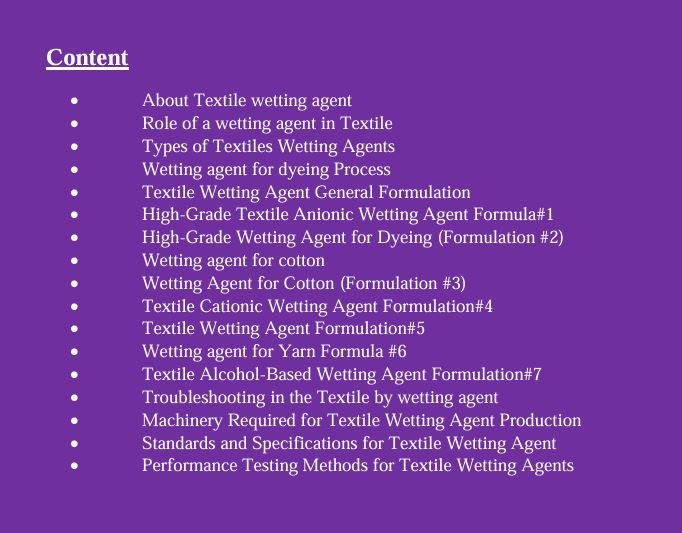
Textile Wetting Agent Formulation
USD $75
PDF manual · Instant downloadPrice:75.0$
Payment Methods
Refund Policy
Custom Formulation Services
Formulation Consultation
Contact Us
Textile-wetting-agent-formulation, also known as surfactants or wetting agents, are chemicals used in the textile industry to reduce the surface tension of water and improve its ability to spread and penetrate textile fibers. They aid in wetting the fabric uniformly during various wet processing stages, such as dyeing, printing, and finishing. Wetting agents are typically formulated as liquid concentrates or powders and are added to water or dye baths to facilitate the wetting process.
Key factors of textile-wetting-agent-formulation
- Surfactants: Wetting agents contain surface-active agents or surfactants as their primary active ingredient. Surfactants have both hydrophobic (water-repellent) and hydrophilic (water-attracting) properties . It allowing them to reduce the surface tension of water and promote better wetting. Common types of surfactants used in textile wetting agent formulations include anionic, cationic, nonionic, and amphoteric surfactants.
- Co-surfactants: Wetting agent formulations may also contain co-surfactants or additives to enhance the wetting performance. These co-surfactants can further reduce the surface tension, improve the stability of the formulation, or provide additional benefits such as foam control or emulsification.
- Solvents and carriers: Wetting agents are typically formulated in liquid form and may contain solvents or carriers to improve their handling, storage, and dispersibility. These solvents or carriers can include water, alcohols, glycols, or other compatible liquid substances.
- pH adjusters and stabilizers: Some wetting agent formulations may include pH adjusters or stabilizers to optimize their performance in specific pH ranges. These additives help maintain the desired pH level of the solution or prevent pH variations that could impact the wetting efficiency.
- Synergistic additives: In certain cases, wetting agent formulations may incorporate synergistic additives or performance-enhancing agents . To improve wetting efficiency, foam control, dispersibility, or other desired properties. These additives can be specific to the application or formulation requirements.
- Environmental considerations: As awareness of environmental sustainability increases, there is a growing demand for eco-friendly and biodegradable wetting agent formulations. Manufacturers are developing formulations that are free from or have reduced levels of harmful substances, such as alkylphenol ethoxylates (APEOs), and comply with environmental regulations.
Troubleshooting in the textile by wetting agent
- Inadequate Wetting
- Foaming During Processing
- Uneven Dyeing or Printing
- Fabric Stiffness
- Yellowing or Discoloration
- Microbial Growth in Wetting Agent Solutions
- Reduced Performance Over Time
To address the challenges outlined above regarding the performance of textile wetting agents, our comprehensive product guide is designed to set new industry standards. Our formulation is crafted to be both productive and efficient, providing a robust solution for enhancing the wetting agent process. By integrating this guide into your production, you can elevate the quality of your textile products, ensuring superior wetting performance. We invite you to explore this guide and consider adding it to your resources. Embarking on the production of wetting agent products with our expertly developed formula can pave the way for a successful and profitable business venture.