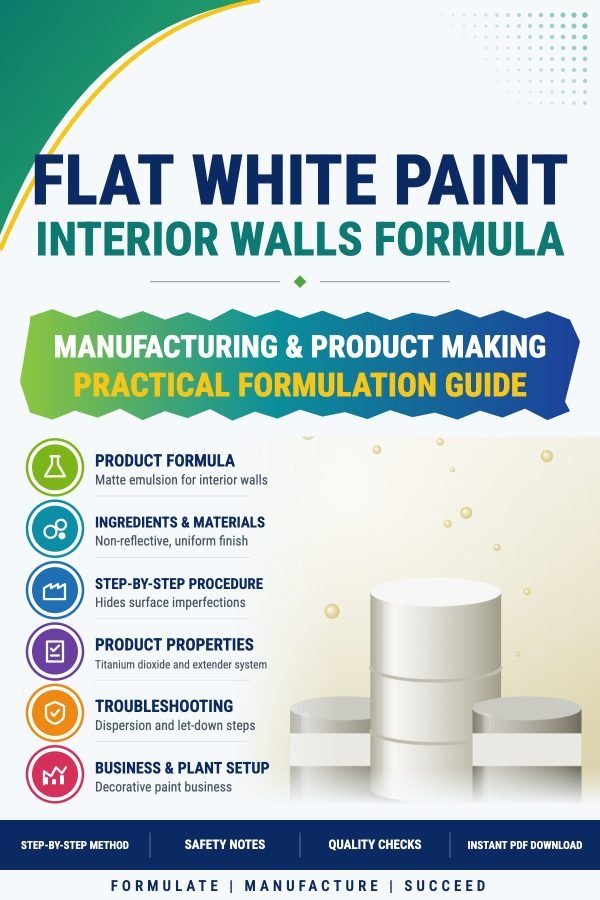
Cheap House Paint White Paint Formula
USD $65
PDF manual · Instant downloadCheap House Paint White Paint Formula: a PDF guide to making an economy white emulsion house paint, with ingredients, manufacturing, quality control and costing advice.
Payment Methods
Refund Policy
Custom Formulation Services
Formulation Consultation
Contact Us
Cheap House Paint White Paint Formula is a practical PDF guide for paint manufacturers, small factory owners, building-material suppliers and entrepreneurs who want to make an affordable white house paint that still gives good coverage, whiteness and durability. Economy paint is the largest-volume segment of the decorative market in many countries, and success depends on getting the balance right between cost and performance. This page explains how a cheap house paint white paint formula works, what the guide covers and how a cheap house paint white paint formulation is built, made and tested, so you can decide whether it suits your business.
This guide is published by Chemical Formulation Services, the formulation publishing and consultancy business of CFS Formulation Services Ltd in Sheffield, United Kingdom. It is written for people who want to understand the product from the raw material to the finished pack, and it keeps its claims practical rather than promotional.
At a glance
- Product: Cheap House Paint White Paint Formula, a digital PDF Product Making Guide.
- Also searched as: cheap house paint white paint formulation, economy white emulsion, low cost wall paint, budget white paint.
- What it covers: binder, pigment, extenders, additives, step-by-step manufacturing, testing and costing.
- Key goals: low cost, good coverage, bright white colour and acceptable durability.
- Who it is for: paint manufacturers, small factories, distributors and entrepreneurs.
- Delivery: instant PDF download after payment is confirmed.
- Publisher: CFS Formulation Services Ltd, England and Wales company number 16678503.
What makes a house paint cheap but still good
Buyers of economy white paint want a product that covers well, looks clean and white, goes on smoothly and lasts a few years without peeling or chalking. They also want it at a low price. The skill of the formulator is to give them those qualities with the least expensive combination of raw materials. This does not mean using poor ingredients or cutting corners that cause failures. It means understanding which ingredients contribute most to performance, which contribute mainly to cost, and where savings are possible without spoiling the paint.
In practice, the cost of a paint is dominated by two materials: the binder, which holds everything together, and the white pigment, titanium dioxide, which provides opacity and whiteness. Every other ingredient affects price too, but these two are where most of the money goes. A cheap formula therefore uses titanium dioxide efficiently, adds inexpensive mineral extenders to fill out the paint, and uses a binder in the right amount, enough to bind but not wastefully high.
How a water-based house paint is built
A modern economy house paint is usually a water-based emulsion, also called latex or acrylic emulsion paint. It consists of water, a polymer emulsion binder, pigments and extenders, and small amounts of additives. When the paint is spread on a wall, the water evaporates, the tiny polymer particles come together and fuse into a continuous film that traps the pigment particles. The result is a flexible, washable coating.
The ratio of pigment to binder is a key design number. If there is too little binder, the film is weak, chalky and poorly adhered. If there is too much, the paint is glossy, expensive and may offer less opacity. Economy paints are generally high in extender and lower in binder, so they are flat or matt and less scrub resistant than premium products, which is the reasonable trade-off at a low price.
Main components of the formula
Water
Water is the cheapest ingredient and the carrier of everything. Clean water without excessive hardness or contamination is important for consistent results.
Binder
Common binders include styrene-acrylic, vinyl acetate or vinyl-acrylic emulsions. Vinyl and vinyl-acrylic types are popular in economy paints because they are cost-effective and give acceptable interior performance. Binder choice affects adhesion, scrub resistance, water resistance and outdoor durability.
Titanium dioxide
Titanium dioxide gives the paint its whiteness and its ability to hide the colour beneath. It is expensive, so the aim is to use the minimum that still gives acceptable coverage. Dispersing it well, so that every particle works at full efficiency, helps save money.
Extenders
Calcium carbonate, talc, china clay, barytes and similar minerals are cheap and fill out the paint. They add bulk, control gloss, improve film build and contribute to opacity, especially when particle sizes are chosen well. The choice and proportion of extenders is where most cost savings are made. Too much extender, however, hurts film strength and washability.
Dispersant
Dispersing agents wet and separate pigment and extender particles so they spread evenly and do not clump. Good dispersion improves opacity and colour strength, which means less pigment is needed.
Thickener
Cellulose ethers or synthetic thickeners give the paint the right viscosity for brush or roller, prevent settling and help it stay on the wall without sagging.
Defoamer
Defoamers stop foam forming during production and application.
Preservative
Water-based paint can spoil in the can, so an in-can preservative is vital. Without it, bacteria and fungi cause smell, thinning and gas formation.
Coalescing agent and other additives
A small amount of coalescent helps the film form at lower temperatures, and wetting agents, pH adjusters and anti-mould agents may be included depending on the target market.
Balancing cost and performance
The art of cheap paint is not only about using less of the expensive material, but about getting the best from the cheap ones. Using extenders of different particle sizes together packs the film better and boosts opacity. Efficient pigment dispersion makes titanium dioxide work harder. A properly tuned thickener system avoids waste from settling and improves application, so that the user paints a larger area per litre. The guide describes these ideas in practical terms and helps with costing a batch, so you can see where each rupee, dollar or pound is going.
What is inside the Cheap House Paint White Paint Formula guide
The guide is a technical formulation data sheet with a practical economy white paint formula, an explanation of each ingredient, a step-by-step manufacturing method, notes on equipment, quality control, troubleshooting and costing, and ideas for starting a paint business. It follows the CFS style of clear, industrially minded instructions that manufacturers and startups can follow.
How the paint is made
The outline below shows the general sequence. The guide gives the full details.
Step 1: Charge water and additives
Water, dispersant, wetting agent and defoamer go into the mixing vessel first, under slow agitation.
Step 2: Add pigments and extenders
Titanium dioxide and extenders are added gradually while the mixer speed increases, to wet each particle and avoid dry lumps.
Step 3: Disperse at high speed
The mixture is dispersed at high speed for the time specified, producing a smooth, fine paste known as the mill base. Good dispersion is the most important step for opacity and cost efficiency.
Step 4: Let down
At slower speed, the binder emulsion, coalescent and remaining additives are added, followed by thickener to adjust viscosity.
Step 5: Adjust and check
Viscosity, pH, density and colour are checked against the standard, and adjustments made.
Step 6: Preserve, filter and fill
Preservative is added, the paint is strained to remove any grit and filled into clean cans or buckets, which are sealed and labelled.
Equipment requirements
A small factory needs accurate scales, a high-speed disperser with a suitable mixing tank, a slow-speed mixer for letdown, strainers, a filling station, storage tanks and a laboratory. Test equipment includes a viscometer, density cup, pH meter, a grind gauge, drawdown tools, a contrast ratio chart or meter and a gloss meter. Larger plants add bead or sand mills for better dispersion, but economy paints can be made well with a good high-speed disperser.
Quality control for every batch
- Viscosity: measured and matched to the standard for good brush and roller application.
- Density and solids: verify the batch composition.
- Fineness of grind: checks that dispersion is complete.
- Colour and whiteness: compared with a standard drawdown.
- Opacity or contrast ratio: confirms coverage per coat.
- pH: kept in the stable range.
- Scrub and wash test: checks durability to the level expected.
- Storage stability: heat ageing and long-term storage tests for settling, thickening, smell and gas.
- Application trial: painting a test panel to judge flow, levelling and finish.
Troubleshooting
Poor hiding power
Not enough titanium dioxide, poor dispersion or low film thickness. Improve grinding, check extender selection and recommend two coats.
Settling in the can
Low viscosity, large particles or weak thickener. Improve thickener balance and dispersion.
Chalking or powdery film
Too little binder for the amount of pigment and extender. Increase binder or reduce extender.
Poor adhesion or peeling
Low binder, poor surface preparation or wrong binder type. Check recipe and recommend a primer or sealer.
Foam and pinholes
Air trapped during mixing. Add or change defoamer and control mixing speed.
Smell, gas or thinning in storage
Microbial contamination. Improve plant hygiene and preservative dosing.
Yellowing
Choose stable binders, avoid contamination and check ingredients that darken with age.
Flashing or patchy finish
Too much extender, poor levelling or wrong thickener. Adjust the formulation and recommend proper application.
Safety, health and regulation
Paint ingredients are mostly low in hazard, but dusts from titanium dioxide and fillers should be controlled, and preservatives can cause skin sensitisation, so gloves and ventilation are advisable. Many countries limit VOC levels, heavy metals such as lead in paint, and certain preservatives, and require labelling with safety and coverage information. Old formulas that used lead or other toxic pigments must never be used. Dispose of wash water and waste paint according to local rules. Quality claims, such as washability or coverage, should be supported by tests.
The business opportunity
Economy house paint sells in very large volumes to builders, landlords, contractors, hardware shops and households in price-sensitive markets. A small factory can sell in drums to contractors and in smaller packs through local shops. Because paint is heavy and costly to ship, local manufacturing has a natural advantage. Reliable colour, honest coverage claims, steady supply and clear instructions create repeat orders. As the business grows, you can add tinted shades, primers, textured finishes and exterior paints.
Related CFS guides expand the range. Browse the Paint Industry category for more paint formulas, Coating Formulations for related coatings, and Construction Chemicals for primers, fillers and waterproofing. See for the wall putty used before painting, Gypsum Bond Formula for plaster-related products, and Transparent Waterproofing Agent Formula for protecting exterior walls.
Getting started
Start with a small batch of 20 to 50 litres, follow the formula precisely and record each step. Test viscosity, coverage and finish, compare with the cheapest brands in your local market, and adjust until you are competitive. Paint a few real walls with the help of a friendly contractor, collect feedback and then scale up gradually.
How to get the best results from this guide
Treat the guide as a tested starting point rather than a finished factory. Begin with a small trial batch in the laboratory or on a bench, using the exact raw materials you plan to buy, and record every weight, temperature, mixing time and observation. Compare the result with the quality checks in the guide, change only one thing at a time, and keep a note of what each change did. Once a small batch is consistently good, repeat it several times, then scale up in stages, because mixing, heating and cooling behave differently in larger vessels. Keep retained samples of every batch, write simple standard operating procedures for your team, and build relationships with two suppliers for each key raw material. Finally, check the labelling, safety and product rules in the country where you will sell, and ask a qualified person to review your process. This careful, documented approach is what turns a good formulation into a reliable product and a trusted brand.
Who should buy this guide?
The guide is written for practical readers. It suits manufacturers who want to add a new product to an existing plant, startups choosing their first product, private-label brands that need to understand what they are buying, technical staff who must set specifications and train operators, and consultants and students who want a structured, plain-language reference. It is less suitable for anyone looking for a quick shortcut or a guarantee, because every formulation still needs testing with your own materials, equipment and local rules. If you are unsure whether it matches your project, send a short question through the contact page before you order, and we will tell you honestly whether it fits.
What is inside the Cheap House Paint White Paint Formula guide
Every Product Making Guide in our shop follows the same structure so you know where to look. This guide includes the product formula, the ingredients and materials, the procedure and preparations, the industrial requirements and the technical specifications. In practice you receive:
- The formulation, written so you can follow it at the bench and scale it up.
- Ingredients and materials, with the job of each material and advice on grades and suppliers.
- The manufacturing procedure, including order of addition, mixing and preparations.
- Industrial requirements, covering equipment, space and packaging.
- Technical specifications, describing what a good finished product should look like and how it should behave.
- Troubleshooting for the faults that makers meet most often.
- Business guidance, to help you take the product from the bench to the market.
These Product Making Guides of chemical formulations and formulas are for manufacturers, startups and entrepreneurs. Every guide contains industrially tested, practical formulations. Anyone who buys a guide can make the product by following its step-by-step instructions. Raw materials vary between suppliers, so always confirm your results with a small trial batch before scaling up.
Who stands behind this guide?
Chemical Formulation Services is the trading name of CFS Formulation Services Ltd, registered in England and Wales under company number 16678503, with its office at Unit F, Winston Business Park, Churchill Way, Sheffield S35 2PS. The business was founded by George Enrick and publishes formulation manuals, technical guides and industry reports. You can check our details on the Companies House register, read about us, or contact us with any question before you order.
A written formulation cannot replace testing with your own raw materials, equipment and climate, and we say so plainly. What the guide does give you is a tested, structured starting point that can save you months of trial and error. Our terms and conditions explain what a purchase from us covers.
How to order
- Select Add to cart to keep browsing, or Buy Now to go straight to checkout.
- Pay with PayPal, Stripe, Xoom by PayPal, Payoneer, payment links for debit and credit cards, or Western Union, Ria and all money exchanges.
- If you pay through a money exchange, email your payment slip to Info@chemicalformulationservices.com. After confirmation, your instant download link is emailed to you.
- For online payments, the PDF is available as soon as the payment is confirmed.
All products are digital downloads and all payments are nonrefundable once the file is delivered, so please read the refund policy and the FAQs before you order. You can compare this guide with others in the formula shop or browse our industrial project reports.
Frequently asked questions about cheap house paint white paint formula
What is the Cheap House Paint White Paint Formula guide?
It is a digital PDF Product Making Guide with a practical economy white house paint formula, ingredient roles, step-by-step manufacturing method, testing and business advice.
Which ingredients cost the most in white paint?
The binder and titanium dioxide pigment make up most of the cost, so economy formulas use titanium dioxide efficiently and rely on cheaper mineral extenders.
Will cheap paint perform as well as premium paint?
Economy paint trades some scrub resistance and durability for price, but a well-balanced formula can still give good coverage, whiteness and several years of service indoors.
Why does paint need a preservative?
Water-based paint can be spoiled by bacteria and fungi in the can, causing smell, thinning and gas, so an in-can preservative is essential.
Do I need special equipment?
A high-speed disperser, mixing tanks, strainers and basic test tools are enough to start. Bead mills improve dispersion at larger scale.
How do I receive the guide?
You receive an instant PDF download after payment is confirmed. For money exchanges, email your payment slip to Info@chemicalformulationservices.com and the link is emailed after we confirm it.
Is the payment refundable?
All payments are nonrefundable because the product is an instant digital download. See the refund policy for details.
Can you help with a custom formulation?
CFS Formulation Services Ltd offers formulation and product development consultancy. Send a short brief through the Contact page.
Last reviewed: November 2026. This page is general information about a digital product. It is not a safety data sheet or professional advice, and any formulation should be tested and reviewed by a qualified person before commercial use.