
Woodwork Enamel Paint Formula
USD $70
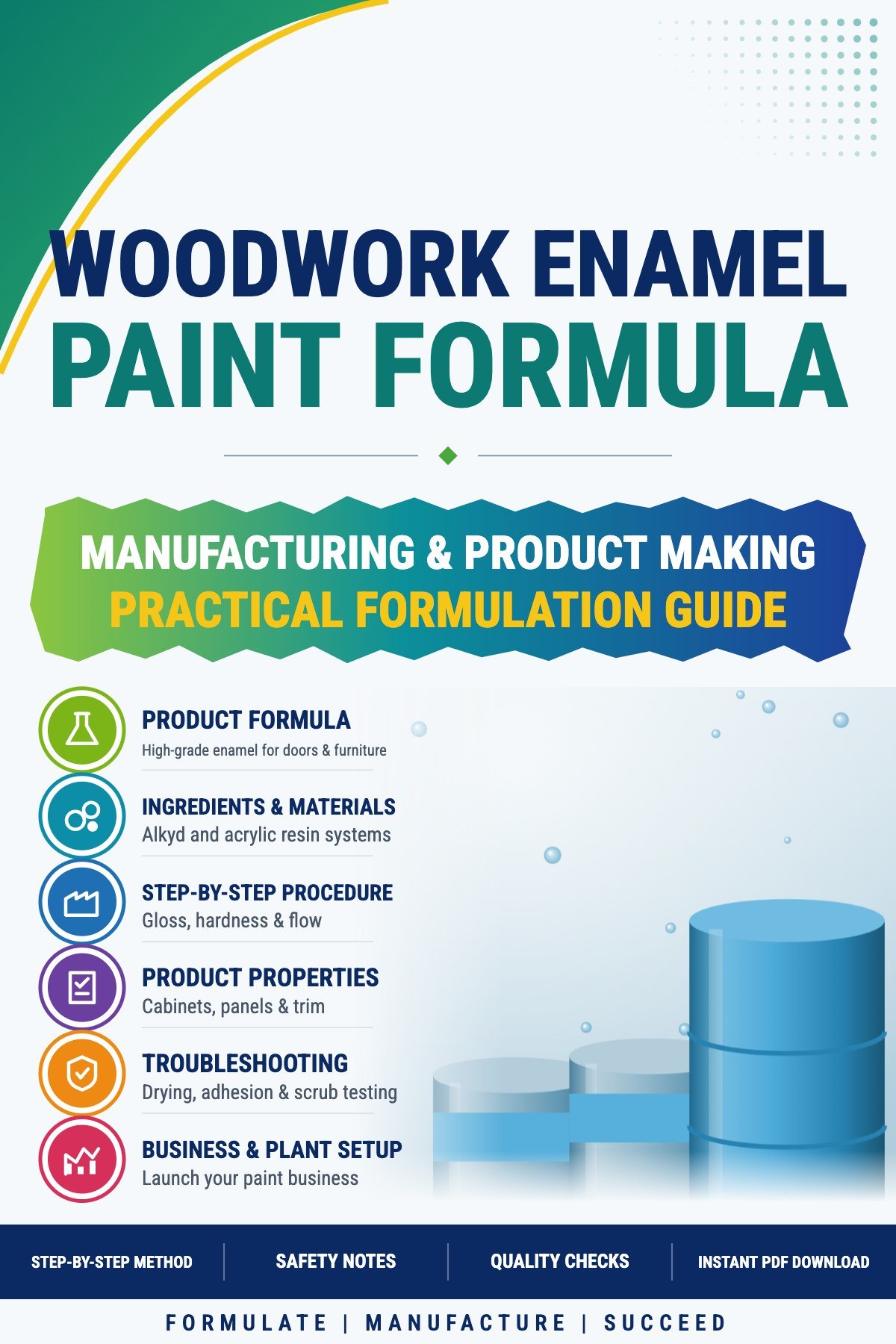
PDF manual · Instant downloadWoodwork Enamel Paint Formula: a PDF guide to making high-grade alkyd and acrylic enamel for doors, furniture and trim, with ingredients, manufacturing, application and testing.
Payment Methods
Refund Policy
Custom Formulation Services
Formulation Consultation
Contact Us
Woodwork Enamel Paint Formula is a practical PDF guide for paint manufacturers, small-factory owners, decorators’ suppliers and entrepreneurs who want to launch or upgrade a paint manufacturing business with a high-grade enamel for wooden surfaces. Enamel paint is the hard-wearing, smooth, glossy or satin finish people choose for doors, furniture, cabinets, panels, skirting boards and trim, because it flows out to a sleek film, resists knocks and stains, and is easy to wipe clean. This page explains how a woodwork enamel paint formula works, what the guide covers and how a woodwork enamel paint formulation is designed, made and tested, so you can decide whether it suits your business.
This guide is published by Chemical Formulation Services, the formulation publishing and consultancy business of CFS Formulation Services Ltd in Sheffield, United Kingdom. It is written for people who want to understand the product from the raw material to the finished pack, and it keeps its claims practical rather than promotional.
At a glance
- Product: Woodwork Enamel Paint Formula, a digital PDF Product Making Guide.
- Also searched as: woodwork enamel paint formulation, wood enamel paint, alkyd enamel, gloss paint for doors and furniture.
- What it covers: binders, pigments, extenders, solvents, driers, additives, manufacturing, application and testing.
- Key goals: smooth glossy film, hardness, adhesion, hiding power and durability.
- Who it is for: paint manufacturers, small factories, distributors and entrepreneurs.
- Delivery: instant PDF download after payment is confirmed.
- Publisher: CFS Formulation Services Ltd, England and Wales company number 16678503.
What enamel paint is
The word enamel in paint means a coating that dries to a hard, smooth, glossy or semi-gloss finish. It is not made from the glassy enamel used on cookware, though the name suggests the same hard, shiny result. Traditional enamel paints use alkyd resins, which are modified polyesters, dissolved in mineral spirits, and they dry by evaporation of the solvent followed by oxidation and cross-linking of the resin with air. Today, enamels also come in water-based acrylic and acrylic-polyurethane versions. A good woodwork enamel levels itself to a smooth surface without brush marks, builds a tough film, covers the underlying colour well and resists yellowing, chipping and household chemicals.
Wood presents its own demands. It expands and contracts with humidity and temperature, so the film needs flexibility. It has grain, knots and resin that can bleed through light colours, so primers and undercoats are important. Furniture and doors are touched, knocked and cleaned all the time, so abrasion and stain resistance matter. A formulation must satisfy all of these needs while remaining workable for brush, roller and spray.
Types of woodwork enamel
Alkyd (oil-based) enamel
The traditional choice, with excellent flow, gloss and adhesion, and a hard durable film. It dries slowly, has a solvent odour and may yellow in dark or indoor conditions over time, especially in white shades.
Acrylic (water-based) enamel
Low in odour and VOC, quick to dry and non-yellowing. Modern acrylic enamels give excellent colour retention and easy cleaning with water, though flow and hardness depend on the resin quality.
Acrylic-alkyd hybrids
Combine the flow and adhesion of alkyd with the colour retention of acrylic, often water-based.
Polyurethane-modified enamels
Urethane alkyds and two-pack systems for tougher films on floors, furniture and high-wear surfaces.
Primers and undercoats
Wood primers, stain-blocking undercoats and sealers prepare wood for the enamel and improve adhesion and hiding.
Main components of an alkyd woodwork enamel
Alkyd resin
The binder determines gloss, flow, hardness, drying time and yellowing. Long-oil alkyds give flexibility and brushing ease, medium-oil alkyds give a balance of speed and hardness and short-oil alkyds dry fast and hard but are less flexible. Urethane- or silicone-modified alkyds improve durability.
Pigments
Titanium dioxide gives white and opacity, and organic and inorganic coloured pigments supply shades. Pigment type and quality set the coverage and colour strength. Pigment volume concentration is kept low for gloss enamel.
Extenders
Small amounts of fine extenders, such as calcium carbonate, talc or barytes, adjust opacity, cost and sheen, but are minimised in high-gloss grades.
Solvents and thinners
Mineral spirits, aliphatic hydrocarbons and low-aromatic grades dissolve the resin and control flow, brushing, and drying. Evaporation rate affects levelling and open time.
Driers
Metal driers, based on cobalt, manganese, zirconium, calcium and sometimes zinc, speed the oxidative drying of the alkyd. Balanced packages give surface and through-drying without wrinkling.
Anti-skinning agent
Prevents skin from forming in the can.
Dispersing, wetting and levelling agents
Improve pigment dispersion, colour development and surface smoothness.
Anti-settling and thixotropic agents
Keep pigment suspended and give controlled brushing and sag resistance.
Anti-yellowing and UV additives
Help to keep whites white and extend colour life.
What is inside the Woodwork Enamel Paint Formula guide
The guide is a technical formulation data sheet created by CFS experts to help you launch or upgrade a paint manufacturing business with a high-grade enamel for wooden surfaces such as doors, furniture, cabinets, panels and trim. It describes ingredient roles, formulation ranges for gloss and satin finishes, step-by-step manufacturing, application, quality control, troubleshooting and business advice. It follows the CFS tradition of clear, industrially minded instructions.
How the enamel is made
The outline below shows the general sequence. The guide gives full details.
Step 1: Prepare the mill base
Part of the alkyd resin, solvent, dispersing agent and anti-settling agent are charged to the mixing vessel. Pigments and extenders are added gradually with increasing agitation.
Step 2: Disperse and mill
The mixture is dispersed at high speed and, for best gloss and colour development, milled in a bead or pearl mill until the fineness of grind meets the specification. Fine grinding is critical for high gloss.
Step 3: Let down
The mill base is blended with the rest of the resin, solvent and additives at lower speed. Driers and anti-skinning agent are added near the end.
Step 4: Adjust and match
Viscosity, gloss, colour and drying time are checked. Tinting pastes and solvent are used to bring the batch to the standard.
Step 5: Strain and test
The paint is strained to remove grit and tested on panels.
Step 6: Fill and label
The enamel is filled into clean tins or pails and sealed, with labels giving coverage, drying times, safety information and instructions.
Equipment requirements
A small paint plant needs accurate scales, a high-speed disperser, a bead mill, mixing and let-down tanks, strainers, filling equipment and approved storage. Solvent-based production needs explosion-proof electrics, earthing, ventilation and fire protection. A laboratory needs a viscometer or flow cup, grind gauge, gloss meter, drawdown applicators, drying time recorder, hardness and adhesion testers, and test panels of wood and metal.
Application guidance
For best results, the wood should be sanded smooth, dust removed and knots sealed. A suitable primer and undercoat should be applied, with light sanding between coats. The enamel is stirred well, thinned only if the instructions allow, and applied in thin even coats by brush, roller or spray, with the recommended drying time between coats. Two finish coats usually give the best appearance and protection. Good ventilation helps solvent-based paint to dry. Brushes can be cleaned with mineral spirits for oil-based paint or water for acrylic.
Quality control for every batch
- Viscosity and density: measured and matched to the specification.
- Fineness of grind: free of coarse particles.
- Gloss: measured at 60 degrees on drawdowns.
- Colour and opacity: compared with the standard, and contrast ratio checked.
- Drying times: touch-dry, tack-free and hard-dry.
- Hardness and scratch resistance: pencil or pendulum tests after cure.
- Adhesion and flexibility: cross-hatch and bend tests.
- Water and stain resistance: spot tests with household liquids.
- Yellowing: accelerated ageing for whites.
- Storage stability: no skinning, settling or thickening in the can.
Troubleshooting
Poor gloss
Coarse grind, high pigment or extender level, absorbent surface or too thin a coat. Improve milling, reduce extender and seal the wood.
Brush marks or poor levelling
Viscosity too high or solvent evaporating too fast. Adjust viscosity and solvent blend, and add levelling agent.
Slow drying
Low driers, thick film, cold or humid weather or oily wood. Adjust the drier package and application.
Wrinkling
Surface drying faster than the interior, often from too much cobalt or a thick film. Balance driers and apply thinner coats.
Yellowing of whites
Alkyd chemistry, lack of light and ammonia exposure. Use non-yellowing resins or acrylic enamels.
Knot bleed or stains
Resin and tannin from wood. Seal with shellac-based knotting solution and stain-blocking primer.
Peeling or poor adhesion
Glossy or dirty surface, or incompatible old paint. Sand, clean and use a suitable primer.
Safety, health and environment
Solvent-based enamels are flammable, and vapours can cause dizziness and long-term health effects, so ventilate and avoid ignition sources. Rags soaked with alkyd paint or drying oils can heat up and ignite spontaneously, so spread them out to dry or soak them in water before disposal. Many countries limit the VOC content of decorative paints, restrict certain driers and pigments, and ban lead and chromate pigments. Water-based enamels reduce hazards but still need standard precautions. Follow labelling and safety data sheet requirements, and dispose of paint and cleaning solvents according to local rules. For children’s furniture and toys, paints must comply with relevant safety standards.
The business opportunity
Doors, windows, cabinets, furniture, skirting boards and joinery need painting in every home and building, and enamel remains the standard finish for many of them. A manufacturer can supply decorators, builders, furniture factories, hardware shops, paint dealers and DIY customers. Colour ranges, tinting systems, satin and gloss grades, matching primers and undercoats and clear instructions create a complete offering. Reliable colour, good flow and honest coverage claims build a reputation. Many small paint businesses begin with enamels and primers and then expand into emulsions and industrial coatings.
Related CFS guides help you build a range. Browse the Paint Industry category for paint formulas and the Wood Polish Formulation category for wood finishes. See Flat Oil Paint Formula, , Concentrated Wood Stain Formula, Solvent-Based PU Top Coat Formulation and , and explore Coating Formulations and Varnish Making.
Getting started
Start with a white and a few basic colours in a medium-oil alkyd enamel. Make small batches, grind carefully, and test gloss, drying and hardness on wood panels. Compare with leading brands and adjust the resin, driers and levelling agents. Ask local painters and joiners to try the paint, collect feedback, refine your formulas and labels, and scale up your plant when quality is consistent.
How to get the best results from this guide
Treat the guide as a tested starting point rather than a finished factory. Begin with a small trial batch in the laboratory or on a bench, using the exact raw materials you plan to buy, and record every weight, temperature, mixing time and observation. Compare the result with the quality checks in the guide, change only one thing at a time, and keep a note of what each change did. Once a small batch is consistently good, repeat it several times, then scale up in stages, because mixing, heating and cooling behave differently in larger vessels. Keep retained samples of every batch, write simple standard operating procedures for your team, and build relationships with two suppliers for each key raw material. Finally, check the labelling, safety and product rules in the country where you will sell, and ask a qualified person to review your process. This careful, documented approach is what turns a good formulation into a reliable product and a trusted brand.
Who should buy this guide?
The guide is written for practical readers. It suits manufacturers who want to add a new product to an existing plant, startups choosing their first product, private-label brands that need to understand what they are buying, technical staff who must set specifications and train operators, and consultants and students who want a structured, plain-language reference. It is less suitable for anyone looking for a quick shortcut or a guarantee, because every formulation still needs testing with your own materials, equipment and local rules. If you are unsure whether it matches your project, send a short question through the contact page before you order, and we will tell you honestly whether it fits.
What is inside the Woodwork Enamel Paint Formula guide
Every Product Making Guide in our shop follows the same structure so you know where to look. This guide includes the product formula, the ingredients and materials, the procedure and preparations, the industrial requirements and the technical specifications. In practice you receive:
- The formulation, written so you can follow it at the bench and scale it up.
- Ingredients and materials, with the job of each material and advice on grades and suppliers.
- The manufacturing procedure, including order of addition, mixing and preparations.
- Industrial requirements, covering equipment, space and packaging.
- Technical specifications, describing what a good finished product should look like and how it should behave.
- Troubleshooting for the faults that makers meet most often.
- Business guidance, to help you take the product from the bench to the market.
These Product Making Guides of chemical formulations and formulas are for manufacturers, startups and entrepreneurs. Every guide contains industrially tested, practical formulations. Anyone who buys a guide can make the product by following its step-by-step instructions. Raw materials vary between suppliers, so always confirm your results with a small trial batch before scaling up.
Who stands behind this guide?
Chemical Formulation Services is the trading name of CFS Formulation Services Ltd, registered in England and Wales under company number 16678503, with its office at Unit F, Winston Business Park, Churchill Way, Sheffield S35 2PS. The business was founded by George Enrick and publishes formulation manuals, technical guides and industry reports. You can check our details on the Companies House register, read about us, or contact us with any question before you order.
A written formulation cannot replace testing with your own raw materials, equipment and climate, and we say so plainly. What the guide does give you is a tested, structured starting point that can save you months of trial and error. Our terms and conditions explain what a purchase from us covers.
How to order
- Select Add to cart to keep browsing, or Buy Now to go straight to checkout.
- Pay with PayPal, Stripe, Xoom by PayPal, Payoneer, payment links for debit and credit cards, or Western Union, Ria and all money exchanges.
- If you pay through a money exchange, email your payment slip to Info@chemicalformulationservices.com. After confirmation, your instant download link is emailed to you.
- For online payments, the PDF is available as soon as the payment is confirmed.
All products are digital downloads and all payments are nonrefundable once the file is delivered, so please read the refund policy and the FAQs before you order. You can compare this guide with others in the formula shop or browse our industrial project reports.
Frequently asked questions about woodwork enamel paint formula
What is the Woodwork Enamel Paint Formula guide?
It is a digital PDF Product Making Guide to formulating and making high-grade enamel paint for doors, furniture, cabinets, panels and trim.
What is enamel paint?
A paint that dries to a hard, smooth, glossy or semi-gloss finish, traditionally based on alkyd resin and now also available in water-based acrylic versions.
Why do oil-based whites yellow?
Alkyd chemistry tends to yellow, especially in dark rooms. Non-yellowing resins and acrylic enamels reduce the effect.
What are driers?
Metal soaps, such as cobalt, manganese and zirconium, that speed up the oxidative drying of alkyd paints.
Why prime wood before enamel?
Primers seal the wood, improve adhesion and hiding, and stop knots and tannins from bleeding through.
How do I receive the guide?
You receive an instant PDF download after payment is confirmed. For money exchanges, email your payment slip to Info@chemicalformulationservices.com and the link is emailed after we confirm it.
Is the payment refundable?
All payments are nonrefundable because the product is an instant digital download. See the refund policy for details.
Can you help with a custom formulation?
CFS Formulation Services Ltd offers formulation and product development consultancy. Send a short brief through the Contact page.
Last reviewed: November 2026. This page is general information about a digital product. It is not a safety data sheet or professional advice, and any formulation should be tested and reviewed by a qualified person before commercial use.